




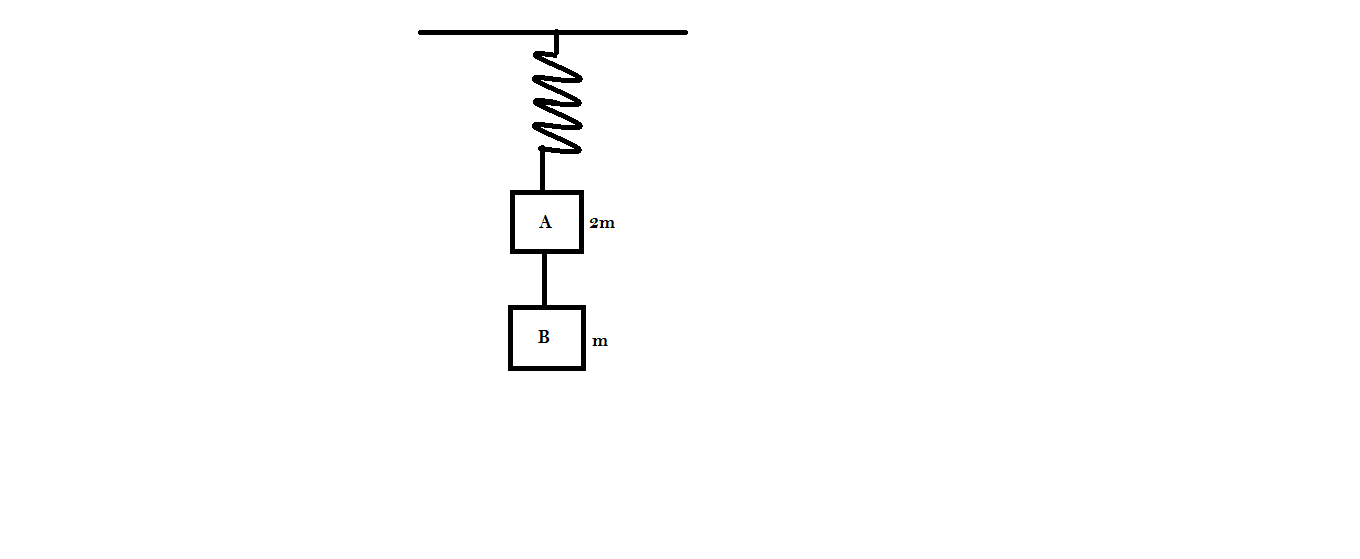
Two blocks A and B of masses $2m$ and $m$ respectively are connected by a massless and inextensible string. The whole system is suspended by a massless spring as shown in the figure. The magnitude of the acceleration of A and B immediately after the string is cut are respectively
A) $g,\dfrac{g}{2}$
B) $\dfrac{g}{2},g$
C) $g,g$
D) \[\dfrac{g}{2},\dfrac{g}{2}\]
Answer
 Verified
259.8k+ views
Hint: Use newton’s second law of motion. In the figure, the system is in equilibrium therefore all the forces are balancing each other. Tension in the string is balanced by the force $mg$ for the B block and the force $2mg + mg$ is balanced by the force $F$ of the spring. Use these equations to find the acceleration for both blocks.
Complete step by step solution:
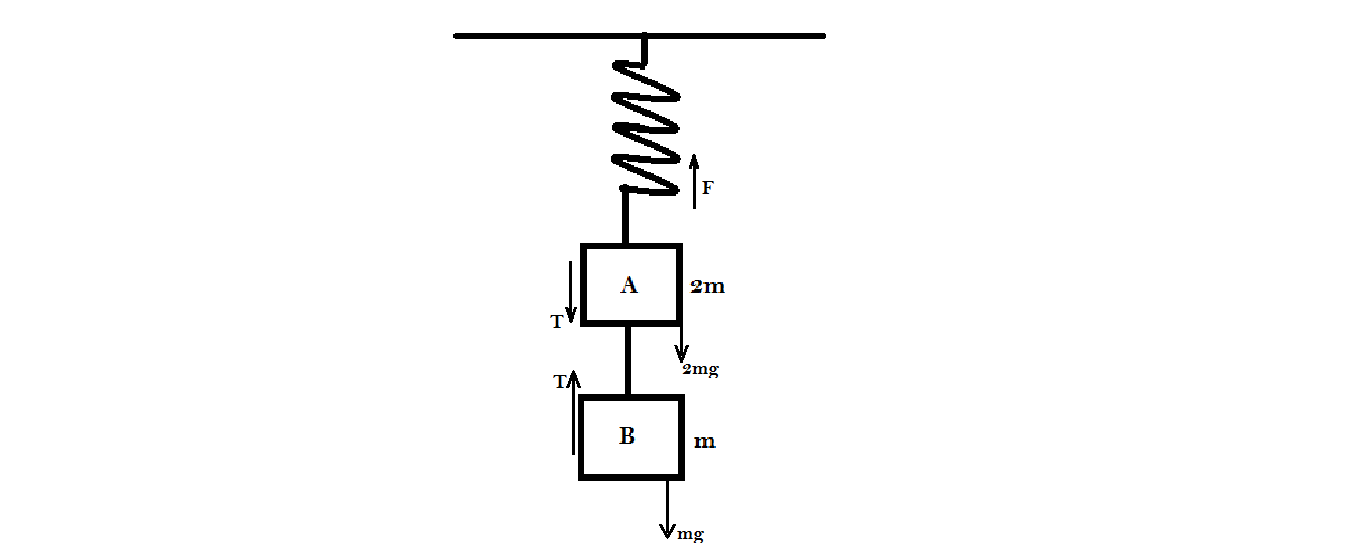 Step 1: In the above figure we can see that the gravitational force on the block B of mass $m$ is balanced out by the tension $T$ in the string because of the mass $m$ . Therefore we can write it as
$\therefore T = mg$ ……equation (1).
Step 2: Since both the blocks are connected and are hanged by a spring. Therefore the total amount of force balanced out by the spring will be $mg + 2mg$ . If the force applied by the spring is $F$ to keep the system in equilibrium then
$\therefore F = mg + 2mg$
$ \Rightarrow F = 3mg$…….equation (2).
Step 3: Now if the string is cut then the tension in the string will disappear and block B start falling. The force which is acting on block B is the only gravitational force. Therefore we can write
$\therefore mg = ma$ , where $a$ is the acceleration of the block
$ \Rightarrow a = g$
Step 4: When the string is cut, immediately the spring pulls block A upwards. Now because the direction of the motion is opposite to the direction of the gravitational force, therefore if the acceleration of the block is $a$ then,
$\therefore F - 2mg = 2ma$
But $F = 3mg$ . Therefore, substitute the value of $F$ in the above equation
$\therefore 3mg - 2mg = 2ma$
$ \Rightarrow mg = 2ma$
$ \Rightarrow a = \dfrac{g}{2}$
Therefore the magnitude of the acceleration of A and B immediately after the string is cut are respectively $\dfrac{g}{2}$ and $g$ .
Hence the option B is correct.
Note: In the question, the magnitude of the acceleration is asked for both blocks. For block A the acceleration will be negative as the gravitational force works downwards while the block is moving upwards. But when we take the magnitude of a negative quantity it becomes positive since the negative sign is only for the direction. The magnitude of the acceleration is a scalar quantity that does not have the direction.
Complete step by step solution:
Step 1: In the above figure we can see that the gravitational force on the block B of mass $m$ is balanced out by the tension $T$ in the string because of the mass $m$ . Therefore we can write it as$\therefore T = mg$ ……equation (1).
Step 2: Since both the blocks are connected and are hanged by a spring. Therefore the total amount of force balanced out by the spring will be $mg + 2mg$ . If the force applied by the spring is $F$ to keep the system in equilibrium then
$\therefore F = mg + 2mg$
$ \Rightarrow F = 3mg$…….equation (2).
Step 3: Now if the string is cut then the tension in the string will disappear and block B start falling. The force which is acting on block B is the only gravitational force. Therefore we can write
$\therefore mg = ma$ , where $a$ is the acceleration of the block
$ \Rightarrow a = g$
Step 4: When the string is cut, immediately the spring pulls block A upwards. Now because the direction of the motion is opposite to the direction of the gravitational force, therefore if the acceleration of the block is $a$ then,
$\therefore F - 2mg = 2ma$
But $F = 3mg$ . Therefore, substitute the value of $F$ in the above equation
$\therefore 3mg - 2mg = 2ma$
$ \Rightarrow mg = 2ma$
$ \Rightarrow a = \dfrac{g}{2}$
Therefore the magnitude of the acceleration of A and B immediately after the string is cut are respectively $\dfrac{g}{2}$ and $g$ .
Hence the option B is correct.
Note: In the question, the magnitude of the acceleration is asked for both blocks. For block A the acceleration will be negative as the gravitational force works downwards while the block is moving upwards. But when we take the magnitude of a negative quantity it becomes positive since the negative sign is only for the direction. The magnitude of the acceleration is a scalar quantity that does not have the direction.
Recently Updated Pages
Circuit Switching vs Packet Switching: Key Differences Explained

Dimensions of Pressure in Physics: Formula, Derivation & SI Unit
JEE General Topics in Chemistry Important Concepts and Tips
JEE Extractive Metallurgy Important Concepts and Tips for Exam Preparation
JEE Atomic Structure and Chemical Bonding important Concepts and Tips
JEE Amino Acids and Peptides Important Concepts and Tips for Exam Preparation
Trending doubts
JEE Main 2026: Exam Dates, Session 2 Updates, City Slip, Admit Card & Latest News
JEE Main Participating Colleges 2026 - A Complete List of Top Colleges
JEE Main Marking Scheme 2026- Paper-Wise Marks Distribution and Negative Marking Details
Hybridisation in Chemistry – Concept, Types & Applications
Understanding the Electric Field of a Uniformly Charged Ring
Derivation of Equation of Trajectory Explained for Students
Other Pages
JEE Advanced 2026 - Exam Date (Released), Syllabus, Registration, Eligibility, Preparation, and More
JEE Advanced Marks vs Ranks 2025: Understanding Category-wise Qualifying Marks and Previous Year Cut-offs
CBSE Notes Class 11 Physics Chapter 1 - Units And Measurements - 2025-26
NCERT Solutions For Class 11 Physics Chapter 1 Units And Measurements - 2025-26
Important Questions For Class 11 Physics Chapter 1 Units and Measurement - 2025-26
JEE Advanced Weightage 2025 Chapter-Wise for Physics, Maths and Chemistry