




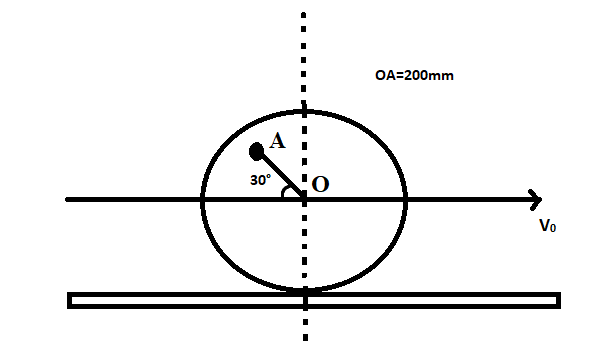
The wheel radius ${\text{ }}r = 300mm{\text{ }}$ rolls to right without slipping and has a velocity ${\text{ }}{v_0} = 3m/s{\text{ }}$ of its center ${\text{ }}O{\text{ }}$. The speed of the point ${\text{ }}A{\text{ }}$ on the wheel for the instant represented in the figure is:
A) $4.36{\text{ m/s}}$
B) $5{\text{ m/s}}$
C) $3{\text{ m/s}}$
D) $1.5{\text{ m/s}}$
Answer
 Verified
233.4k+ views
Hint: In this question, we have to use the analytical method to find the velocity at the point${\text{ }}A{\text{ }}$. In the analytical method, we use vectors and calculate the speed at a particular instant. We use the parallelogram method to analyze the vector. Velocity is a vector quantity and can be calculated using the vector analysis method.
Formula used:
$R = \sqrt {{A^2} + {B^2} + 2AB\cos \alpha } $
Where ${\text{ }}A{\text{ }}$and ${\text{ }}B{\text{ }}$ are two vectors inclined to each other at a particular angle.
$\alpha {\text{ }}$ is the angle between the two vectors.
$R$ is the resultant vector of the two vectors ${\text{ }}A{\text{ }}$and${\text{ }}B$
$v = r\omega $ (where${\text{ v }}$ is the velocity,${\text{ r }}$ is the radius and ${\text{ }}\omega {\text{ }}$ is the angular velocity)
Complete step by step solution:
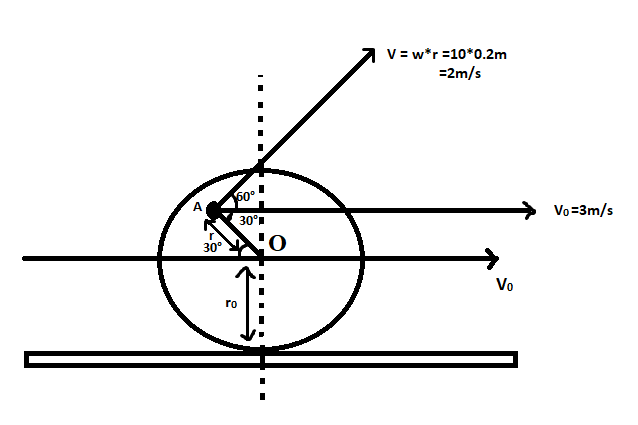
The wheel is in a uniform circular motion. It is rolling with a velocity ${\text{ }}{v_0} = 3m/s$.
We know that the linear speed of an object moving in a circular motion is ${\text{ }}{v_0} = r{\omega _0}$
Where ${\text{ }}r{\text{ }}$ is the radius of the wheel and ${\text{ }}{\omega _0}{\text{ }}$is the angular velocity
We can find the angular velocity of the from the linear velocity as,
$\omega = \dfrac{{{v_0}}}{r}$$ = \dfrac{3}{{300 \times {{10}^{ - 3}}}}$ (Given${\text{ }}{v_0} = 3m/s,r = 300 \times {10^{ - 3}}$)
$\omega = 10{\text{ }} rad$
Given ${\text{ }}OA = {\omega _A} = 200mm = 200 \times {10^{ - 3}}m$
The velocity at a point ${\text{ }}A{\text{ }}$ is
$v = r{\omega _A}$=$200 \times {10^{ - 3}} \times 10 = 2m/s$
The total velocity at the instant is can be obtained by using the formula,
$R = \sqrt {{A^2} + {B^2} + 2AB\cos \alpha } $……………………………(1)
Here, ${\text{ }}A \Rightarrow v,B \Rightarrow {v_0}{\text{ }}$ and the angle between ${\text{ }}v{\text{ }}$ and ${\text{ }}{v_0}{\text{ }}$ is${\text{ }}{60^ \circ }{\text{ }}$ that is obtained from the figure.
The net velocity ${\text{ }}{v_{net}}{\text{ }}$ can be obtained by substituting the values in the equation $(1)$
${v_{net}} = \sqrt {{v^2} + {v_0}^2 + 2v{v_0}\cos \theta } $
${v_{net}} = \sqrt {{2^2} + {3^2} + 2 \times 2 \times 3 \times \cos {{60}^ \circ }} $
Calculating the values,
${v_{net}} = \sqrt {4 + 9 + 12 \times \dfrac{1}{2}} $
${v_{net}} = \sqrt {4 + 9 + 6} = \sqrt {19} = 4.36{\text{ m/s}}$
The answer is Option (A):${\text{ }}4.36{\text{ m/s }}$.
Note: An object is in a uniform circular motion if it moves along the circumference of a circle with constant speed. The right-hand grip rule states that if the curvature of the fingers of the right hand represents the sense of rotation then the thumb represents the direction of the angular displacement vector. Angular velocity is defined as the time rate of angular displacement.
Formula used:
$R = \sqrt {{A^2} + {B^2} + 2AB\cos \alpha } $
Where ${\text{ }}A{\text{ }}$and ${\text{ }}B{\text{ }}$ are two vectors inclined to each other at a particular angle.
$\alpha {\text{ }}$ is the angle between the two vectors.
$R$ is the resultant vector of the two vectors ${\text{ }}A{\text{ }}$and${\text{ }}B$
$v = r\omega $ (where${\text{ v }}$ is the velocity,${\text{ r }}$ is the radius and ${\text{ }}\omega {\text{ }}$ is the angular velocity)
Complete step by step solution:
The wheel is in a uniform circular motion. It is rolling with a velocity ${\text{ }}{v_0} = 3m/s$.
We know that the linear speed of an object moving in a circular motion is ${\text{ }}{v_0} = r{\omega _0}$
Where ${\text{ }}r{\text{ }}$ is the radius of the wheel and ${\text{ }}{\omega _0}{\text{ }}$is the angular velocity
We can find the angular velocity of the from the linear velocity as,
$\omega = \dfrac{{{v_0}}}{r}$$ = \dfrac{3}{{300 \times {{10}^{ - 3}}}}$ (Given${\text{ }}{v_0} = 3m/s,r = 300 \times {10^{ - 3}}$)
$\omega = 10{\text{ }} rad$
Given ${\text{ }}OA = {\omega _A} = 200mm = 200 \times {10^{ - 3}}m$
The velocity at a point ${\text{ }}A{\text{ }}$ is
$v = r{\omega _A}$=$200 \times {10^{ - 3}} \times 10 = 2m/s$
The total velocity at the instant is can be obtained by using the formula,
$R = \sqrt {{A^2} + {B^2} + 2AB\cos \alpha } $……………………………(1)
Here, ${\text{ }}A \Rightarrow v,B \Rightarrow {v_0}{\text{ }}$ and the angle between ${\text{ }}v{\text{ }}$ and ${\text{ }}{v_0}{\text{ }}$ is${\text{ }}{60^ \circ }{\text{ }}$ that is obtained from the figure.
The net velocity ${\text{ }}{v_{net}}{\text{ }}$ can be obtained by substituting the values in the equation $(1)$
${v_{net}} = \sqrt {{v^2} + {v_0}^2 + 2v{v_0}\cos \theta } $
${v_{net}} = \sqrt {{2^2} + {3^2} + 2 \times 2 \times 3 \times \cos {{60}^ \circ }} $
Calculating the values,
${v_{net}} = \sqrt {4 + 9 + 12 \times \dfrac{1}{2}} $
${v_{net}} = \sqrt {4 + 9 + 6} = \sqrt {19} = 4.36{\text{ m/s}}$
The answer is Option (A):${\text{ }}4.36{\text{ m/s }}$.
Note: An object is in a uniform circular motion if it moves along the circumference of a circle with constant speed. The right-hand grip rule states that if the curvature of the fingers of the right hand represents the sense of rotation then the thumb represents the direction of the angular displacement vector. Angular velocity is defined as the time rate of angular displacement.
Recently Updated Pages
JEE Main 2023 April 6 Shift 1 Question Paper with Answer Key

JEE Main 2023 April 6 Shift 2 Question Paper with Answer Key
JEE Main 2023 (January 31 Evening Shift) Question Paper with Solutions [PDF]
JEE Main 2023 January 30 Shift 2 Question Paper with Answer Key
JEE Main 2023 January 25 Shift 1 Question Paper with Answer Key
JEE Main 2023 January 24 Shift 2 Question Paper with Answer Key
Trending doubts
JEE Main 2026: Session 2 Registration Open, City Intimation Slip, Exam Dates, Syllabus & Eligibility
JEE Main 2026 Application Login: Direct Link, Registration, Form Fill, and Steps
Understanding the Angle of Deviation in a Prism
Hybridisation in Chemistry – Concept, Types & Applications
How to Convert a Galvanometer into an Ammeter or Voltmeter
Understanding Uniform Acceleration in Physics
Other Pages
JEE Advanced Marks vs Ranks 2025: Understanding Category-wise Qualifying Marks and Previous Year Cut-offs
Laws of Motion Class 11 Physics Chapter 4 CBSE Notes - 2025-26
Waves Class 11 Physics Chapter 14 CBSE Notes - 2025-26
Mechanical Properties of Fluids Class 11 Physics Chapter 9 CBSE Notes - 2025-26
Thermodynamics Class 11 Physics Chapter 11 CBSE Notes - 2025-26
Units And Measurements Class 11 Physics Chapter 1 CBSE Notes - 2025-26