




The vectors \[\bar A\vec B = 3\hat i + 5j + 4\hat k\] and \[\bar A\vec C = 5\hat i - 5j + 2\hat k\] are the sides of a triangle ABC. The length of the median through \[A\] is
A. \[3\]
B. \[ - 4\]
C. \[1\]
D. \[5\]
Answer
 Verified
232.8k+ views
Hint: In the given question, we need to find the value of the length of the median through \[A\]. For this, we will find the position vector of \[AD\] and its modulus to get the desired result. Also, we will draw the diagram for this.
Formula used: The following formula used for solving the given question.
The modulus of a vector \[\vec u = a\hat i + b\hat j + c\hat k\] is given by
\[\left| {\vec u} \right| = \sqrt {{a^2} + {b^2} + {c^2}} \]
Complete step by step solution: Consider the following figure.
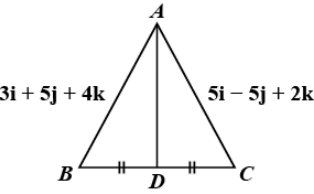
We know that the vectors \[\bar A\vec B = 3\hat i + 5j + 4\hat k\] and \[\bar A\vec C = 5\hat i - 5j + 2\hat k\] are the sides of a triangle ABC.
Here, we will find the position vector of \[AD\]
Thus, the position vector is given by
\[AD = \dfrac{{\left( {3 + 5} \right)\hat i + \left( {5 - 5} \right)\hat j + \left( {4 + 2} \right)\hat k}}{2}\]
By simplifying, we get
\[AD = \dfrac{{\left( 8 \right)\hat i + \left( 0 \right)\hat j + \left( 6 \right)\hat k}}{2}\]
By simplifying, we get
\[AD = \left( 4 \right)\hat i + \left( 3 \right)\hat k\]
Now, the length of a medium is given by
\[\left| {AD} \right| = \sqrt {{{\left( 4 \right)}^2} + {{\left( 3 \right)}^2}} \]
\[\left| {AD} \right| = \sqrt {16 + 9} \]
\[\left| {AD} \right| = \sqrt {25} \]
By taking square root, we get
\[\left| {AD} \right| = 5\]
Hence, the length of the median through \[A\] is \[5\] if the vectors \[\bar A\vec B = 3\hat i + 5j + 4\hat k\] and \[\bar A\vec C = 5\hat i - 5j + 2\hat k\] are the sides of a triangle ABC.
Thus, Option (D) is correct.
Additional Information:The definition of a vector is an entity with both magnitude and direction. The movement of an object between two points is described by a vector. The directed line segment can be used to geometrically represent vector mathematics. The magnitude of a vector is the length of the directed line segment, and the vector's direction is indicated by the angle at which it is inclined. A vector's "Tail" (the point where it begins) and "Head" (the point where it ends and has an arrow) are its respective names.
Note: Many students make mistake in finding the position vector of \[AD\]. This is the only way, through which we can solve the example in simplest way. Also, it is necessary to draw the figure to analyse the question to get the desired result.
Formula used: The following formula used for solving the given question.
The modulus of a vector \[\vec u = a\hat i + b\hat j + c\hat k\] is given by
\[\left| {\vec u} \right| = \sqrt {{a^2} + {b^2} + {c^2}} \]
Complete step by step solution: Consider the following figure.
We know that the vectors \[\bar A\vec B = 3\hat i + 5j + 4\hat k\] and \[\bar A\vec C = 5\hat i - 5j + 2\hat k\] are the sides of a triangle ABC.
Here, we will find the position vector of \[AD\]
Thus, the position vector is given by
\[AD = \dfrac{{\left( {3 + 5} \right)\hat i + \left( {5 - 5} \right)\hat j + \left( {4 + 2} \right)\hat k}}{2}\]
By simplifying, we get
\[AD = \dfrac{{\left( 8 \right)\hat i + \left( 0 \right)\hat j + \left( 6 \right)\hat k}}{2}\]
By simplifying, we get
\[AD = \left( 4 \right)\hat i + \left( 3 \right)\hat k\]
Now, the length of a medium is given by
\[\left| {AD} \right| = \sqrt {{{\left( 4 \right)}^2} + {{\left( 3 \right)}^2}} \]
\[\left| {AD} \right| = \sqrt {16 + 9} \]
\[\left| {AD} \right| = \sqrt {25} \]
By taking square root, we get
\[\left| {AD} \right| = 5\]
Hence, the length of the median through \[A\] is \[5\] if the vectors \[\bar A\vec B = 3\hat i + 5j + 4\hat k\] and \[\bar A\vec C = 5\hat i - 5j + 2\hat k\] are the sides of a triangle ABC.
Thus, Option (D) is correct.
Additional Information:The definition of a vector is an entity with both magnitude and direction. The movement of an object between two points is described by a vector. The directed line segment can be used to geometrically represent vector mathematics. The magnitude of a vector is the length of the directed line segment, and the vector's direction is indicated by the angle at which it is inclined. A vector's "Tail" (the point where it begins) and "Head" (the point where it ends and has an arrow) are its respective names.
Note: Many students make mistake in finding the position vector of \[AD\]. This is the only way, through which we can solve the example in simplest way. Also, it is necessary to draw the figure to analyse the question to get the desired result.
Recently Updated Pages
Trending doubts
JEE Main 2026: Session 2 Registration Open, City Intimation Slip, Exam Dates, Syllabus & Eligibility

JEE Main 2026 Application Login: Direct Link, Registration, Form Fill, and Steps
JEE Main Marking Scheme 2026- Paper-Wise Marks Distribution and Negative Marking Details
Understanding the Angle of Deviation in a Prism
Hybridisation in Chemistry – Concept, Types & Applications
How to Convert a Galvanometer into an Ammeter or Voltmeter
Other Pages
JEE Advanced Marks vs Ranks 2025: Understanding Category-wise Qualifying Marks and Previous Year Cut-offs
Understanding the Electric Field of a Uniformly Charged Ring
Derivation of Equation of Trajectory Explained for Students
Understanding Electromagnetic Waves and Their Importance
Inductive Effect and Its Role in Acidic Strength
JEE Advanced Weightage 2025 Chapter-Wise for Physics, Maths and Chemistry