




The type of elements present in group 3 to 12[IB to VIIB and VIII] are:
A. Alkali
B. Alkaline
C. Transition
D. halogen
Answer
 Verified
271.8k+ views
Hint: According to the recommendation of International Union of Pure and Applied Chemistry (IUPAC), the groups are numbered from 1 to 18 replacing the older notation of groups IA… VIIA, VIII, 1B and 0. This is called a long form of periodic table.
Complete step-by-step answer:
Elements in the same column of the periodic table have the same number of valence electrons in their outer energy level. This leads to their similar properties. All the elements in group 1(IA) have just one valence electron and therefore they are highly reactive. All the other elements in group 1 except hydrogen are alkali metals.
The alkaline earth metals include all the elements in group 2(IIA). These have just two valence electrons, they are reactive but less than alkali metals. Groups 3-12(IB to VIIB and VIII) of the periodic table contain transition metals. They have more valence electrons and are less reactive than the first two groups.
Groups 13-16 each contain one or more metalloids, group 13(IIIA) is boron group(boron is a metalloid). Group 14(IVA) is carbon group, group 15(VA) is nitrogen group and group 16(VIA) is oxygen group. These groups have nonmetals and metalloids as their elements.
Elements in group 17(VIIA) belong to the halogen family. They are very reactive non-metals with seven electrons in their valence shell. Group 18(VIIIA) elements are also non-metals and called noble gases. Their outer energy level is full, hence they are very stable and least reactive.
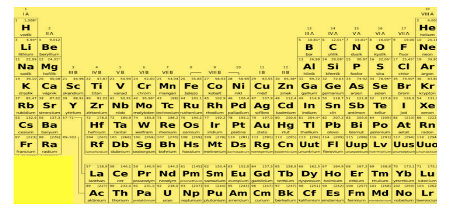
Hence, the correct option is (C).
Note: This modern periodic table states that the physical and chemical properties of the elements are periodic functions of their atomic numbers. But as per old periodic table by Mendeleev, it was a periodic function of atomic masses. It was rejected because he was not able to locate hydrogen and isotopes of elements which were found later on.
Complete step-by-step answer:
Elements in the same column of the periodic table have the same number of valence electrons in their outer energy level. This leads to their similar properties. All the elements in group 1(IA) have just one valence electron and therefore they are highly reactive. All the other elements in group 1 except hydrogen are alkali metals.
The alkaline earth metals include all the elements in group 2(IIA). These have just two valence electrons, they are reactive but less than alkali metals. Groups 3-12(IB to VIIB and VIII) of the periodic table contain transition metals. They have more valence electrons and are less reactive than the first two groups.
Groups 13-16 each contain one or more metalloids, group 13(IIIA) is boron group(boron is a metalloid). Group 14(IVA) is carbon group, group 15(VA) is nitrogen group and group 16(VIA) is oxygen group. These groups have nonmetals and metalloids as their elements.
Elements in group 17(VIIA) belong to the halogen family. They are very reactive non-metals with seven electrons in their valence shell. Group 18(VIIIA) elements are also non-metals and called noble gases. Their outer energy level is full, hence they are very stable and least reactive.
Hence, the correct option is (C).
Note: This modern periodic table states that the physical and chemical properties of the elements are periodic functions of their atomic numbers. But as per old periodic table by Mendeleev, it was a periodic function of atomic masses. It was rejected because he was not able to locate hydrogen and isotopes of elements which were found later on.
Recently Updated Pages
JoSAA Counselling 2026: JoSAA 2026 Mock Seat Allotment LIVE: Round 2 Result Released, Registration, Choice Filling and Ranks

Disproportionation Reaction: Definition, Example & JEE Guide
Hess Law of Constant Heat Summation: Definition, Formula & Applications
JEE General Topics in Chemistry Important Concepts and Tips
JEE Extractive Metallurgy Important Concepts and Tips for Exam Preparation
JEE Atomic Structure and Chemical Bonding important Concepts and Tips
Trending doubts
JEE Main 2026: Exam Dates, Session 2 Updates, City Slip, Admit Card & Latest News
JEE Main Participating Colleges 2026 - A Complete List of Top Colleges
Understanding the Electric Field of a Uniformly Charged Ring
Understanding Atomic Structure for Beginners
Derivation of Equation of Trajectory Explained for Students
Understanding the Different Types of Solutions in Chemistry
Other Pages
JEE Advanced 2026 Notification Out with Exam Date, Registration (Extended), Syllabus and More
JEE Advanced Percentile vs Marks 2026: JEE Main Cutoff, AIR & IIT Admission Guide
JEE Advanced Weightage Chapter Wise 2026 for Physics, Chemistry, and Mathematics
NCERT Solutions For Class 11 Chemistry In Hindi Chapter 1 Some Basic Concepts Of Chemistry - 2025-26
How to Convert a Galvanometer into an Ammeter or Voltmeter
Electron Gain Enthalpy and Electron Affinity Explained