




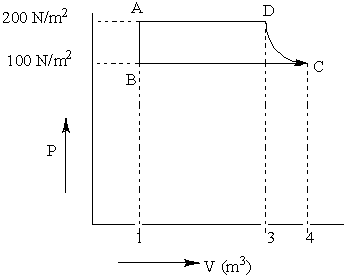
The P-V diagram of a diatomic ideal gas going under cyclic process as shown in the figure. The work done during an adiabatic process CD is (use \[\gamma \] =1.4):
(1) - 500 J
(2) - 400 J
(3) 400 J
(4) 200 J
Answer
 Verified
249.9k+ views
Hint: An adiabatic process defines a process in thermodynamics where transferring of energy takes place without the transfer of mass or heat to the surrounding.
Formula used:
The formula for the work done is,
\[W = \dfrac{{{p_f}{v_f} - {p_i}{v_i}}}{{1 - \gamma }}\]
Here, W is work done, \[{p_f}\] is the final pressure, \[{p_i}\] is the initial pressure, \[{v_f}\] is the final volume and \[{v_i}\] is the initial volume.
Complete Step by Step Solution:
The Given diagram represents the adiabatic process of an ideal gas. From the graph, \[{p_i}\]is 100 N/m2 and \[{p_f}\]is 200 N/m2 . And \[{v_f}\]is 3 and \[{v_i}\]is 4 and \[\gamma \]is 1.4.
Putting all the above values in the formula of W.
So, work done in adiabatic process is,
\[\] \[{W_{CD}} = \dfrac{{200 \times 3 - 4 \times 100}}{{1 - 1.4}}\]
\[{W_{CD}} = \dfrac{{600 - 400}}{{ - 0.4}}\]
\[{W_{CD}} = - 500\,J\]
Hence, the work done in the given adiabatic process is -500 J. Therefore, option (1) is right
Additional Information:
Thermodynamics defines the studying of relations between work, energy, heat and temperature. The different thermodynamic law explains how the change of energy of a system takes place and whether the system has the ability to perform important work on the surroundings.
Note: There is the possibility of both reversibility or irreversibility of an adiabatic process. The necessary conditions required for the adiabatic process: (a)Perfect insulation of the system from the surrounding (b) The process should happen quickly so that there is enough time for the taking place of heat transfer.
Formula used:
The formula for the work done is,
\[W = \dfrac{{{p_f}{v_f} - {p_i}{v_i}}}{{1 - \gamma }}\]
Here, W is work done, \[{p_f}\] is the final pressure, \[{p_i}\] is the initial pressure, \[{v_f}\] is the final volume and \[{v_i}\] is the initial volume.
Complete Step by Step Solution:
The Given diagram represents the adiabatic process of an ideal gas. From the graph, \[{p_i}\]is 100 N/m2 and \[{p_f}\]is 200 N/m2 . And \[{v_f}\]is 3 and \[{v_i}\]is 4 and \[\gamma \]is 1.4.
Putting all the above values in the formula of W.
So, work done in adiabatic process is,
\[\] \[{W_{CD}} = \dfrac{{200 \times 3 - 4 \times 100}}{{1 - 1.4}}\]
\[{W_{CD}} = \dfrac{{600 - 400}}{{ - 0.4}}\]
\[{W_{CD}} = - 500\,J\]
Hence, the work done in the given adiabatic process is -500 J. Therefore, option (1) is right
Additional Information:
Thermodynamics defines the studying of relations between work, energy, heat and temperature. The different thermodynamic law explains how the change of energy of a system takes place and whether the system has the ability to perform important work on the surroundings.
Note: There is the possibility of both reversibility or irreversibility of an adiabatic process. The necessary conditions required for the adiabatic process: (a)Perfect insulation of the system from the surrounding (b) The process should happen quickly so that there is enough time for the taking place of heat transfer.
Recently Updated Pages
JEE Isolation, Preparation and Properties of Non-metals Important Concepts and Tips for Exam Preparation

Isoelectronic Definition in Chemistry: Meaning, Examples & Trends
Ionisation Energy and Ionisation Potential Explained
Iodoform Reactions - Important Concepts and Tips for JEE
Introduction to Dimensions: Understanding the Basics
Instantaneous Velocity Explained: Formula, Examples & Graphs
Trending doubts
JEE Main 2026: Exam Dates, Session 2 Updates, City Slip, Admit Card & Latest News
Hybridisation in Chemistry – Concept, Types & Applications
JEE Main 2026 Application Login: Direct Link, Registration, Form Fill, and Steps
Understanding the Electric Field of a Uniformly Charged Ring
Derivation of Equation of Trajectory Explained for Students
JEE Main Marking Scheme 2026- Paper-Wise Marks Distribution and Negative Marking Details
Other Pages
JEE Advanced Marks vs Ranks 2025: Understanding Category-wise Qualifying Marks and Previous Year Cut-offs
JEE Advanced 2026 - Exam Date (Released), Syllabus, Registration, Eligibility, Preparation, and More
CBSE Notes Class 11 Chemistry Chapter 9 - Hydrocarbons - 2025-26
CBSE Notes Class 11 Chemistry Chapter 5 - Thermodynamics - 2025-26
CBSE Notes Class 11 Chemistry Chapter 8 - Organic Chemistry Some Basic Principles And Techniques - 2025-26
JEE Advanced Weightage 2025 Chapter-Wise for Physics, Maths and Chemistry