




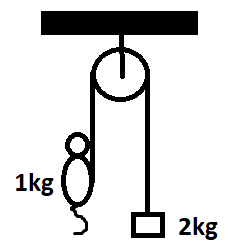
The pulley shown in the diagram is frictionless. A cat of mass 1kg moves up on the massless string so as to just lift a block of mass 2kg. After some time, the cat stops moving with respect to the string. The magnitude of the change in the cat's acceleration is:
Answer
 Verified
264k+ views
Hint: In order to solve the question it is important to understand how a pulley works. If the two objects have the same weight, the pulley will not move; however, a small tug on either side will move them in one direction or the other. If the loads are different the heavier one will accelerate down while the lighter load accelerates up.
Formula Used:
The change in acceleration of any body is given by the simple mathematical formula mentioned below:
$a = {a_{initial}} - {a_{final}}$
Complete step by step answer:
According to the question, the cat is moving in an upwards direction, so initial upward acceleration of the cat will be:
${a_{initial}} = g$
Now, the final upward acceleration of the cat is given by the following mathematical expression:
${a_{final}} = \dfrac{{({m_{block}} - {m_{cat}})g}}{{({m_{block}} + {m_{cat}})}}$
Now, we know that the mass of the block is given as $2kg$ and the mass of the cat is given as $1kg$. Now, putting these values in the above equation, we obtain:
${a_{final}} = \dfrac{{(2 - 1)g}}{{(2 + 1)}} \\
\Rightarrow {a_{final}} = \dfrac{g}{3} \\ $
Now, substituting these values in the mathematical formula for calculating change in acceleration we obtain:
$ a = {a_{initial}} - {a_{final}} \\
\Rightarrow a = g - \dfrac{g}{3} = \dfrac{{2g}}{3} \\
$
Thus, we find that the change in acceleration of the cat is equal to $\dfrac{{2g}}{3}$.
Additional Information: Problems involving two objects, connecting strings and pulleys are characterized by objects that are moving (or even accelerating) in different directions. They move or accelerate at the same rate but in different directions. As such, it becomes important in approaching such problems to select a different reference frame and axes system for each object. Attention should be given to selecting an axes system such that both objects are accelerating along an axis in the positive direction. With the axes properly defined for each individual object, a free-body diagram can be constructed. Then Newton's laws can be applied to each diagram to develop a system of two equations for solving for the two unknowns.
Note: One strategy for solving two-body problems involves the use of a system analysis to determine the acceleration combined with an individual object analysis to determine the force transmitted between the objects. The second strategy involved the use of two individual object analyses in order to develop a system of two equations for solving for the two unknown quantities.
Formula Used:
The change in acceleration of any body is given by the simple mathematical formula mentioned below:
$a = {a_{initial}} - {a_{final}}$
Complete step by step answer:
According to the question, the cat is moving in an upwards direction, so initial upward acceleration of the cat will be:
${a_{initial}} = g$
Now, the final upward acceleration of the cat is given by the following mathematical expression:
${a_{final}} = \dfrac{{({m_{block}} - {m_{cat}})g}}{{({m_{block}} + {m_{cat}})}}$
Now, we know that the mass of the block is given as $2kg$ and the mass of the cat is given as $1kg$. Now, putting these values in the above equation, we obtain:
${a_{final}} = \dfrac{{(2 - 1)g}}{{(2 + 1)}} \\
\Rightarrow {a_{final}} = \dfrac{g}{3} \\ $
Now, substituting these values in the mathematical formula for calculating change in acceleration we obtain:
$ a = {a_{initial}} - {a_{final}} \\
\Rightarrow a = g - \dfrac{g}{3} = \dfrac{{2g}}{3} \\
$
Thus, we find that the change in acceleration of the cat is equal to $\dfrac{{2g}}{3}$.
Additional Information: Problems involving two objects, connecting strings and pulleys are characterized by objects that are moving (or even accelerating) in different directions. They move or accelerate at the same rate but in different directions. As such, it becomes important in approaching such problems to select a different reference frame and axes system for each object. Attention should be given to selecting an axes system such that both objects are accelerating along an axis in the positive direction. With the axes properly defined for each individual object, a free-body diagram can be constructed. Then Newton's laws can be applied to each diagram to develop a system of two equations for solving for the two unknowns.
Note: One strategy for solving two-body problems involves the use of a system analysis to determine the acceleration combined with an individual object analysis to determine the force transmitted between the objects. The second strategy involved the use of two individual object analyses in order to develop a system of two equations for solving for the two unknown quantities.
Recently Updated Pages
JEE Main 2026 Exam Date, Session 2 Results OUT, Cutoff Released, City Slip & Admit Card

JEE Main Mock Test 2025-26: Principles Related To Practical
JEE Main 2025-26 Experimental Skills Mock Test – Free Practice
JEE Main 2025-26 Electronic Devices Mock Test: Free Practice Online
JEE Main 2025-26 Mock Tests: Free Practice Papers & Solutions
JEE Main 2025-26: Magnetic Effects of Current & Magnetism Mock Test
Trending doubts
JEE Main Participating Colleges 2026 - A Complete List of Top Colleges
Understanding Atomic Structure for Beginners
Understanding Uniform Acceleration in Physics
Understanding the Electric Field of a Charged Spherical Shell
Understanding Average and RMS Value in Electrical Circuits
Free Radical Substitution and Its Stepwise Mechanism
Other Pages
JEE Advanced 2022 Question Paper with Solutions PDF free Download
CBSE Notes Class 11 Physics Chapter 11 - Thermodynamics - 2025-26
Valentine Week 2026 Complete List, Dates, Quotes & Wishes
Mother's Day 2026 Date Wishes Quotes Gifts and Card Ideas
Navratri 2026 Colours with Dates, Devi Names & 9 Days Colour Guide Signifcance
UP Board 10th Result 2026 OUT Check Class 10 Result Pass Percentage Toppers