




The moment of inertia of a rectangular lamina of mass 'm', length ' l ' and width ‘b' about an axis passing through its centre of mass, perpendicular to its diagonal and lies in the plane.
A) $\text{m}\left[ \dfrac{{{\ell }^{2}}+{{\text{b}}^{2}}}{12} \right]$
B) $\dfrac{\mathrm{m}}{12}\left[\dfrac{\ell^{4}+\mathrm{b}^{4}}{\ell^{2}+\mathrm{b}^{2}}\right]$
C) $\dfrac{\mathrm{m}}{6}\left[\dfrac{\ell^{4}+\mathrm{b}^{4}}{\ell^{2}+\mathrm{b}^{2}}\right]$
D) $\text{None of these}$
Answer
 Verified
566.3k+ views
Hint: Moment of Inertia is the name given to rotational inertia, the rotational analog of mass for straight movement. It shows up in the connections for the dynamics of rotational movement. The moment of inertia must be determined regarding a picked pivot of revolution. For a point mass, the moment of inertia is only the mass multiplied by the square of perpendicular distance to the rotational axis, $I=m{{r}^{2}}$. That point mass relationship turns into the reason for all different moments of inertia since any item can be developed from an assortment of point masses.
Complete step by step answer:
To solve the given question, we must apply the concept of the moment of inertia.
We consider the given diagram to answer the given question,
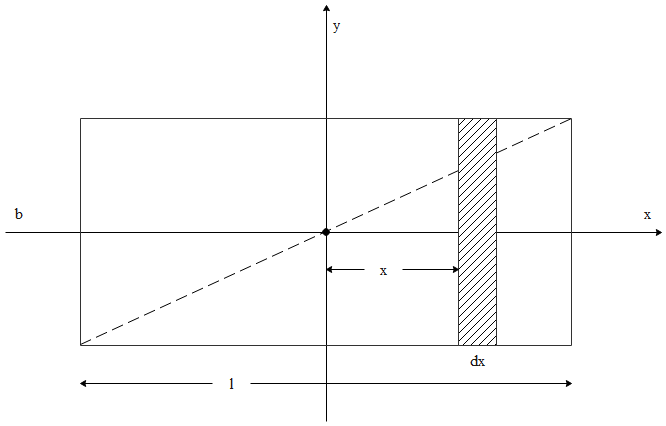
We can calculate the differential area as,
$\Rightarrow d A=b d x$
$\Rightarrow \sigma =\dfrac{M}{l\times b}$
Therefore,
$\Rightarrow dM=\sigma dA\Rightarrow \dfrac{Mdx}{lb}$
Integrating the values, we get,
$\Rightarrow \int{d}{{I}_{y}}=\int\limits_{-\dfrac{l}{2}}^{\dfrac{l}{2}}{d}M\times {{x}^{2}}$
$\Rightarrow {{I}_{y}}=\dfrac{M}{l}\int\limits_{-\dfrac{l}{2}}^{\dfrac{l}{2}}{{{x}^{2}}}dx$
$\Rightarrow \dfrac{M{{l}^{2}}}{12}$
Similarly, ${{I}_{y}}=\dfrac{M{{b}^{2}}}{12}$
$\Rightarrow {{I}_{z}}={{I}_{x}}+{{I}_{y}}=\dfrac{M{{b}^{2}}}{12}+\dfrac{M{{l}^{2}}}{12}$
$\Rightarrow M\left( \dfrac{{{l}^{2}}+{{b}^{2}}}{12} \right)$
Therefore, the correct answer is Option A.
Note: Moment of Inertia is characterized as for a particular rotation axis. The moment of inertia of a point mass with deference toward a pivot is characterized as the result of the mass multiplied by the distance from the axis squared. The moment of inertia of any all-inclusive article is developed from that essential definition. The overall type existing apart from the moment of inertia includes an integral.
Complete step by step answer:
To solve the given question, we must apply the concept of the moment of inertia.
We consider the given diagram to answer the given question,
We can calculate the differential area as,
$\Rightarrow d A=b d x$
$\Rightarrow \sigma =\dfrac{M}{l\times b}$
Therefore,
$\Rightarrow dM=\sigma dA\Rightarrow \dfrac{Mdx}{lb}$
Integrating the values, we get,
$\Rightarrow \int{d}{{I}_{y}}=\int\limits_{-\dfrac{l}{2}}^{\dfrac{l}{2}}{d}M\times {{x}^{2}}$
$\Rightarrow {{I}_{y}}=\dfrac{M}{l}\int\limits_{-\dfrac{l}{2}}^{\dfrac{l}{2}}{{{x}^{2}}}dx$
$\Rightarrow \dfrac{M{{l}^{2}}}{12}$
Similarly, ${{I}_{y}}=\dfrac{M{{b}^{2}}}{12}$
$\Rightarrow {{I}_{z}}={{I}_{x}}+{{I}_{y}}=\dfrac{M{{b}^{2}}}{12}+\dfrac{M{{l}^{2}}}{12}$
$\Rightarrow M\left( \dfrac{{{l}^{2}}+{{b}^{2}}}{12} \right)$
Therefore, the correct answer is Option A.
Note: Moment of Inertia is characterized as for a particular rotation axis. The moment of inertia of a point mass with deference toward a pivot is characterized as the result of the mass multiplied by the distance from the axis squared. The moment of inertia of any all-inclusive article is developed from that essential definition. The overall type existing apart from the moment of inertia includes an integral.
Recently Updated Pages
Mass vs Weight: Key Differences Explained for Students

Circuit Switching vs Packet Switching: Key Differences Explained
Uniform Acceleration Explained: Formula, Examples & Graphs
Wheatstone Bridge – Principle, Formula, Diagram & Applications
Classification of Drugs in Chemistry: Types, Examples & Exam Guide
Area vs Volume: Key Differences Explained for Students
Trending doubts
JEE Main 2026: Exam Dates, Session 2 Updates, City Slip, Admit Card & Latest News
JEE Main Participating Colleges 2026 - A Complete List of Top Colleges
Understanding the Electric Field of a Uniformly Charged Ring
Understanding Atomic Structure for Beginners
Derivation of Equation of Trajectory Explained for Students
How to Convert a Galvanometer into an Ammeter or Voltmeter
Other Pages
JEE Advanced 2026 Notification Out with Exam Date, Registration (Extended), Syllabus and More
JEE Advanced Percentile vs Marks 2026: JEE Main Cutoff, AIR & IIT Admission Guide
CBSE Notes Class 11 Physics Chapter 1 - Units And Measurements - 2026-27
NCERT Solutions For Class 11 Physics Chapter 1 Units And Measurements - 2025-26
Important Questions For Class 11 Physics Chapter 1 Units and Measurement - 2026-27
JEE Advanced Weightage Chapter Wise 2026 for Physics, Chemistry, and Mathematics