




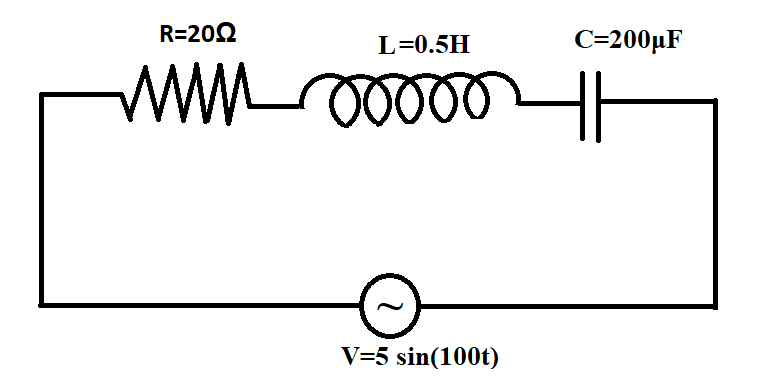
The maximum voltage drop across inductance is
A) $50 Volt$
B) $25 Volt$
C) $12.5 Volt$
D) $5 Volt$
Answer
 Verified
260.1k+ views
Hint: In this question, we have to use the equations for the series LCR circuit. To find voltage drop we have to multiply the total current with the total resistance of the circuit. In an LCR circuit, the net effective resistance is offered by the combination of resistor, inductor, and capacitor and this is known as the impedance of the circuit.
Formula used:
i) $V = {V_0}\sin \omega t$ (Where V stands for the applied voltage, ${V_0}$ is the peak value of voltage, $\omega = 2\pi f$, where f stands for the frequency of ac)
ii) ${X_L} = \omega L$ (${X_L}$Stands for the inductive resistance, L stands for the inductance of the circuit)
iii) ${X_c} = \dfrac{1}{{\omega C}}$ (${X_C}$ stands for the capacitive reactance, C stands for the capacitance of the circuit)
iv) $Z = \sqrt {{R^2} + {{({X_L} - {X_c})}^2}} $ (Z stands for the impedance of the circuit, R stands for the resistance of the circuit)
v) $I = \dfrac{{{V_0}}}{Z}$ (Where I stands for the current)
vi) ${V_{{X_L}}} = I{X_L}$(where ${V_{{X_L}}}$stands for the voltage drop across the inductance)
Complete step by step solution:
We know that, $V = {V_0}\sin \omega t$ …………………...……………………….(1)
In the question, it is given $V = 5\sin (100t)$……………………..(2)
Comparing $(1)$ and $(2)$ we get,
${V_0} = 5volt$ and $\omega = 100$ (We need these values for the calculation of Inductive resistance, capacitive reactance and maximum current)
Now, we have to find the impedance of the circuit. To find the impedance, we have to find the inductive resistance and the capacitive reactance using the formulae given above)
The inductive resistance, ${X_L} = \omega L$
$\because \omega = 100,L = 0.5H$
${X_L} = 100 \times 0.5 = 50$
The capacitive reactance, ${X_c} = \dfrac{1}{{\omega C}}$
$\because \omega = 100,C = 200 \times {10^{ - 6}}$
${X_c} = \dfrac{1}{{100 \times 200 \times {{10}^{ - 6}}}} = 50$
We have calculated the net resistance offered by the inductor i.e. the inductive resistance and the net resistance offered by the capacitor i.e. the capacitive reactance using their respective formulae.
From the question, $R = 20\Omega $
Now we have the values of ${X_{L,}}{X_c} \& R$ to calculate impedance.
$Z = \sqrt {{R^2} + {{({X_L} - {X_c})}^2}} $
$\because {X_L} = 50,{X_C} = 50\& R = 20$
$Z = \sqrt {{{20}^2} + {{(50 - 50)}^2}} $
$ \Rightarrow Z = \sqrt {{{20}^2} + 0} $
$ \Rightarrow Z = \sqrt {{{20}^2}} = 20$
Using the equation of impedance, we have calculated Z, now we have to find the maximum current through the circuit using the formula, $I = \dfrac{{{V_0}}}{Z}$
$\because {V_0} = 5,Z = 20$
$I = \dfrac{5}{{20}} = 0.25 A$
We know that the formula for current is \[I = \dfrac{V}{R}\].
Since the net effective resistance offered by the circuit is Z we have to use Z to find the maximum current instead of R.
Now we have all the values required to find the voltage drop across the inductance. The voltage drop is obtained by multiplying the total current with the inductive resistance.
${V_{{X_L}}} = I{X_L}$
${V_{{X_L}}} = 0.25 \times 50 $
${V_{{X_L}}} = 12.5 Volt$
The answer is (C) $12.5 Volt$.
Note: While solving units of resistance, capacitance and inductance should be taken care of. Always convert the given value of resistance into units of $\Omega $ (for example if resistance is given in Kilo $\Omega $ convert into $\Omega$ before using in the formula) same applies for inductance and capacitance as well.
Formula used:
i) $V = {V_0}\sin \omega t$ (Where V stands for the applied voltage, ${V_0}$ is the peak value of voltage, $\omega = 2\pi f$, where f stands for the frequency of ac)
ii) ${X_L} = \omega L$ (${X_L}$Stands for the inductive resistance, L stands for the inductance of the circuit)
iii) ${X_c} = \dfrac{1}{{\omega C}}$ (${X_C}$ stands for the capacitive reactance, C stands for the capacitance of the circuit)
iv) $Z = \sqrt {{R^2} + {{({X_L} - {X_c})}^2}} $ (Z stands for the impedance of the circuit, R stands for the resistance of the circuit)
v) $I = \dfrac{{{V_0}}}{Z}$ (Where I stands for the current)
vi) ${V_{{X_L}}} = I{X_L}$(where ${V_{{X_L}}}$stands for the voltage drop across the inductance)
Complete step by step solution:
We know that, $V = {V_0}\sin \omega t$ …………………...……………………….(1)
In the question, it is given $V = 5\sin (100t)$……………………..(2)
Comparing $(1)$ and $(2)$ we get,
${V_0} = 5volt$ and $\omega = 100$ (We need these values for the calculation of Inductive resistance, capacitive reactance and maximum current)
Now, we have to find the impedance of the circuit. To find the impedance, we have to find the inductive resistance and the capacitive reactance using the formulae given above)
The inductive resistance, ${X_L} = \omega L$
$\because \omega = 100,L = 0.5H$
${X_L} = 100 \times 0.5 = 50$
The capacitive reactance, ${X_c} = \dfrac{1}{{\omega C}}$
$\because \omega = 100,C = 200 \times {10^{ - 6}}$
${X_c} = \dfrac{1}{{100 \times 200 \times {{10}^{ - 6}}}} = 50$
We have calculated the net resistance offered by the inductor i.e. the inductive resistance and the net resistance offered by the capacitor i.e. the capacitive reactance using their respective formulae.
From the question, $R = 20\Omega $
Now we have the values of ${X_{L,}}{X_c} \& R$ to calculate impedance.
$Z = \sqrt {{R^2} + {{({X_L} - {X_c})}^2}} $
$\because {X_L} = 50,{X_C} = 50\& R = 20$
$Z = \sqrt {{{20}^2} + {{(50 - 50)}^2}} $
$ \Rightarrow Z = \sqrt {{{20}^2} + 0} $
$ \Rightarrow Z = \sqrt {{{20}^2}} = 20$
Using the equation of impedance, we have calculated Z, now we have to find the maximum current through the circuit using the formula, $I = \dfrac{{{V_0}}}{Z}$
$\because {V_0} = 5,Z = 20$
$I = \dfrac{5}{{20}} = 0.25 A$
We know that the formula for current is \[I = \dfrac{V}{R}\].
Since the net effective resistance offered by the circuit is Z we have to use Z to find the maximum current instead of R.
Now we have all the values required to find the voltage drop across the inductance. The voltage drop is obtained by multiplying the total current with the inductive resistance.
${V_{{X_L}}} = I{X_L}$
${V_{{X_L}}} = 0.25 \times 50 $
${V_{{X_L}}} = 12.5 Volt$
The answer is (C) $12.5 Volt$.
Note: While solving units of resistance, capacitance and inductance should be taken care of. Always convert the given value of resistance into units of $\Omega $ (for example if resistance is given in Kilo $\Omega $ convert into $\Omega$ before using in the formula) same applies for inductance and capacitance as well.
Recently Updated Pages
Algebra Made Easy: Step-by-Step Guide for Students

JEE Isolation, Preparation and Properties of Non-metals Important Concepts and Tips for Exam Preparation
JEE Energetics Important Concepts and Tips for Exam Preparation
Chemical Properties of Hydrogen - Important Concepts for JEE Exam Preparation
JEE General Topics in Chemistry Important Concepts and Tips
JEE Amino Acids and Peptides Important Concepts and Tips for Exam Preparation
Trending doubts
JEE Main 2026: Exam Dates, Session 2 Updates, City Slip, Admit Card & Latest News
JEE Main Participating Colleges 2026 - A Complete List of Top Colleges
Hybridisation in Chemistry – Concept, Types & Applications
Understanding the Electric Field of a Uniformly Charged Ring
Derivation of Equation of Trajectory Explained for Students
Understanding Atomic Structure for Beginners
Other Pages
CBSE Class 12 Physics Question Paper 2026: Download SET-wise PDF with Answer Key & Analysis
JEE Advanced 2026 Notification Out with Exam Date, Registration (Extended), Syllabus and More
JEE Advanced Marks vs Ranks 2025: Understanding Category-wise Qualifying Marks and Previous Year Cut-offs
JEE Advanced Weightage Chapter Wise 2026 for Physics, Chemistry, and Mathematics
How to Convert a Galvanometer into an Ammeter or Voltmeter
Electron Gain Enthalpy and Electron Affinity Explained