




The height at which liquid will stand in the open end of the pipe is:
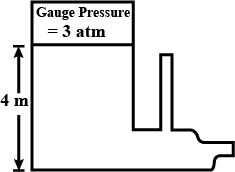
(A) 4 m
(B) 3.5 m
(C) 4.5 m
(D) 5.6 m
Answer
 Verified
241.2k+ views
Hint: We know that the continuity equation in physics is an equation that describes the transport of some quantity. It is particularly simple and powerful when applied to a conserved quantity, but it can be generalized to apply to any extensive quantity. The continuity equation reflects the fact that mass is conserved in any non-nuclear continuum mechanics analysis. The equation is developed by adding up the rate at which mass is flowing in and out of a control volume, and setting the net in-flow equal to the rate of change of mass within it. The continuity equation is important for describing the movement of fluids as they pass from a tube of greater diameter to one of smaller diameter. It is critical to keep in mind that the fluid has to be of constant density as well as being incompressible.
Complete step by step answer
It is known that fluid statics or hydrostatics is the branch of fluid mechanics that studies "fluids at rest and the pressure in a fluid or exerted by a fluid on an immersed body". It encompasses the study of the conditions under which fluids are at rest in stable equilibrium as opposed to fluid dynamics, the study of fluids in motion.
The diagram is given as:
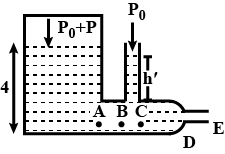
Let us consider that atmospheric pressure be $\mathrm{p}_{0}$. Then absolute pressure of air is
$\mathrm{p}+\mathrm{p}_{0}=4 \mathrm{atm}$
Pressure at $A, p_{A}=p+p_{0}+\rho g h$
So, from equation of continuity and Bernoulli's theorem,
$\mathrm{p}_{\mathrm{B}}=\mathrm{p}_{\mathrm{C}}$
Now applying Bernoulli's theorem at $A$ and $E$, we have $\mathrm{p}+\mathrm{p}_{0}+\rho \mathrm{gh}=\mathrm{p}_{\mathrm{C}}+\dfrac{\mathrm{pv}_{\mathrm{C}}^{2}}{2}=\mathrm{p}_{0}+\dfrac{\rho \mathrm{v}_{\mathrm{E}}^{2}}{2}$
where $\mathrm{v}_{\mathrm{C}}$ and $\mathrm{v}_{\mathrm{E}}$ are the velocities of flow of liquid at $\mathrm{C}$ and $\mathrm{E}$,
respectively.
According to the hydrostatic law, at any point inside a static fluid the vertical rate of increase of pressure must equal the local specific weight of the fluid.
From hydrostatics, $\mathrm{p}_{\mathrm{C}}=\mathrm{p}_{0}+\rho \mathrm{gh}^{\prime}$
From continuity equation, $\mathrm{A}_{\mathrm{C}} \mathrm{v}_{\mathrm{C}}=\mathrm{A}_{\mathrm{E}} \mathrm{v}_{\mathrm{E}}$
where $\mathrm{A}_{\mathrm{C}}=6 \mathrm{cm}^{2}$ and $\mathrm{A}_{\mathrm{E}}=3 \mathrm{cm}^{2}$
Solving above equations, we get $\mathrm{v}_{\mathrm{E}}=13.4 \mathrm{m} / \mathrm{s}$
$\mathrm{v}_{\mathrm{C}}=6.7 \mathrm{m} / \mathrm{s}$
$\mathrm{h}^{\prime}=4.5 \mathrm{m}$
So, the correct answer is option C.
Note:We can conclude that according to Bernoulli's theorem, the sum of pressure energy, kinetic energy, and potential energy per unit mass of an incompressible, non-viscous fluid in a streamlined flow remains a constant. The simplified form of Bernoulli's equation can be summarized in the following memorable word equation: static pressure + dynamic pressure = total pressure. Every point in a steadily flowing fluid, regardless of the fluid speed at that point, has its own unique static pressure p and dynamic pressure q. Bernoulli's principle is then cited to conclude that since the air moves slower along the bottom of the wing, the air pressure must be higher, pushing the wing up. However, there is no physical principle that requires equal transit time and experimental results show that this assumption is false.
Complete step by step answer
It is known that fluid statics or hydrostatics is the branch of fluid mechanics that studies "fluids at rest and the pressure in a fluid or exerted by a fluid on an immersed body". It encompasses the study of the conditions under which fluids are at rest in stable equilibrium as opposed to fluid dynamics, the study of fluids in motion.
The diagram is given as:
Let us consider that atmospheric pressure be $\mathrm{p}_{0}$. Then absolute pressure of air is
$\mathrm{p}+\mathrm{p}_{0}=4 \mathrm{atm}$
Pressure at $A, p_{A}=p+p_{0}+\rho g h$
So, from equation of continuity and Bernoulli's theorem,
$\mathrm{p}_{\mathrm{B}}=\mathrm{p}_{\mathrm{C}}$
Now applying Bernoulli's theorem at $A$ and $E$, we have $\mathrm{p}+\mathrm{p}_{0}+\rho \mathrm{gh}=\mathrm{p}_{\mathrm{C}}+\dfrac{\mathrm{pv}_{\mathrm{C}}^{2}}{2}=\mathrm{p}_{0}+\dfrac{\rho \mathrm{v}_{\mathrm{E}}^{2}}{2}$
where $\mathrm{v}_{\mathrm{C}}$ and $\mathrm{v}_{\mathrm{E}}$ are the velocities of flow of liquid at $\mathrm{C}$ and $\mathrm{E}$,
respectively.
According to the hydrostatic law, at any point inside a static fluid the vertical rate of increase of pressure must equal the local specific weight of the fluid.
From hydrostatics, $\mathrm{p}_{\mathrm{C}}=\mathrm{p}_{0}+\rho \mathrm{gh}^{\prime}$
From continuity equation, $\mathrm{A}_{\mathrm{C}} \mathrm{v}_{\mathrm{C}}=\mathrm{A}_{\mathrm{E}} \mathrm{v}_{\mathrm{E}}$
where $\mathrm{A}_{\mathrm{C}}=6 \mathrm{cm}^{2}$ and $\mathrm{A}_{\mathrm{E}}=3 \mathrm{cm}^{2}$
Solving above equations, we get $\mathrm{v}_{\mathrm{E}}=13.4 \mathrm{m} / \mathrm{s}$
$\mathrm{v}_{\mathrm{C}}=6.7 \mathrm{m} / \mathrm{s}$
$\mathrm{h}^{\prime}=4.5 \mathrm{m}$
So, the correct answer is option C.
Note:We can conclude that according to Bernoulli's theorem, the sum of pressure energy, kinetic energy, and potential energy per unit mass of an incompressible, non-viscous fluid in a streamlined flow remains a constant. The simplified form of Bernoulli's equation can be summarized in the following memorable word equation: static pressure + dynamic pressure = total pressure. Every point in a steadily flowing fluid, regardless of the fluid speed at that point, has its own unique static pressure p and dynamic pressure q. Bernoulli's principle is then cited to conclude that since the air moves slower along the bottom of the wing, the air pressure must be higher, pushing the wing up. However, there is no physical principle that requires equal transit time and experimental results show that this assumption is false.
Recently Updated Pages
Dimensions of Charge: Dimensional Formula, Derivation, SI Units & Examples

How to Calculate Moment of Inertia: Step-by-Step Guide & Formulas
Circuit Switching vs Packet Switching: Key Differences Explained
Dimensions of Pressure in Physics: Formula, Derivation & SI Unit
JEE Extractive Metallurgy Important Concepts and Tips for Exam Preparation
JEE General Topics in Chemistry Important Concepts and Tips
Trending doubts
JEE Main 2026: Session 1 Results Out and Session 2 Registration Open, City Intimation Slip, Exam Dates, Syllabus & Eligibility
Ideal and Non-Ideal Solutions Explained for Class 12 Chemistry
JEE Main Participating Colleges 2026 - A Complete List of Top Colleges
Clemmensen and Wolff Kishner Reductions Explained for JEE & NEET
Degree of Dissociation: Meaning, Formula, Calculation & Uses
Understanding the Angle of Deviation in a Prism
Other Pages
JEE Advanced Marks vs Ranks 2025: Understanding Category-wise Qualifying Marks and Previous Year Cut-offs
JEE Advanced 2026 - Exam Date (Released), Syllabus, Registration, Eligibility, Preparation, and More
CBSE Notes Class 11 Physics Chapter 4 - Laws of Motion - 2025-26
CBSE Notes Class 11 Physics Chapter 14 - Waves - 2025-26
CBSE Notes Class 11 Physics Chapter 9 - Mechanical Properties of Fluids - 2025-26
Inductive Effect and Its Role in Acidic Strength