




The forward biased diode
Answer
 Verified
273.6k+ views
Hint: Here, we get the answer by knowing about the PN Junction diode and its characteristics of forward bias current flows from higher potential to lower potential and from opinion you can get the answer.
Complete step by step solution:
The P-N junction diode can be represented by
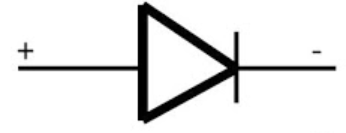
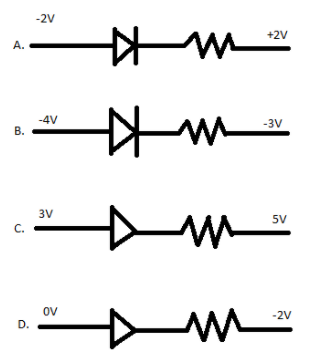
in which the ‘+’ side is called a cathode. In the forward bias current flows from anode to cathode and anode must be connected to higher potential and cathode must be connected to lower potential. When voltage is supplied from the battery source current starts to flow from higher potential to lower potential and is the same way diodes must be inserted that current enter from anode side and leave from cathode side. Anode side is also called P side and cathode side also called N side. Therefore the voltage must be higher at the anode side and voltage must be lower at the cathode side. So, from options we can see in option(D) only, the P side is at higher potential than n side.
P side (anode) at ’0’ volt and n side (cathode) at ‘-2’ volt.
Note: In the case of reverse bias, the polarity of battery change and there current enters to n side (cathode) and leaves from p side (anode). We can see option(C) n side at higher potential (5V) and p side at lower potential (3V). So, it is the case of reverse bias diode circuits.
Complete step by step solution:
The P-N junction diode can be represented by
in which the ‘+’ side is called a cathode. In the forward bias current flows from anode to cathode and anode must be connected to higher potential and cathode must be connected to lower potential. When voltage is supplied from the battery source current starts to flow from higher potential to lower potential and is the same way diodes must be inserted that current enter from anode side and leave from cathode side. Anode side is also called P side and cathode side also called N side. Therefore the voltage must be higher at the anode side and voltage must be lower at the cathode side. So, from options we can see in option(D) only, the P side is at higher potential than n side.
P side (anode) at ’0’ volt and n side (cathode) at ‘-2’ volt.
Note: In the case of reverse bias, the polarity of battery change and there current enters to n side (cathode) and leaves from p side (anode). We can see option(C) n side at higher potential (5V) and p side at lower potential (3V). So, it is the case of reverse bias diode circuits.
Recently Updated Pages
WBJEE 2026 Result Live: Important Dates, Last Date Apply Online 2026

JoSAA Counselling 2026: JoSAA 2026 Mock Seat Allotment LIVE: Round 2 Result Released, Registration, Choice Filling and Ranks
Circuit Switching vs Packet Switching: Key Differences Explained
JEE General Topics in Chemistry Important Concepts and Tips
JEE Extractive Metallurgy Important Concepts and Tips for Exam Preparation
JEE Atomic Structure and Chemical Bonding important Concepts and Tips
Trending doubts
JEE Main Participating Colleges 2026 - A Complete List of Top Colleges
Kinematics Mock Test for JEE Main 2025-26: Comprehensive Practice
Electron Gain Enthalpy and Electron Affinity Explained
Understanding Uniform Acceleration in Physics
Understanding Electromagnetic Waves and Their Importance
In an electromagnetic wave A Power is equally transferred class 12 physics JEE_Main
Other Pages
Electrochemistry JEE Advanced 2026 Notes
A Zener diode having breakdown voltage equal to 15V class 12 physics JEE_Main
JEE Main 2025-26 Chapter-Wise Mock Test Preparation Guide
Kinematics Mock Test 2025 with Answers and Explanations
JEE Advanced 2026 Notes
The average and RMS value of voltage for square waves class 12 physics JEE_Main