




The electron configuration for Potassium in the ground state:
(A)- $1{{s}^{2}}2{{s}^{2}}2{{p}^{6}}3{{s}^{2}}3{{p}^{6}}$
(B)- $1{{s}^{2}}2{{s}^{2}}2{{p}^{6}}3{{s}^{2}}3{{p}^{6}}4{{s}^{2}}$
(C)- $1{{s}^{2}}2{{s}^{2}}2{{p}^{6}}3{{s}^{2}}3{{p}^{6}}4{{s}^{1}}$
(D)- $1{{s}^{2}}$
(E)- $1{{s}^{2}}2{{s}^{2}}2{{p}^{6}}3{{p}^{1}}$
Answer
 Verified
270.3k+ views
Hint: Potassium in the ground state has 19 electrons and the shell structure is 2,8,8,1. To fill electrons in the orbitals there are some rules we must keep in mind namely Hund’s rule and Aufbau principle.
Complete step by step solution:
> In order to write the Potassium electron configuration we first need to know the number of electrons for the K atom. When we write the configuration we'll put all 19 electrons in orbitals around the nucleus of the Potassium atom.
> We need to distribute 19 electrons, knowing that there can be
- 2 in an s-orbital
- 6 in a p-orbital (2 in ${{p}_{x}}$, 2 in ${{p}_{y}}$ and 2 in ${{p}_{z}}$)
- 10 in a d-orbital
> We won’t need f-orbitals before atomic number 58.
The energy of an electron in a single electron atom can be determined by the principal quantum number. Thus, the order of increase in energy of various orbitals is given as, 1s < 2s = 2p < 3s = 3p = 3d <4s = 4p = 4d= 4f. But a multiple electron system (n+l) rule involving principal and azimuthal quantum numbers is followed although we do not need to apply it here.
> In writing the electron configuration for Potassium the first two electrons will go in the 1s orbital. Since 1s can only hold two electrons the next 2 electrons for Potassium go in the 2s orbital.
> The next six electrons will go in the 2p orbital. The p orbital can hold up to six electrons. We'll put six in the 2p orbital and then put the next two electrons in the 3s.
Since the 3s are now full we'll move to the 3p where we'll place the next six electrons.
We now shift to the 4s orbital where we place the remaining electron.
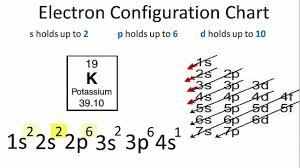
Therefore the Potassium electron configuration will be $1{{s}^{2}}2{{s}^{2}}2{{p}^{6}}3{{s}^{2}}3{{p}^{6}}4{{s}^{1}}$.
Hence, Option C is the correct answer.
Note: The electronic configuration provides an easy way for scientists to understand how electrons are arranged around the nucleus of an atom. This makes it easier to predict how atoms will interact to form chemical bonds.
Complete step by step solution:
> In order to write the Potassium electron configuration we first need to know the number of electrons for the K atom. When we write the configuration we'll put all 19 electrons in orbitals around the nucleus of the Potassium atom.
> We need to distribute 19 electrons, knowing that there can be
- 2 in an s-orbital
- 6 in a p-orbital (2 in ${{p}_{x}}$, 2 in ${{p}_{y}}$ and 2 in ${{p}_{z}}$)
- 10 in a d-orbital
> We won’t need f-orbitals before atomic number 58.
The energy of an electron in a single electron atom can be determined by the principal quantum number. Thus, the order of increase in energy of various orbitals is given as, 1s < 2s = 2p < 3s = 3p = 3d <4s = 4p = 4d= 4f. But a multiple electron system (n+l) rule involving principal and azimuthal quantum numbers is followed although we do not need to apply it here.
> In writing the electron configuration for Potassium the first two electrons will go in the 1s orbital. Since 1s can only hold two electrons the next 2 electrons for Potassium go in the 2s orbital.
> The next six electrons will go in the 2p orbital. The p orbital can hold up to six electrons. We'll put six in the 2p orbital and then put the next two electrons in the 3s.
Since the 3s are now full we'll move to the 3p where we'll place the next six electrons.
We now shift to the 4s orbital where we place the remaining electron.
Therefore the Potassium electron configuration will be $1{{s}^{2}}2{{s}^{2}}2{{p}^{6}}3{{s}^{2}}3{{p}^{6}}4{{s}^{1}}$.
Hence, Option C is the correct answer.
Note: The electronic configuration provides an easy way for scientists to understand how electrons are arranged around the nucleus of an atom. This makes it easier to predict how atoms will interact to form chemical bonds.
Recently Updated Pages
Disproportionation Reaction: Definition, Example & JEE Guide

Hess Law of Constant Heat Summation: Definition, Formula & Applications
JEE General Topics in Chemistry Important Concepts and Tips
JEE Extractive Metallurgy Important Concepts and Tips for Exam Preparation
JEE Atomic Structure and Chemical Bonding important Concepts and Tips
JEE Amino Acids and Peptides Important Concepts and Tips for Exam Preparation
Trending doubts
JEE Main 2026: Exam Dates, Session 2 Updates, City Slip, Admit Card & Latest News
JEE Main Participating Colleges 2026 - A Complete List of Top Colleges
Understanding the Electric Field of a Uniformly Charged Ring
Understanding Atomic Structure for Beginners
Derivation of Equation of Trajectory Explained for Students
JEE Main Marking Scheme 2026- Paper-Wise Marks Distribution and Negative Marking Details
Other Pages
JEE Advanced 2026 Notification Out with Exam Date, Registration (Extended), Syllabus and More
JEE Advanced Percentile vs Marks 2026: JEE Main Cutoff, AIR & IIT Admission Guide
JEE Advanced Weightage Chapter Wise 2026 for Physics, Chemistry, and Mathematics
Understanding the Different Types of Solutions in Chemistry
NCERT Solutions For Class 11 Chemistry In Hindi Chapter 1 Some Basic Concepts Of Chemistry - 2025-26
How to Convert a Galvanometer into an Ammeter or Voltmeter