




The distance between the hydrogen atom and the fluorine atom in a hydrogen fluorine $(H F)$ molecules is $0.92{{A}^{0}}$. The mass of the hydrogen atom is 1 a.m.u and mass of the fluorine atom is 19 a.m.u. The position of the centre of ass of the hydrogen
fluorine molecule is
(A) $0.5{{A}^{0}}$from hydrogen atom
(B) $0.5{{A}^{0}}$ from fluorine atom
(C) $0.87{{A}^{0}}$ from hydrogen atom
(D) $0.87{{A}^{0}}$ from fluorine atom
Answer
 Verified
233.1k+ views
Hint: We know that the atomic mass of an element is the average mass of the atoms of an element measured in atomic mass units (amu, also known as Daltons, D). The atomic mass is a weighted average of all of the isotopes of that element, in which the mass of each isotope is multiplied by the abundance of that particular isotope. An atomic unit of mass is defined as accurately 1/12 the mass of a carbon-12 atom. The carbon-12 atom has six neutrons and six protons in its nucleus. The atomic unit mass is symbolized as AMU or amu. The mass of one mole of atoms of a pure element in grams is equivalent to the atomic mass of that element in atomic mass units (amu) or in grams per mole (g/mol). Although mass can be expressed as both amu and g/mol, g/mol is the most useful system of units for laboratory chemistry. Using this theory, we can solve this question.
Complete step by step answer
Let us first draw the diagram to get an idea about the following
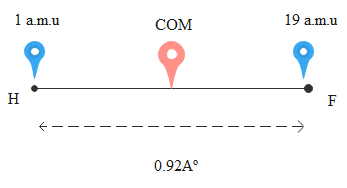
We know that the center of mass is a position defined relative to an object or system of objects. It is the average position of all the parts of the system, weighted according to their masses. For simple rigid objects with uniform density, the center of mass is located at the centroid.
The centre of mass is given as:
$\dfrac{(1\times 0)+(19\times 0.92)}{20}$
After the evaluation we get that it is $0.87{{A}^{0}}$from the hydrogen atom.
Hence, the correct answer is option C.
Note We can conclude that the centre of mass of an object is the point at which the object can be balanced. The centre of mass is useful because problems can often be simplified by treating a collection of masses as one mass at their common centre of mass. The weight of the object then acts through this point. The centre of mass of a system is a hypothetical point, where the entire mass of the body is supposed to be concentrated. The velocity of the system's center of mass does not change, as long as the system is closed. The system moves as if all the mass is concentrated at a single point. The final location will be at the weighted distance between the masses. In most mechanics’ problems the gravitational field is assumed to be uniform. The center of gravity is then in exactly the same position as the center of mass. The terms center of gravity and center of mass tend to often be used interchangeably since they are often at the same location.
Complete step by step answer
Let us first draw the diagram to get an idea about the following
We know that the center of mass is a position defined relative to an object or system of objects. It is the average position of all the parts of the system, weighted according to their masses. For simple rigid objects with uniform density, the center of mass is located at the centroid.
The centre of mass is given as:
$\dfrac{(1\times 0)+(19\times 0.92)}{20}$
After the evaluation we get that it is $0.87{{A}^{0}}$from the hydrogen atom.
Hence, the correct answer is option C.
Note We can conclude that the centre of mass of an object is the point at which the object can be balanced. The centre of mass is useful because problems can often be simplified by treating a collection of masses as one mass at their common centre of mass. The weight of the object then acts through this point. The centre of mass of a system is a hypothetical point, where the entire mass of the body is supposed to be concentrated. The velocity of the system's center of mass does not change, as long as the system is closed. The system moves as if all the mass is concentrated at a single point. The final location will be at the weighted distance between the masses. In most mechanics’ problems the gravitational field is assumed to be uniform. The center of gravity is then in exactly the same position as the center of mass. The terms center of gravity and center of mass tend to often be used interchangeably since they are often at the same location.
Recently Updated Pages
Dimensions of Charge: Dimensional Formula, Derivation, SI Units & Examples

How to Calculate Moment of Inertia: Step-by-Step Guide & Formulas
Circuit Switching vs Packet Switching: Key Differences Explained
Dimensions of Pressure in Physics: Formula, Derivation & SI Unit
JEE General Topics in Chemistry Important Concepts and Tips
JEE Extractive Metallurgy Important Concepts and Tips for Exam Preparation
Trending doubts
JEE Main 2026: Session 2 Registration Open, City Intimation Slip, Exam Dates, Syllabus & Eligibility
JEE Main 2026 Application Login: Direct Link, Registration, Form Fill, and Steps
JEE Main Marking Scheme 2026- Paper-Wise Marks Distribution and Negative Marking Details
Understanding the Angle of Deviation in a Prism
Hybridisation in Chemistry – Concept, Types & Applications
How to Convert a Galvanometer into an Ammeter or Voltmeter
Other Pages
JEE Advanced Marks vs Ranks 2025: Understanding Category-wise Qualifying Marks and Previous Year Cut-offs
Laws of Motion Class 11 Physics Chapter 4 CBSE Notes - 2025-26
Waves Class 11 Physics Chapter 14 CBSE Notes - 2025-26
Mechanical Properties of Fluids Class 11 Physics Chapter 9 CBSE Notes - 2025-26
Thermodynamics Class 11 Physics Chapter 11 CBSE Notes - 2025-26
Units And Measurements Class 11 Physics Chapter 1 CBSE Notes - 2025-26