




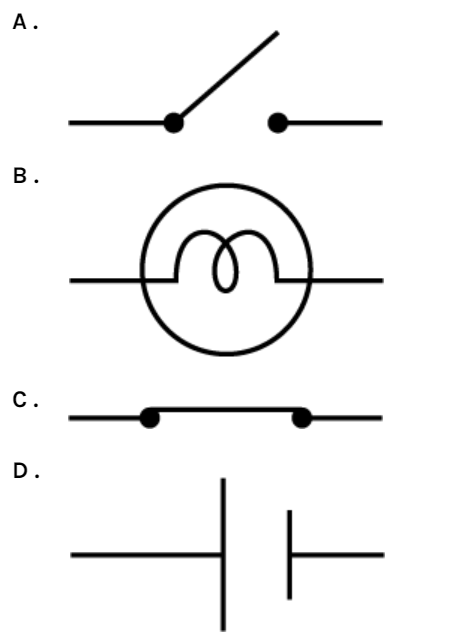
Symbol of switch is “ON” position is
Answer
 Verified
567.9k+ views
Hint:Phrase “Switch is on” means, circuit is connected and current is flowing through it. For the current to be flowing, the path should be complete. To understand and analyze electric circuits, one should have understanding of basic symbols, like resistor, battery, switch ON and OFF, etc.
Complete step-by-step answer:
Circuit is a path that is required to flow electricity.
Switch is a device which is attached to a circuit, and it is required to disconnect the circuit when we don’t want to use appliances.
Thus, switch has two mode-
ON – when circuit is connected and electricity is flowing through it.

OFF – when circuit is disconnected and electricity is not flowing through it
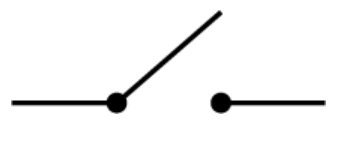
Thus, the correct answer is C.
Additional information:
A circuit is made of made devices attached to it, which are essential to it and useful to flow current through it.
These devices are-
Battery – It transforms chemical energy stored in it into electrical energy. It is represented as:
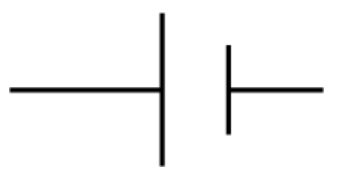
Which is the option D.
Switch – Which is used to disconnect circuits, when we don’t want to use appliances.
Resistor – It is the hindrance faced by the electron in a metallic wire, which causes wire to heat up and loss of energy.
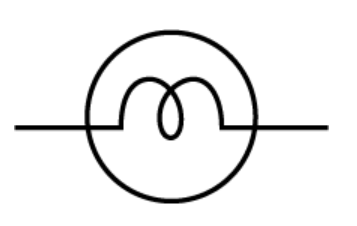
Appliance – In the above shown diagram appliance is a light bulb, which needs electricity supply to work.
Note: Switches are used to disconnect circuits when we don’t want to use appliances, it is shown as a connecting wire.
When wire is shown not connected, it reflects that switch is OFF.
When wire is shown connected, it reflects that switch is ON.
Complete step-by-step answer:
Circuit is a path that is required to flow electricity.
Switch is a device which is attached to a circuit, and it is required to disconnect the circuit when we don’t want to use appliances.
Thus, switch has two mode-
ON – when circuit is connected and electricity is flowing through it.
OFF – when circuit is disconnected and electricity is not flowing through it
Thus, the correct answer is C.
Additional information:
A circuit is made of made devices attached to it, which are essential to it and useful to flow current through it.
These devices are-
Battery – It transforms chemical energy stored in it into electrical energy. It is represented as:
Which is the option D.
Switch – Which is used to disconnect circuits, when we don’t want to use appliances.
Resistor – It is the hindrance faced by the electron in a metallic wire, which causes wire to heat up and loss of energy.
Appliance – In the above shown diagram appliance is a light bulb, which needs electricity supply to work.
Note: Switches are used to disconnect circuits when we don’t want to use appliances, it is shown as a connecting wire.
When wire is shown not connected, it reflects that switch is OFF.
When wire is shown connected, it reflects that switch is ON.
Recently Updated Pages
Wheatstone Bridge – Principle, Formula, Diagram & Applications

Mass vs Weight: Key Differences Explained for Students
Circuit Switching vs Packet Switching: Key Differences Explained
Young’s Double Slit Experiment Derivation Explained
Classification of Drugs in Chemistry: Types, Examples & Exam Guide
Area vs Volume: Key Differences Explained for Students
Trending doubts
JEE Main 2026: Exam Dates, Session 2 Updates, City Slip, Admit Card & Latest News
Understanding the Electric Field of a Uniformly Charged Ring
Understanding Atomic Structure for Beginners
Derivation of Equation of Trajectory Explained for Students
Electron Gain Enthalpy and Electron Affinity Explained
How to Convert a Galvanometer into an Ammeter or Voltmeter
Other Pages
CBSE Class 12 Physics Question Paper 2026: Download SET-wise PDF with Answer Key & Analysis
JEE Advanced 2026 Notification Out with Exam Date, Registration (Extended), Syllabus and More
JEE Advanced Percentile vs Marks 2026: JEE Main Cutoff, AIR & IIT Admission Guide
JEE Advanced Weightage Chapter Wise 2026 for Physics, Chemistry, and Mathematics
Understanding Uniform Acceleration in Physics
Understanding Electromagnetic Waves and Their Importance