




Propyne and propene can be distinguished by:
A. Conc.${{\text{H}}_{2}}\text{S}{{\text{O}}_{4}}$
B. $\text{B}{{\text{r}}_{2}}$ in $\text{CC}{{\text{l}}_{4}}$
C. Dilute $\text{KMn}{{\text{O}}_{4}}$
D. $\text{AgN}{{\text{O}}_{3}}$ in ammonia
Answer
 Verified
273k+ views
Hint: The chemical reagents give differences in chemical compounds. Concentrated sulphuric acid and bromination show additional reactions. Dilute potassium permanganate gives carboxylic acids on reaction with one and alcohols with another. Ammoniacal silver nitrate removes acidic hydrogen to give precipitates.
Complete step by step solution:
Let us discuss the products formed when propyne and propene react with the reagents given in the options:
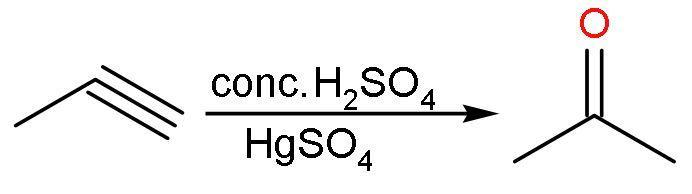
(A) Conc.${{\text{H}}_{2}}\text{S}{{\text{O}}_{4}}$: Propyne reacts with concentrated sulphuric acid in presence of mercuric sulphate to form acetone in equilibrium with its tautomeric structure. The reaction is
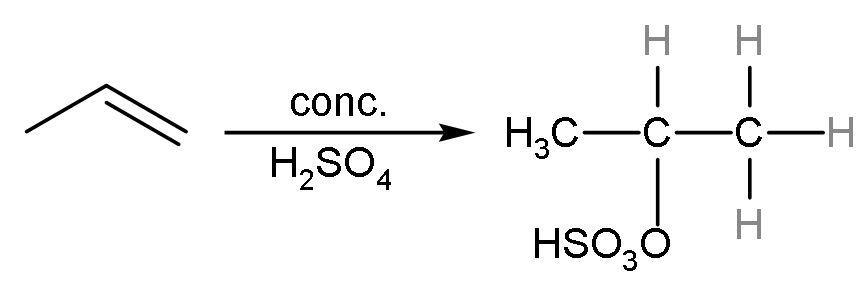
Propene reacts with concentrated sulphuric acid to give an additional reaction. In this reaction, ${{\text{H}}^{+}}$ of sulphuric acid adds to more hydrogenated double-bonded carbon and $^{-}\text{OS}{{\text{O}}_{3}}\text{H}$ to less hydrogenated carbon atom. The reaction is
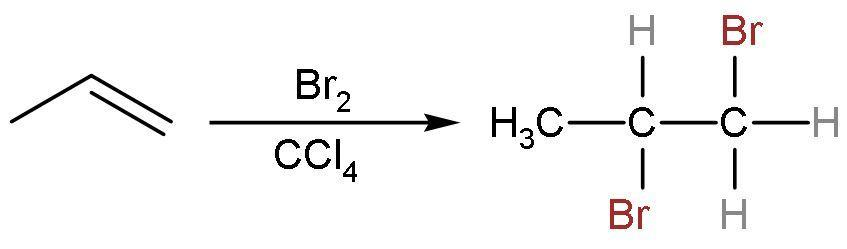
(B) $\text{B}{{\text{r}}_{2}}$ in $\text{CC}{{\text{l}}_{4}}$: Propene is an unsaturated compound. So, it gives an additional reaction with bromine in a nonpolar solvent of carbon tetrachloride. The double bond is replaced by the single bond between the carbon atoms and additions of bromine atoms on both the double-bonded carbon atoms take place. The reaction is
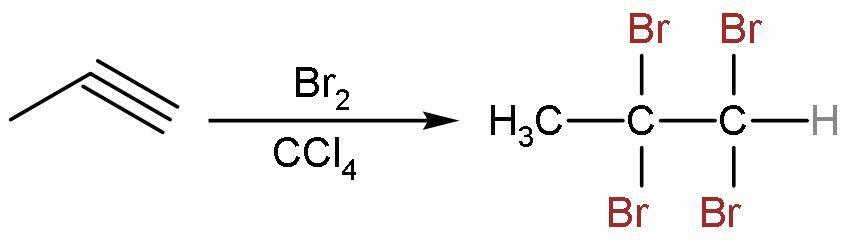
Similarly, propyne reacts with $\text{B}{{\text{r}}_{2}}$ in $\text{CC}{{\text{l}}_{4}}$ to give addition reaction only. Here, the triple bond is replaced by the single bond. The 2 moles of $\text{B}{{\text{r}}_{2}}$ in $\text{CC}{{\text{l}}_{4}}$ will be needed here. The reaction is
(C) Dilute $\text{KMn}{{\text{O}}_{4}}$: In this reaction, propyne reacts with potassium permanganate to give carboxylic acids of lesser carbon atoms. It means that the triple bond is broken from the presence of a triple bond. The reaction is

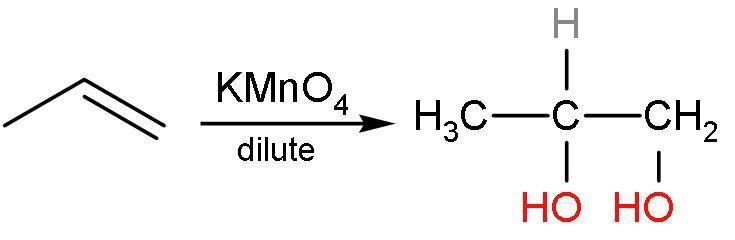
Propene reacts with potassium permanganate to give an additional reaction. In this, the hydroxyl groups are added to both the double-bonded carbon atom. This is vicinal diols or 1,2-diols. The double bond is replaced by the alcohol groups. The reaction is
(D) $\text{AgN}{{\text{O}}_{3}}$ in ammonia: Propene does not react with ammoniacal silver nitrate.
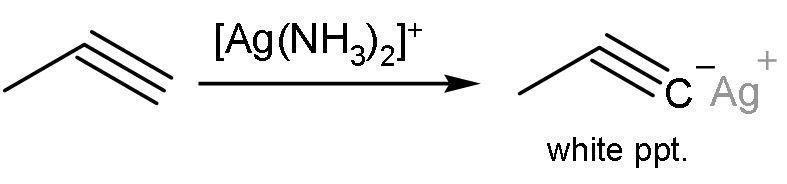
Propyne, on the other hand, gives this reaction. Propyne has a triple bond between ${{\text{C}}_{1}}-{{\text{C}}_{2}}$. This means that the alkyne is terminal. Terminal alkynes have acidic hydrogens. These hydrogens are removed and insoluble precipitates are formed. The reaction is
Propyne and propene can be distinguished by $\text{AgN}{{\text{O}}_{3}}$ in ammonia, which is option ’d’.
So, the connected answer is (D).
Note: Aldehydes are oxidised by diamine silver ions $\left[ \text{Ag}\left( \text{N}{{\text{H}}_{3}} \right)_{2}^{+} \right]$ or ammoniacal silver nitrate solution to carboxylic acids. This reagent is also known as Tollen’s reagent. The reaction forms out of a silver mirror as a product to confirm the presence of aldehydes. The reaction is
Complete step by step solution:
Let us discuss the products formed when propyne and propene react with the reagents given in the options:
(A) Conc.${{\text{H}}_{2}}\text{S}{{\text{O}}_{4}}$: Propyne reacts with concentrated sulphuric acid in presence of mercuric sulphate to form acetone in equilibrium with its tautomeric structure. The reaction is
Propene reacts with concentrated sulphuric acid to give an additional reaction. In this reaction, ${{\text{H}}^{+}}$ of sulphuric acid adds to more hydrogenated double-bonded carbon and $^{-}\text{OS}{{\text{O}}_{3}}\text{H}$ to less hydrogenated carbon atom. The reaction is
(B) $\text{B}{{\text{r}}_{2}}$ in $\text{CC}{{\text{l}}_{4}}$: Propene is an unsaturated compound. So, it gives an additional reaction with bromine in a nonpolar solvent of carbon tetrachloride. The double bond is replaced by the single bond between the carbon atoms and additions of bromine atoms on both the double-bonded carbon atoms take place. The reaction is
Similarly, propyne reacts with $\text{B}{{\text{r}}_{2}}$ in $\text{CC}{{\text{l}}_{4}}$ to give addition reaction only. Here, the triple bond is replaced by the single bond. The 2 moles of $\text{B}{{\text{r}}_{2}}$ in $\text{CC}{{\text{l}}_{4}}$ will be needed here. The reaction is
(C) Dilute $\text{KMn}{{\text{O}}_{4}}$: In this reaction, propyne reacts with potassium permanganate to give carboxylic acids of lesser carbon atoms. It means that the triple bond is broken from the presence of a triple bond. The reaction is
Propene reacts with potassium permanganate to give an additional reaction. In this, the hydroxyl groups are added to both the double-bonded carbon atom. This is vicinal diols or 1,2-diols. The double bond is replaced by the alcohol groups. The reaction is
(D) $\text{AgN}{{\text{O}}_{3}}$ in ammonia: Propene does not react with ammoniacal silver nitrate.
Propyne, on the other hand, gives this reaction. Propyne has a triple bond between ${{\text{C}}_{1}}-{{\text{C}}_{2}}$. This means that the alkyne is terminal. Terminal alkynes have acidic hydrogens. These hydrogens are removed and insoluble precipitates are formed. The reaction is
Propyne and propene can be distinguished by $\text{AgN}{{\text{O}}_{3}}$ in ammonia, which is option ’d’.
So, the connected answer is (D).
Note: Aldehydes are oxidised by diamine silver ions $\left[ \text{Ag}\left( \text{N}{{\text{H}}_{3}} \right)_{2}^{+} \right]$ or ammoniacal silver nitrate solution to carboxylic acids. This reagent is also known as Tollen’s reagent. The reaction forms out of a silver mirror as a product to confirm the presence of aldehydes. The reaction is
Recently Updated Pages
WBJEE 2026 Result Live: Important Dates, Last Date Apply Online 2026

JoSAA Counselling 2026: JoSAA 2026 Mock Seat Allotment LIVE: Round 2 Result Released, Registration, Choice Filling and Ranks
JEE General Topics in Chemistry Important Concepts and Tips
JEE Extractive Metallurgy Important Concepts and Tips for Exam Preparation
JEE Atomic Structure and Chemical Bonding important Concepts and Tips
JEE Amino Acids and Peptides Important Concepts and Tips for Exam Preparation
Trending doubts
JEE Main 2026: Exam Dates, Session 2 Updates, City Slip, Admit Card & Latest News
JEE Main Participating Colleges 2026 - A Complete List of Top Colleges
Understanding the Electric Field of a Uniformly Charged Ring
Understanding Atomic Structure for Beginners
Derivation of Equation of Trajectory Explained for Students
Understanding the Different Types of Solutions in Chemistry
Other Pages
JEE Advanced 2026 Notification Out with Exam Date, Registration (Extended), Syllabus and More
JEE Advanced Percentile vs Marks 2026: JEE Main Cutoff, AIR & IIT Admission Guide
CBSE Class 12 Chemistry Question Paper 2026 PDF Download (All Sets) with Answer Key
NCERT Solutions For Class 12 Chemistry Chapter 2 Electrochemistry - 2025-26
NCERT Solutions For Class 12 Chemistry Chapter 1 Solutions - 2025-26
NCERT Solutions For Class 12 Chemistry Chapter 3 Chemical Kinetics - 2025-26