




Mark the correct statements about the friction between two bodies.
(A) Static friction is always greater than the kinetic friction.
(B) coefficient of static friction is always greater than the coefficient of kinetic friction
(C) Limiting friction is always greater than the kinetic friction
(D) Limiting friction never less than static friction
Answer
 Verified
273k+ views
Hint Assume that you’re placing a block on a surface that isn’t said to be smooth. Friction is the opposing force by the surface on the body, when the body is pushed or pulled. Apply this concept and select the correct options.
Complete Step By Step Solution
When a pull of push force is applied on the block on a surface, it experiences a constant static friction. As and when it is in contact with the surface, the surface opposes the block’s motion over a certain period of time. As and when we start to apply greater force on the body, the body will begin to accelerate with a kinetic friction. Now the friction value decreases, since the body is moving . When the body is said to be static, the amount of friction exerted by the surface on the body will be greater , until the force applied on the body exceeds the holding friction value. Hence static friction is greater than kinetic friction since there are more forces that apply on the body to keep it stationary than the kinetic forces that make it accelerate.
The maximum static friction is called the limiting friction. Limiting friction certainly has a greater value than that of kinetic friction but never lesser than static friction since it is the maxima point of static friction.
The graph of the same is given below
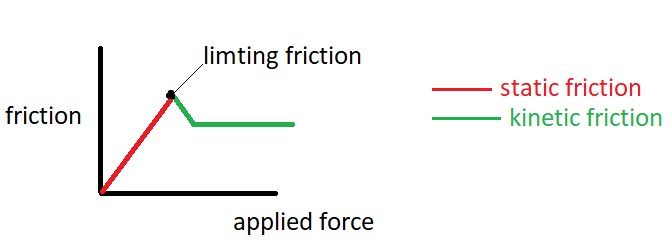
Thus, Options (b) (c) (d) are the right answers for the given question.
Note It is not always essential that static friction should always be greater than that of kinetic friction. This is because static friction is not constant and depends upon the force applied on the body to move it which is a bit less than limiting friction. Hence we can’t conclude that static friction will always be greater than kinetic.
Complete Step By Step Solution
When a pull of push force is applied on the block on a surface, it experiences a constant static friction. As and when it is in contact with the surface, the surface opposes the block’s motion over a certain period of time. As and when we start to apply greater force on the body, the body will begin to accelerate with a kinetic friction. Now the friction value decreases, since the body is moving . When the body is said to be static, the amount of friction exerted by the surface on the body will be greater , until the force applied on the body exceeds the holding friction value. Hence static friction is greater than kinetic friction since there are more forces that apply on the body to keep it stationary than the kinetic forces that make it accelerate.
The maximum static friction is called the limiting friction. Limiting friction certainly has a greater value than that of kinetic friction but never lesser than static friction since it is the maxima point of static friction.
The graph of the same is given below
Thus, Options (b) (c) (d) are the right answers for the given question.
Note It is not always essential that static friction should always be greater than that of kinetic friction. This is because static friction is not constant and depends upon the force applied on the body to move it which is a bit less than limiting friction. Hence we can’t conclude that static friction will always be greater than kinetic.
Recently Updated Pages
WBJEE 2026 Result Live: Important Dates, Last Date Apply Online 2026

JoSAA Counselling 2026: JoSAA 2026 Mock Seat Allotment LIVE: Round 2 Result Released, Registration, Choice Filling and Ranks
Circuit Switching vs Packet Switching: Key Differences Explained
Dimensions of Pressure in Physics: Formula, Derivation & SI Unit
JEE General Topics in Chemistry Important Concepts and Tips
JEE Extractive Metallurgy Important Concepts and Tips for Exam Preparation
Trending doubts
JEE Main 2026: Exam Dates, Session 2 Updates, City Slip, Admit Card & Latest News
JEE Main Participating Colleges 2026 - A Complete List of Top Colleges
Understanding the Electric Field of a Uniformly Charged Ring
Understanding Atomic Structure for Beginners
Derivation of Equation of Trajectory Explained for Students
How to Convert a Galvanometer into an Ammeter or Voltmeter
Other Pages
JEE Advanced 2026 Notification Out with Exam Date, Registration (Extended), Syllabus and More
JEE Advanced Percentile vs Marks 2026: JEE Main Cutoff, AIR & IIT Admission Guide
CBSE Notes Class 11 Physics Chapter 1 - Units And Measurements - 2026-27
NCERT Solutions For Class 11 Physics Chapter 1 Units And Measurements - 2025-26
Important Questions For Class 11 Physics Chapter 1 Units and Measurement - 2026-27
JEE Advanced Weightage Chapter Wise 2026 for Physics, Chemistry, and Mathematics