




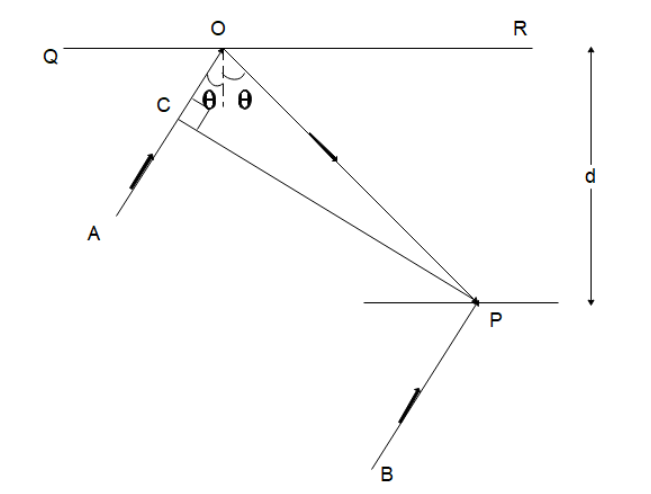
ln the adjacent diagram, CP represents a wavefront and AO and BP, the corresponding two rays. The condition on $\theta $ for constructive interference at P between the ray BP and reflected ray OP is:
A) $\cos \theta = \dfrac{{3\lambda }}{{2d}}$
B) $\cos \theta = \dfrac{\lambda }{{4d}}$
C) $\sec \theta - \cos \theta = \dfrac{\lambda }{d}$
D) $\sec \theta - \cos \theta = \dfrac{{4\lambda }}{d}$
Answer
 Verified
283.8k+ views
Hint: In this solution, we will first calculate the extra distance by the ray AO before it reaches the point P which will be the path difference of the two rays. There will be constructive interference if the path difference is an integral multiple of the wavelength of the two waves. However, in this case, the reflection of one of the rays from the top surface will flip the condition for constructive interference.
Complete step by step answer:
From the diagram, we can see that while the two rays AO and BP are parallel to each other the ray AO will have to travel an extra distance before it reaches the point P. We know that this is the path difference between the two rays. Let us find the extra distance the ray AO has to travel.
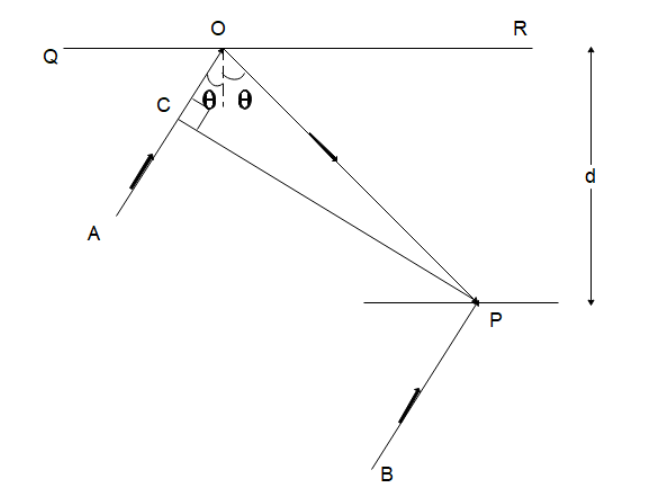
Since the line CP represents a wavefront, the extra distance, the ray AO will travel will be the sum of distance CO and OP.
We can find the distance BP from triangle OPM as:
$\cos \theta = \dfrac{d}{{OP}}$
$ \Rightarrow OP = \dfrac{d}{{\cos \theta }}$
For CO, we can see that
\[\cos 2\theta = \dfrac{{CO}}{{OP}}\]
As $OP = \dfrac{d}{{\cos \theta }}$, we can write
\[ \Rightarrow CO = \dfrac{{d\cos 2\theta }}{{\cos \theta }}\]
Now the net path difference will be
$D = CO + OP$
$ \Rightarrow D = \dfrac{d}{{\cos \theta }}(\cos 2\theta + 1)$
Since \[\cos (2\theta + 1) = 2{\cos ^2}\theta \], we have
$D = 2d\cos \theta $
Under normal circumstances, the path difference would have to be equal to an integral multiple of wavelengths. But in this case, the reflection of the ray OP causes an additional path difference of $\lambda /2$. Hence the condition of the constructive interference, in this case, will be
$\Rightarrow$ $D = \dfrac{{n\lambda }}{2}$ which we can write as
$\Rightarrow$ $2d\cos \theta = \dfrac{{n\lambda }}{2}$
Which gives us
$\cos \theta = \dfrac{{n\lambda }}{{4d}}$
For $n = 1$,
$\cos \theta = \dfrac{\lambda }{{4d}}$ which corresponds to option (B).
Note: We must be careful to include the reflection of the ray OP and its effect on an additional path difference in the ray. For this, we have assumed that the medium outside OQ is rarer than the medium where the waves are propagating.
Complete step by step answer:
From the diagram, we can see that while the two rays AO and BP are parallel to each other the ray AO will have to travel an extra distance before it reaches the point P. We know that this is the path difference between the two rays. Let us find the extra distance the ray AO has to travel.
Since the line CP represents a wavefront, the extra distance, the ray AO will travel will be the sum of distance CO and OP.
We can find the distance BP from triangle OPM as:
$\cos \theta = \dfrac{d}{{OP}}$
$ \Rightarrow OP = \dfrac{d}{{\cos \theta }}$
For CO, we can see that
\[\cos 2\theta = \dfrac{{CO}}{{OP}}\]
As $OP = \dfrac{d}{{\cos \theta }}$, we can write
\[ \Rightarrow CO = \dfrac{{d\cos 2\theta }}{{\cos \theta }}\]
Now the net path difference will be
$D = CO + OP$
$ \Rightarrow D = \dfrac{d}{{\cos \theta }}(\cos 2\theta + 1)$
Since \[\cos (2\theta + 1) = 2{\cos ^2}\theta \], we have
$D = 2d\cos \theta $
Under normal circumstances, the path difference would have to be equal to an integral multiple of wavelengths. But in this case, the reflection of the ray OP causes an additional path difference of $\lambda /2$. Hence the condition of the constructive interference, in this case, will be
$\Rightarrow$ $D = \dfrac{{n\lambda }}{2}$ which we can write as
$\Rightarrow$ $2d\cos \theta = \dfrac{{n\lambda }}{2}$
Which gives us
$\cos \theta = \dfrac{{n\lambda }}{{4d}}$
For $n = 1$,
$\cos \theta = \dfrac{\lambda }{{4d}}$ which corresponds to option (B).
Note: We must be careful to include the reflection of the ray OP and its effect on an additional path difference in the ray. For this, we have assumed that the medium outside OQ is rarer than the medium where the waves are propagating.
Recently Updated Pages
How to Calculate Moment of Inertia: Step-by-Step Guide & Formulas

Dimensions of Charge: Dimensional Formula, Derivation, SI Units & Examples
Mass vs Weight: Key Differences Explained for Students
Uniform Acceleration Explained: Formula, Examples & Graphs
JEE Main 2025-26 Mock Test: Binomial Theorem & Quick Practice
Properties of Solids and Liquids Mock Test 2025
Trending doubts
JEE Main 2026: Exam Dates, Session 2 Updates, City Slip, Admit Card & Latest News
Understanding the Electric Field of a Uniformly Charged Ring
Understanding Atomic Structure for Beginners
Derivation of Equation of Trajectory Explained for Students
Electron Gain Enthalpy and Electron Affinity Explained
How to Convert a Galvanometer into an Ammeter or Voltmeter
Other Pages
JEE Advanced Percentile vs Marks 2026: JEE Main Cutoff, AIR & IIT Admission Guide
CBSE Notes Class 11 Physics Chapter 1 - Units And Measurements - 2026-27
NCERT Solutions For Class 11 Physics Chapter 1 Units And Measurements - 2026-27 Free PDF Download (Login Required)
NCERT Solutions For Class 11 Physics Chapter 2 Motion In A Straight Line - 2026-27 Free PDF Download (Login Required)
Important Questions For Class 11 Physics Chapter 1 Units and Measurement - 2026-27
CBSE Notes Class 11 Physics Chapter 2 - Motion in a Straight Line - 2026-27