




In the Molisch reagent the substance used is:
A) β- naphthol in alcohol
B) α-naphthol in alcohol
C) Resorcinol in alcohol
D) Rosaniline in water
Answer
 Verified
273.6k+ views
Hint: Molisch test is a test to check for the presence of carbohydrates, whether they are in free or in any combined forms. Such tests always require an end point indication to confirm the presence; it can be odour, colour, effervescence, etc. So, now think which of the options can do so with carbohydrates.
Complete step by step solution:
-Molisch test has been named after Austrian botanist Hans Molisch.
-This test is used to check if carbohydrates are present or not. Monosaccharides, glycoproteins, disaccharides and polysaccharides all react to this test. Although monosaccharides react rapidly, while polysaccharides and disaccharides react a bit slower.
-The reagent used in this test is known as Molisch’s reagent. It consists of: α-naphthol (${C_{10}}{H_8}OH$) dissolved in ethanol (${C_2}{H_5}OH$).
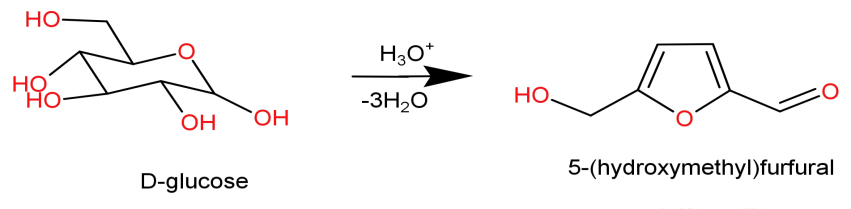
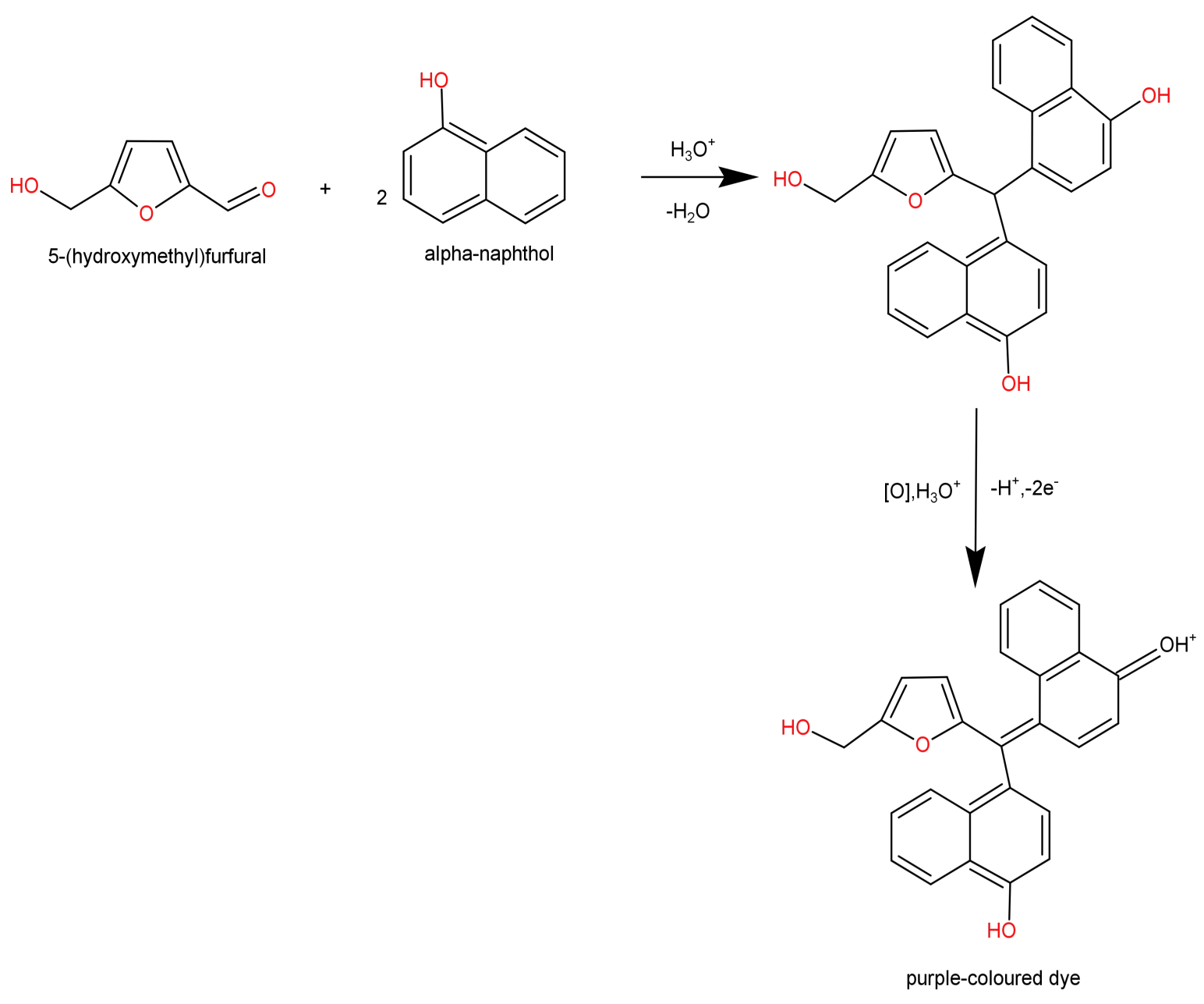
-Principle: Carbohydrates are dehydrated with concentrated${H_2}S{O_4}$ to form its corresponding furfural derivatives which are then condensed by the α-naphthol to give a coloured condensation product.
-here concentrated sulphuric acid (concentrated${H_2}S{O_4}$) acts like a strong dehydrating agent which dehydrates the carbohydrate or sugar into its corresponding furfural (from pentoses) or hydroxymethyl furfural (from hexoses).
-Furfurals are then condensed using α-naphthol, which gives a violet or purple coloured product (ring is formed at the interface). This product is a furfuryl-diphenyl-methane-dye.
- When the carbohydrate is a poly- or disaccharide, first its monosaccharide components are hydrolysed to form the furfural derivatives.
-End point of this test: appearance of purple or violet ring at the interface. If seen then carbohydrate is present otherwise not.
So, the correct option is: B) α-naphthol in alcohol
Note: always remember that although α-naphthol and β-naphthol are isomers, it does not mean they are the same. The difference in the position of alcohol groups in both causes them to differ in their reactivity and that is why this test is not given by β-naphthol.
Complete step by step solution:
-Molisch test has been named after Austrian botanist Hans Molisch.
-This test is used to check if carbohydrates are present or not. Monosaccharides, glycoproteins, disaccharides and polysaccharides all react to this test. Although monosaccharides react rapidly, while polysaccharides and disaccharides react a bit slower.
-The reagent used in this test is known as Molisch’s reagent. It consists of: α-naphthol (${C_{10}}{H_8}OH$) dissolved in ethanol (${C_2}{H_5}OH$).
-Principle: Carbohydrates are dehydrated with concentrated${H_2}S{O_4}$ to form its corresponding furfural derivatives which are then condensed by the α-naphthol to give a coloured condensation product.
-here concentrated sulphuric acid (concentrated${H_2}S{O_4}$) acts like a strong dehydrating agent which dehydrates the carbohydrate or sugar into its corresponding furfural (from pentoses) or hydroxymethyl furfural (from hexoses).
-Furfurals are then condensed using α-naphthol, which gives a violet or purple coloured product (ring is formed at the interface). This product is a furfuryl-diphenyl-methane-dye.
- When the carbohydrate is a poly- or disaccharide, first its monosaccharide components are hydrolysed to form the furfural derivatives.
-End point of this test: appearance of purple or violet ring at the interface. If seen then carbohydrate is present otherwise not.
So, the correct option is: B) α-naphthol in alcohol
Note: always remember that although α-naphthol and β-naphthol are isomers, it does not mean they are the same. The difference in the position of alcohol groups in both causes them to differ in their reactivity and that is why this test is not given by β-naphthol.
Recently Updated Pages
Classification of Drugs in Chemistry: Types, Examples & Exam Guide

Difference Between Alcohol and Phenol: Structure, Tests & Uses
Wheatstone Bridge – Principle, Formula, Diagram & Applications
Mass vs Weight: Key Differences Explained for Students
Area vs Volume: Key Differences Explained for Students
Mutually Exclusive vs Independent Events: Key Differences Explained
Trending doubts
JEE Main 2026: Exam Dates, Session 2 Updates, City Slip, Admit Card & Latest News
JEE Main Participating Colleges 2026 - A Complete List of Top Colleges
Understanding the Electric Field of a Uniformly Charged Ring
Understanding Atomic Structure for Beginners
Derivation of Equation of Trajectory Explained for Students
Understanding the Different Types of Solutions in Chemistry
Other Pages
JEE Advanced 2026 Notification Out with Exam Date, Registration (Extended), Syllabus and More
JEE Advanced Percentile vs Marks 2026: JEE Main Cutoff, AIR & IIT Admission Guide
CBSE Class 12 Chemistry Question Paper 2026 PDF Download (All Sets) with Answer Key
NCERT Solutions For Class 12 Chemistry Chapter 2 Electrochemistry - 2025-26
NCERT Solutions For Class 12 Chemistry Chapter 1 Solutions - 2025-26
NCERT Solutions For Class 12 Chemistry Chapter 3 Chemical Kinetics - 2025-26