




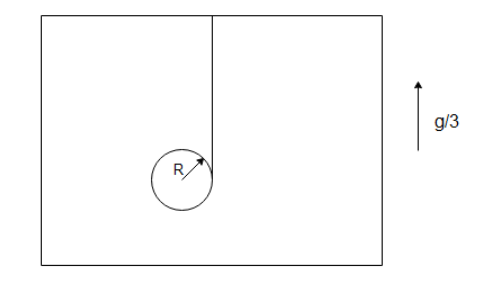
In the arrangement shown a solid cylinder of mass $M$ and radius $R$ is suspended with the help of an ideal string, and the lift is moving upward with acceleration $g/3$. The tension in the string is
A) $\dfrac{{5mg}}{{12}}$
B) $\dfrac{{4mg}}{3}$
C) $\dfrac{{3mg}}{4}$
D) $\dfrac{{4mg}}{9}$
Answer
 Verified
273.9k+ views
Hint: The tension in the string can be determined from the force balance of the string. It can also be determined from the angular motion of the solid cylinder on the string. We will equate these two equations to determine the tension in the string.
Formula used: In this solution, we will use the following formulae:
Torque on the cylinder: $\tau = F.R = I.\alpha $ where $F$ is the force or the tension in the string, $R$ is the radius of the pulley, $I$ is the moment of inertia of the rod, and $\alpha $ is the angular acceleration of the cylinder.
Complete step by step answer:
Let us start by drawing a free body diagram of the situation described:
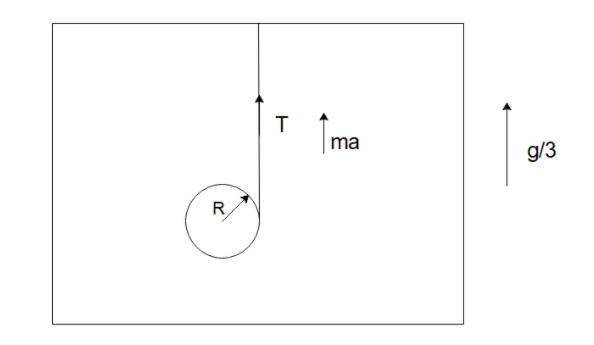
We can see that the net acceleration experienced by the system will be due to gravity and the acceleration of the lift as $a = g + \dfrac{g}{3} = \dfrac{{4g}}{3}$.
Then the force balance of the diagram in the vertical direction will be
$\dfrac{{4mg}}{3} - T = ma$
where $a$ is the net acceleration of the object.
Now looking at the angular motion of the cylinder, we know that the moment of inertia of a solid cylinder is calculated as $\dfrac{{m{R^2}}}{2}$. Then the torque acting on the cylinder due to the unrolling of the string will be
$TR = \dfrac{{M{R^2}}}{2}\alpha $
As the angular acceleration is the product of the linear acceleration and the radius of the sphere, we have $\alpha = aR$. Then the above equation can be written as
$ma = 2T$
Equating equation (1) and (2), we get
$\dfrac{{4mg}}{3} - T = 2T$
Which gives us the tension as
$T = \dfrac{{4mg}}{9}$ which corresponds to option (D).
Note: Such questions always require knowledge of the translational dynamics as well as the rotational dynamics of the object. We should also know the moment of inertia of certain objects like cylinders about different axes as these objects are frequently encountered in such questions.
Formula used: In this solution, we will use the following formulae:
Torque on the cylinder: $\tau = F.R = I.\alpha $ where $F$ is the force or the tension in the string, $R$ is the radius of the pulley, $I$ is the moment of inertia of the rod, and $\alpha $ is the angular acceleration of the cylinder.
Complete step by step answer:
Let us start by drawing a free body diagram of the situation described:
We can see that the net acceleration experienced by the system will be due to gravity and the acceleration of the lift as $a = g + \dfrac{g}{3} = \dfrac{{4g}}{3}$.
Then the force balance of the diagram in the vertical direction will be
$\dfrac{{4mg}}{3} - T = ma$
where $a$ is the net acceleration of the object.
Now looking at the angular motion of the cylinder, we know that the moment of inertia of a solid cylinder is calculated as $\dfrac{{m{R^2}}}{2}$. Then the torque acting on the cylinder due to the unrolling of the string will be
$TR = \dfrac{{M{R^2}}}{2}\alpha $
As the angular acceleration is the product of the linear acceleration and the radius of the sphere, we have $\alpha = aR$. Then the above equation can be written as
$ma = 2T$
Equating equation (1) and (2), we get
$\dfrac{{4mg}}{3} - T = 2T$
Which gives us the tension as
$T = \dfrac{{4mg}}{9}$ which corresponds to option (D).
Note: Such questions always require knowledge of the translational dynamics as well as the rotational dynamics of the object. We should also know the moment of inertia of certain objects like cylinders about different axes as these objects are frequently encountered in such questions.
Recently Updated Pages
Mass vs Weight: Key Differences Explained for Students

Circuit Switching vs Packet Switching: Key Differences Explained
Uniform Acceleration Explained: Formula, Examples & Graphs
Wheatstone Bridge – Principle, Formula, Diagram & Applications
Classification of Drugs in Chemistry: Types, Examples & Exam Guide
Area vs Volume: Key Differences Explained for Students
Trending doubts
JEE Main 2026: Exam Dates, Session 2 Updates, City Slip, Admit Card & Latest News
Understanding the Electric Field of a Uniformly Charged Ring
Understanding Atomic Structure for Beginners
Derivation of Equation of Trajectory Explained for Students
Electron Gain Enthalpy and Electron Affinity Explained
How to Convert a Galvanometer into an Ammeter or Voltmeter
Other Pages
JEE Advanced 2026 Notification Out with Exam Date, Registration (Extended), Syllabus and More
JEE Advanced Percentile vs Marks 2026: JEE Main Cutoff, AIR & IIT Admission Guide
CBSE Notes Class 11 Physics Chapter 1 - Units And Measurements - 2026-27
NCERT Solutions For Class 11 Physics Chapter 1 Units And Measurements - 2025-26
Important Questions For Class 11 Physics Chapter 1 Units and Measurement - 2026-27
JEE Advanced Weightage Chapter Wise 2026 for Physics, Chemistry, and Mathematics