




In refraction incident ray and emergent ray are parallel. Type 1 for true and 0 for false.
Answer
 Verified
259.5k+ views
Hint: To answer this question, we need to take the case of refraction through a glass slab. Then we need to examine whether the emergent ray is parallel to the incident ray, using Snell's law.
Formula Used: The formula used in this solution is
\[\mu = \dfrac{{\sin i}}{{\sin r}}\], \[\mu = \]refractive index, \[i = \]angle of incidence, and \[r = \] angle of refraction
Complete step-by-step answer
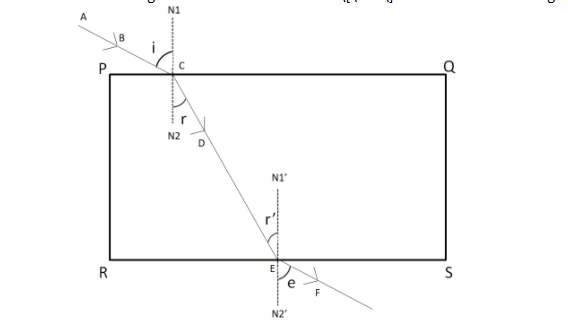
Consider a glass slab of refractive index \[\mu \] as shown in the flowing figure.
A ray \[AB\] is incident on the upper interface at the point \[C\], which gets refracted in the glass medium as the ray \[CD\]. The refracted ray is incident on the lower interface at the point \[E\]. Finally, \[CD\] is refracted and emerges out of the glass medium back into the air as the ray\[EF\].
Applying Snell’s law on the upper interface, we get
\[\mu = \dfrac{{\sin i}}{{\sin r}}\] (i)
Again applying Snell’s law on the lower interface, we get
\[\mu = \dfrac{{\sin e}}{{\sin r'}}\] (ii)
As \[{N_1}{N_2}\] is the normal to the upper interface,
\[\therefore {N_1}{N_2} \bot PQ\] (iii)
Also, \[{N’_1}{N’_2}\] is the normal to the lower surface
\[\therefore {N’_1}{N’_2} \bot RS\] (iv)
Case 1
If \[PQ\parallel RS\] then by (iii) and (iv), we have
\[{N_1}{N_2}\parallel {N’_1}{N’_2}\]
Now, in the figure, as \[r\] and \[r'\] are alternate interior angles, so they are equal.
\[\therefore r = r'\]
Taking sine both the sides, we get
\[\sin r = \sin r'\] (v)
From (i) and (ii)
\[\dfrac{{\sin i}}{{\sin r}} = \dfrac{{\sin e}}{{\sin r'}}\]
Multiplying with \[\sin r\] on both sides
\[\sin i = \sin r\dfrac{{\sin e}}{{\sin r'}}\]
From (v)
\[\sin i = \sin e\]
\[\because \] both \[i\& e\] are acute, so we can say
\[i = e\]
As \[{N_1}{N_2} \parallel {N’_1}{N’_2}\] and \[i = e\]
So \[AB\parallel EF\]
Hence, the incident ray and emergent ray are parallel.
Case 2
If \[PQ\& RS\] are not parallel, then
\[r \ne r'\]
both \[i\& e\] are acute, so we can say
\[\sin r \ne \sin r'\]
From (i) and (ii)
\[\dfrac{{\sin i}}{{\sin r}} = \dfrac{{\sin e}}{{\sin r'}}\]
But \[\sin r \ne \sin r'\]
So, \[\sin i \ne \sin e\] and therefore
\[i \ne e\]
Thus, \[AB\] is not parallel to \[EF\]
\[\therefore \] We conclude that the incident and the emergent rays are parallel only with the condition that the two refracting interfaces should be parallel to each other. They are not always parallel.
So the statement given in the question is false.
Hence, the correct answer is 0.
Note: This question can also be attempted by taking the case of refraction through a triangular prism. In that case, we can directly conclude that the emergent ray is not parallel to the incident ray through simple observation.
Formula Used: The formula used in this solution is
\[\mu = \dfrac{{\sin i}}{{\sin r}}\], \[\mu = \]refractive index, \[i = \]angle of incidence, and \[r = \] angle of refraction
Complete step-by-step answer
Consider a glass slab of refractive index \[\mu \] as shown in the flowing figure.
A ray \[AB\] is incident on the upper interface at the point \[C\], which gets refracted in the glass medium as the ray \[CD\]. The refracted ray is incident on the lower interface at the point \[E\]. Finally, \[CD\] is refracted and emerges out of the glass medium back into the air as the ray\[EF\].
Applying Snell’s law on the upper interface, we get
\[\mu = \dfrac{{\sin i}}{{\sin r}}\] (i)
Again applying Snell’s law on the lower interface, we get
\[\mu = \dfrac{{\sin e}}{{\sin r'}}\] (ii)
As \[{N_1}{N_2}\] is the normal to the upper interface,
\[\therefore {N_1}{N_2} \bot PQ\] (iii)
Also, \[{N’_1}{N’_2}\] is the normal to the lower surface
\[\therefore {N’_1}{N’_2} \bot RS\] (iv)
Case 1
If \[PQ\parallel RS\] then by (iii) and (iv), we have
\[{N_1}{N_2}\parallel {N’_1}{N’_2}\]
Now, in the figure, as \[r\] and \[r'\] are alternate interior angles, so they are equal.
\[\therefore r = r'\]
Taking sine both the sides, we get
\[\sin r = \sin r'\] (v)
From (i) and (ii)
\[\dfrac{{\sin i}}{{\sin r}} = \dfrac{{\sin e}}{{\sin r'}}\]
Multiplying with \[\sin r\] on both sides
\[\sin i = \sin r\dfrac{{\sin e}}{{\sin r'}}\]
From (v)
\[\sin i = \sin e\]
\[\because \] both \[i\& e\] are acute, so we can say
\[i = e\]
As \[{N_1}{N_2} \parallel {N’_1}{N’_2}\] and \[i = e\]
So \[AB\parallel EF\]
Hence, the incident ray and emergent ray are parallel.
Case 2
If \[PQ\& RS\] are not parallel, then
\[r \ne r'\]
both \[i\& e\] are acute, so we can say
\[\sin r \ne \sin r'\]
From (i) and (ii)
\[\dfrac{{\sin i}}{{\sin r}} = \dfrac{{\sin e}}{{\sin r'}}\]
But \[\sin r \ne \sin r'\]
So, \[\sin i \ne \sin e\] and therefore
\[i \ne e\]
Thus, \[AB\] is not parallel to \[EF\]
\[\therefore \] We conclude that the incident and the emergent rays are parallel only with the condition that the two refracting interfaces should be parallel to each other. They are not always parallel.
So the statement given in the question is false.
Hence, the correct answer is 0.
Note: This question can also be attempted by taking the case of refraction through a triangular prism. In that case, we can directly conclude that the emergent ray is not parallel to the incident ray through simple observation.
Recently Updated Pages
JEE Main Mock Test 2025-26: Electromagnetic Induction & Alternating Currents

JEE Main Mock Test 2025-26: Optics Chapter Practice Online
JEE Main 2025-26 Mock Test: Properties of Solids and Liquids
JEE Main Mock Test 2025-26: Dual Nature of Matter & Radiation
JEE Main 2025-26 Electromagnetic Waves Mock Test with Solutions
JEE Main 2025-26 Mock Test: Electronic Devices Chapter Practice
Trending doubts
JEE Main Marking Scheme 2026- Paper-Wise Marks Distribution and Negative Marking Details
Understanding Atomic Structure for Beginners
Electron Gain Enthalpy and Electron Affinity Explained
Understanding the Electric Field Due to Infinite Linear Charge and Cylinders
Understanding the Angle of Deviation in a Prism
Understanding Average and RMS Value in Electrical Circuits
Other Pages
Understanding Electric Flux and Area Vector in Physics
A point charge is placed at the corner of a cube The class 12 physics JEE_Main
Understanding Geostationary and Geosynchronous Satellites
Explain the construction and working of a GeigerMuller class 12 physics JEE_Main
JEE Main 2025-26 Electrostatics Mock Test for Effective Preparation
JEE Advanced 2026 Revision Notes for Vectors