




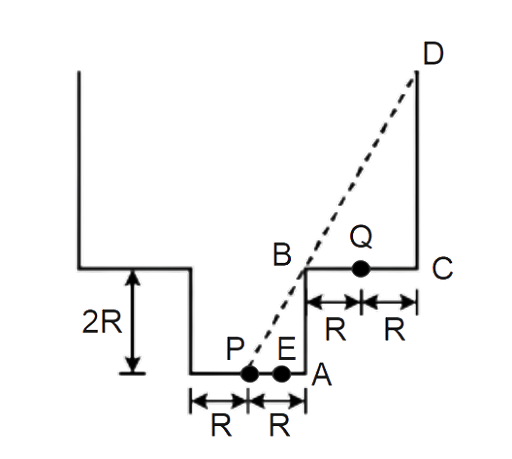
In a vessel, as shown in figure, point P is just visible when no liquid is filled in the vessel through a telescope in the air. When liquid is filled in the vessel completely, point Q is visible without moving the vessel or telescope. Find the refractive index of the liquid.
A. $\dfrac{\sqrt{14}}{3} \\ $
B. $\dfrac{\sqrt{85}}{5} \\ $
C. $\sqrt{2}$
D. $\sqrt{3}$
Answer
 Verified
253.2k+ views
Hint:In this question, a figure is given in which a point P is visible when no liquid is filled in the vessel. When we fill the liquid, a point Q is visible and we have to find the refractive index of that point. We find the refractive index with the help of Snell's law. By putting the values in the snell’s law, we find out the value of the refractive index.
Formula Used:
We solve this question with the help of snell’s law:-
$\mu \sin i=\sin r$
Here, $\mu$ is the refractive index, $i$ is the angle of incidence and $r$ is the angle of refraction.
Complete step by step solution:
When the vessel is not filled with the liquid, Point P can just be seen.
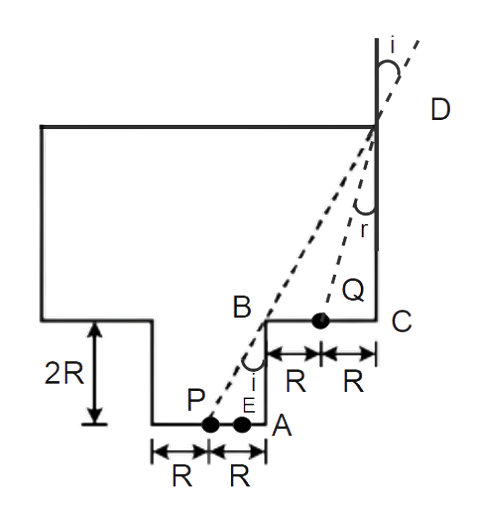
Then the triangles ABP and BCD are similar.
Thus $\dfrac{PA}{AB}=\dfrac{BC}{CD}$
Hence CD = 4 R
Now after filling in a liquid of refractive index $\mu $, point Q can be seen. Hence the angle of refraction at D is r can be seen in the figure.
Now we apply snell’s law to the refraction at point D,
$\mu \sin i=\sin r$
$\Rightarrow \mu \sin (\angle CDQ)=1\times \sin (\angle CDB)$
Hence $\mu \times \dfrac{1}{\sqrt{5}}=1\times \dfrac{2R}{R\sqrt{20}}$
Solving further, we get
$\mu =\dfrac{2\sqrt{17}}{\sqrt{20}}$
Hence $\mu =\dfrac{\sqrt{85}}{5}$
Hence, option B is the correct answer.
Note: Remember that in the snell’s law, when the ray of light is incident perpendicularly, the speed changes, but the direction remains unaltered. When light passes from a rare medium to a denser medium, it is inclined closer towards the normal. When light rays pass from a dense medium to a rare medium, it is inclined away from the normal.
Formula Used:
We solve this question with the help of snell’s law:-
$\mu \sin i=\sin r$
Here, $\mu$ is the refractive index, $i$ is the angle of incidence and $r$ is the angle of refraction.
Complete step by step solution:
When the vessel is not filled with the liquid, Point P can just be seen.
Then the triangles ABP and BCD are similar.
Thus $\dfrac{PA}{AB}=\dfrac{BC}{CD}$
Hence CD = 4 R
Now after filling in a liquid of refractive index $\mu $, point Q can be seen. Hence the angle of refraction at D is r can be seen in the figure.
Now we apply snell’s law to the refraction at point D,
$\mu \sin i=\sin r$
$\Rightarrow \mu \sin (\angle CDQ)=1\times \sin (\angle CDB)$
Hence $\mu \times \dfrac{1}{\sqrt{5}}=1\times \dfrac{2R}{R\sqrt{20}}$
Solving further, we get
$\mu =\dfrac{2\sqrt{17}}{\sqrt{20}}$
Hence $\mu =\dfrac{\sqrt{85}}{5}$
Hence, option B is the correct answer.
Note: Remember that in the snell’s law, when the ray of light is incident perpendicularly, the speed changes, but the direction remains unaltered. When light passes from a rare medium to a denser medium, it is inclined closer towards the normal. When light rays pass from a dense medium to a rare medium, it is inclined away from the normal.
Recently Updated Pages
States of Matter Chapter For JEE Main Chemistry

Young’s Double Slit Experiment Derivation Explained
JEE Main Participating Colleges 2026 - A Complete List of Top Colleges
Wheatstone Bridge – Principle, Formula, Diagram & Applications
Circuit Switching vs Packet Switching: Key Differences Explained
Mass vs Weight: Key Differences Explained for Students
Trending doubts
JEE Main 2026: Exam Dates, Session 2 Updates, City Slip, Admit Card & Latest News
JEE Main Marking Scheme 2026- Paper-Wise Marks Distribution and Negative Marking Details
JEE Main 2026 Application Login: Direct Link, Registration, Form Fill, and Steps
Hybridisation in Chemistry – Concept, Types & Applications
Understanding the Electric Field of a Uniformly Charged Ring
Derivation of Equation of Trajectory Explained for Students
Other Pages
CBSE Class 12 Physics Question Paper 2026: Download SET-wise PDF with Answer Key & Analysis
JEE Advanced 2026 - Exam Date (Released), Syllabus, Registration, Eligibility, Preparation, and More
JEE Advanced Marks vs Ranks 2025: Understanding Category-wise Qualifying Marks and Previous Year Cut-offs
JEE Advanced Weightage 2025 Chapter-Wise for Physics, Maths and Chemistry
Ideal and Non-Ideal Solutions Explained for Class 12 Chemistry
JEE Advanced Marks vs Rank 2025 - Predict Your IIT Rank Based on Score