




In a triangle ABC, if a = 2, B =$60^{\circ}$ and C =$75^{\circ}$ , then b =
A. $\sqrt{3}$
B.$\sqrt{6}$
C. $\sqrt{9}$
D. $1+\sqrt{2}$
Answer
 Verified
233.1k+ views
Hint: We are given a triangle ABC with a = 2, B =$60^{\circ}$ and C =$75^{\circ}$ . We need to find the measure of side b. Properties of a triangle and the law of sines.
Formula used:
From the law of sines we have,
$\dfrac{sin A}{a} = \dfrac{sin B}{b} = \dfrac{sin C}{c}$
Complete Step-by-Step : We have triangle ABC and a = 2, B = $60^{\circ}$and C =$75^{\circ}$ .
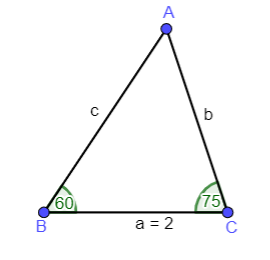
Since Sum of Angle of triangle is 180, we get,
$\angle A+\angle B+\angle C = 180^{\circ}$
$\angle A + 60^{\circ} + 75^{\circ} = 180^{\circ}$
$\angle A = 180^{\circ}-(60^{\circ} + 75^{\circ})$
$\angle A = 180^{\circ}-135^{\circ}$
$\angle A = 45^{\circ}$
From the law of sines we have,
$\dfrac{sin A}{a} = \dfrac{sin B}{b} = \dfrac{sin C}{c}$
We can find the value of b by using the first two ratios,
$\dfrac{sin A}{a} = \dfrac{sin B}{b}$
Substituting the values of a, and we get,
$\dfrac{sin 45^{\circ}}{2} = \dfrac{sin 60^{\circ}}{b}$
$\dfrac{1}{\sqrt{2}}\times \dfrac{1}{2} = \dfrac{\sqrt{3}}{2}\times\dfrac{1}{b}$
$\dfrac{1}{2\sqrt{2}} = \dfrac{\sqrt{3}}{2b}$
$\implies 2b = \sqrt{3}\times2\sqrt{2}$
$\implies b = \sqrt{3}\times\sqrt{2}$
$\implies b = \sqrt{6}$
Therefore, the measure of b is $\sqrt{6}$. So, the answer is Option B.
Note:To solve this question, we have used the law of sines. You may have thought of using the tan ratio for solving the same, but it does not work since the tan ratio works only with the right triangles and the triangle ABC that we have in the question is not a right triangle. It is due to this reason that we used the law of sines to find the value of b.
Formula used:
From the law of sines we have,
$\dfrac{sin A}{a} = \dfrac{sin B}{b} = \dfrac{sin C}{c}$
Complete Step-by-Step : We have triangle ABC and a = 2, B = $60^{\circ}$and C =$75^{\circ}$ .
Since Sum of Angle of triangle is 180, we get,
$\angle A+\angle B+\angle C = 180^{\circ}$
$\angle A + 60^{\circ} + 75^{\circ} = 180^{\circ}$
$\angle A = 180^{\circ}-(60^{\circ} + 75^{\circ})$
$\angle A = 180^{\circ}-135^{\circ}$
$\angle A = 45^{\circ}$
From the law of sines we have,
$\dfrac{sin A}{a} = \dfrac{sin B}{b} = \dfrac{sin C}{c}$
We can find the value of b by using the first two ratios,
$\dfrac{sin A}{a} = \dfrac{sin B}{b}$
Substituting the values of a, and we get,
$\dfrac{sin 45^{\circ}}{2} = \dfrac{sin 60^{\circ}}{b}$
$\dfrac{1}{\sqrt{2}}\times \dfrac{1}{2} = \dfrac{\sqrt{3}}{2}\times\dfrac{1}{b}$
$\dfrac{1}{2\sqrt{2}} = \dfrac{\sqrt{3}}{2b}$
$\implies 2b = \sqrt{3}\times2\sqrt{2}$
$\implies b = \sqrt{3}\times\sqrt{2}$
$\implies b = \sqrt{6}$
Therefore, the measure of b is $\sqrt{6}$. So, the answer is Option B.
Note:To solve this question, we have used the law of sines. You may have thought of using the tan ratio for solving the same, but it does not work since the tan ratio works only with the right triangles and the triangle ABC that we have in the question is not a right triangle. It is due to this reason that we used the law of sines to find the value of b.
Recently Updated Pages
JEE Main 2023 April 6 Shift 1 Question Paper with Answer Key

JEE Main 2023 April 6 Shift 2 Question Paper with Answer Key
JEE Main 2023 (January 31 Evening Shift) Question Paper with Solutions [PDF]
JEE Main 2023 January 30 Shift 2 Question Paper with Answer Key
JEE Main 2023 January 25 Shift 1 Question Paper with Answer Key
JEE Main 2023 January 24 Shift 2 Question Paper with Answer Key
Trending doubts
JEE Main 2026: Session 2 Registration Open, City Intimation Slip, Exam Dates, Syllabus & Eligibility
JEE Main 2026 Application Login: Direct Link, Registration, Form Fill, and Steps
Understanding the Angle of Deviation in a Prism
Hybridisation in Chemistry – Concept, Types & Applications
How to Convert a Galvanometer into an Ammeter or Voltmeter
Understanding the Electric Field of a Uniformly Charged Ring
Other Pages
JEE Advanced Marks vs Ranks 2025: Understanding Category-wise Qualifying Marks and Previous Year Cut-offs
NCERT Solutions For Class 11 Maths Chapter 12 Limits and Derivatives (2025-26)
NCERT Solutions For Class 11 Maths Chapter 10 Conic Sections (2025-26)
JEE Advanced Weightage 2025 Chapter-Wise for Physics, Maths and Chemistry
Derivation of Equation of Trajectory Explained for Students
Understanding Electromagnetic Waves and Their Importance