




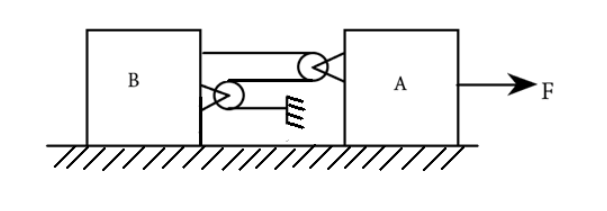
If work done by string on block A is W. shown in the given arrangement, then the work done by the string on block B is
(A) \[ - W\]
(B) \[\dfrac{{ - 2W}}{3}\]
(C) \[\dfrac{{2W}}{3}\]
(D) \[\dfrac{{ - 3W}}{2}\]
Answer
 Verified
270.3k+ views
Hint: The total length of the string is constant. The distance increase from the fixed point of one will result in a corresponding decrease in the other.
Formula used: In this solution we will be using the following formulae;
\[W = Fd\] where \[W\] is the work done by a force on a body, \[F\] is the force acting on a body and \[d\] is the distance moved by the body while the body acts on it.
Complete Step-by-Step Solution:
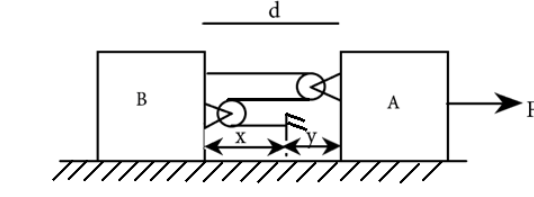
Let the distance between the two blocks be \[d\]. The let the distance of the left block to the fixed point be \[x\], and the distance of the right block to fix point be \[y\] such that their sum is the distance from each other
Hence, if the block A is pulled, then the distance \[y\] changes. But since the total length of the string is constant, the distance \[x\] must reduce correspondingly.
Then \[\Delta y = - \Delta x\]
Now, since it’s the same string, the tensions in each line of the string are all equal to say \[T\]. This means that the total tension acting on block A will be \[2T\] (because the lines connected to A are 2).
Similarity, the tension on the block B will be \[3T\]
Work done on an object is \[W = Fd\] where \[F\] is the force acting on a body and \[d\] is the distance moved by the body while the body acts on it.
Work done on A is
\[W = 2T \times \Delta y\]
\[ \Rightarrow \Delta y = \dfrac{W}{{2T}}\]
Then the work done on B would be
\[W = 3T \times \Delta x = 3T \times - \Delta y\]
\[ \Rightarrow 3T \times - \left( {\dfrac{W}{{2T}}} \right) = - \dfrac{{3W}}{2}\]
Hence the correct option is C
Note: For clarity, we can prove that \[\Delta y = - \Delta x\] as follows.
The distance between the blocks is the sum of \[x\] and \[y\] as in
\[d = x + y\]
By finding the derivative (which gives the instantaneous change of the quantities), we get
\[0 = dx + dy\] (since the length of the string is constant, the distance between the blocks cannot increase)
\[dy= - dx\]
\[ \Rightarrow \Delta y = - \Delta x\]
Formula used: In this solution we will be using the following formulae;
\[W = Fd\] where \[W\] is the work done by a force on a body, \[F\] is the force acting on a body and \[d\] is the distance moved by the body while the body acts on it.
Complete Step-by-Step Solution:
Let the distance between the two blocks be \[d\]. The let the distance of the left block to the fixed point be \[x\], and the distance of the right block to fix point be \[y\] such that their sum is the distance from each other
Hence, if the block A is pulled, then the distance \[y\] changes. But since the total length of the string is constant, the distance \[x\] must reduce correspondingly.
Then \[\Delta y = - \Delta x\]
Now, since it’s the same string, the tensions in each line of the string are all equal to say \[T\]. This means that the total tension acting on block A will be \[2T\] (because the lines connected to A are 2).
Similarity, the tension on the block B will be \[3T\]
Work done on an object is \[W = Fd\] where \[F\] is the force acting on a body and \[d\] is the distance moved by the body while the body acts on it.
Work done on A is
\[W = 2T \times \Delta y\]
\[ \Rightarrow \Delta y = \dfrac{W}{{2T}}\]
Then the work done on B would be
\[W = 3T \times \Delta x = 3T \times - \Delta y\]
\[ \Rightarrow 3T \times - \left( {\dfrac{W}{{2T}}} \right) = - \dfrac{{3W}}{2}\]
Hence the correct option is C
Note: For clarity, we can prove that \[\Delta y = - \Delta x\] as follows.
The distance between the blocks is the sum of \[x\] and \[y\] as in
\[d = x + y\]
By finding the derivative (which gives the instantaneous change of the quantities), we get
\[0 = dx + dy\] (since the length of the string is constant, the distance between the blocks cannot increase)
\[dy= - dx\]
\[ \Rightarrow \Delta y = - \Delta x\]
Recently Updated Pages
Circuit Switching vs Packet Switching: Key Differences Explained

Dimensions of Pressure in Physics: Formula, Derivation & SI Unit
JEE General Topics in Chemistry Important Concepts and Tips
JEE Extractive Metallurgy Important Concepts and Tips for Exam Preparation
JEE Atomic Structure and Chemical Bonding important Concepts and Tips
JEE Amino Acids and Peptides Important Concepts and Tips for Exam Preparation
Trending doubts
JEE Main Marking Scheme 2026- Paper-Wise Marks Distribution and Negative Marking Details
Electron Gain Enthalpy and Electron Affinity Explained
Understanding Instantaneous Velocity
JEE Main Colleges 2026: Complete List of Participating Institutes
Hybridisation in Chemistry – Concept, Types & Applications
Ideal and Non-Ideal Solutions Explained for Class 12 Chemistry
Other Pages
JEE Advanced 2026 Marks vs Rank: Estimate IIT Rank from Your Score
CBSE Notes Class 11 Physics Chapter 9 - Mechanical Properties of Fluids - 2026-27
CBSE Notes Class 11 Physics Chapter 6 - System of Particles and Rotational Motion - 2026-27
A car is moving with speed 30 ms on a circular path class 11 physics JEE_Main
CBSE Notes Class 11 Physics Chapter 11 - Thermodynamics - 2025-26
Understanding Displacement and Velocity Time Graphs