




If the bob of a simple pendulum starts from x = -A at t=0, then, at x = +A, the values of velocity and acceleration will be
(A) v=max and a=0
(B) v=0 and a=0
(C) v=0 and a=max
(D) v=max and a=max
Answer
 Verified
267.9k+ views
Hint At mean position velocity is max as the kinetic energy is max and acceleration is angular which is zero because angle made by the pendulum with the vertical is zero.
Complete step-by-step solution
In an oscillatory motion of a simple pendulum, we know that the kinetic energy of the bob is max at the mean position. Kinetic energy is given by
$K = \dfrac{1}{2}m{v^2}$
As kinetic energy is max only due to velocity, at mean position the velocity is max.
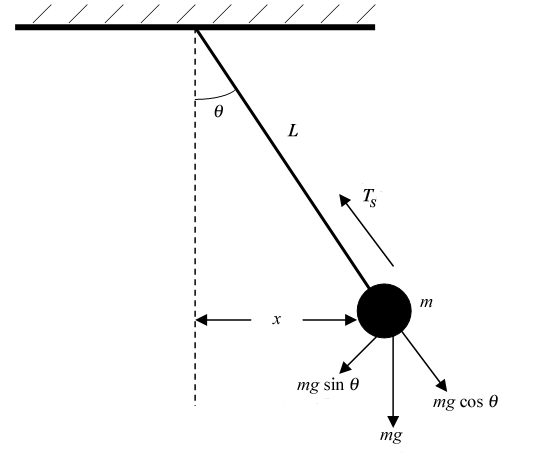
The weight of the bob W=mg is resolved into vector components, the cos component is balanced by the tension of the string and sin component is along the circular path of the pendulum. As the motion is part of the circular motion the acceleration is given by
$\alpha = - \dfrac{{mgL}}{I}\sin \theta $
At mean position θ is zero therefore,
$
\sin 0 = 0 \\
\alpha = 0 \\
$
Hence at mean position, velocity is max and acceleration is zero
correct option is A
Note Kinetic energy is zero at extreme position as velocity is zero and potential energy is maximum. Potential energy is minimum at the mean position which is also the lowest position.
If the motion of the pendulum makes a very small angle, then this motion can be approximated to Simple Harmonics Motion. One will need this information to solve SHM and pendulum involving questions.
Complete step-by-step solution
In an oscillatory motion of a simple pendulum, we know that the kinetic energy of the bob is max at the mean position. Kinetic energy is given by
$K = \dfrac{1}{2}m{v^2}$
As kinetic energy is max only due to velocity, at mean position the velocity is max.
The weight of the bob W=mg is resolved into vector components, the cos component is balanced by the tension of the string and sin component is along the circular path of the pendulum. As the motion is part of the circular motion the acceleration is given by
$\alpha = - \dfrac{{mgL}}{I}\sin \theta $
At mean position θ is zero therefore,
$
\sin 0 = 0 \\
\alpha = 0 \\
$
Hence at mean position, velocity is max and acceleration is zero
correct option is A
Note Kinetic energy is zero at extreme position as velocity is zero and potential energy is maximum. Potential energy is minimum at the mean position which is also the lowest position.
If the motion of the pendulum makes a very small angle, then this motion can be approximated to Simple Harmonics Motion. One will need this information to solve SHM and pendulum involving questions.
Recently Updated Pages
Algebra Made Easy: Step-by-Step Guide for Students

JEE Isolation, Preparation and Properties of Non-metals Important Concepts and Tips for Exam Preparation
JEE Energetics Important Concepts and Tips for Exam Preparation
Chemical Properties of Hydrogen - Important Concepts for JEE Exam Preparation
JEE General Topics in Chemistry Important Concepts and Tips
JEE Amino Acids and Peptides Important Concepts and Tips for Exam Preparation
Trending doubts
JEE Main 2026: Exam Dates, Session 2 Updates, City Slip, Admit Card & Latest News
JEE Main Participating Colleges 2026 - A Complete List of Top Colleges
Understanding the Electric Field of a Uniformly Charged Ring
Derivation of Equation of Trajectory Explained for Students
Understanding Atomic Structure for Beginners
How to Convert a Galvanometer into an Ammeter or Voltmeter
Other Pages
JEE Advanced 2026 Notification Out with Exam Date, Registration (Extended), Syllabus and More
JEE Advanced Percentile vs Marks 2026: JEE Main Cutoff, AIR & IIT Admission Guide
CBSE Notes Class 11 Physics Chapter 1 - Units And Measurements - 2025-26
JEE Advanced 2026 Marks vs Rank: Estimate IIT Rank from Your Score
NCERT Solutions For Class 11 Physics Chapter 1 Units And Measurements - 2025-26
Important Questions For Class 11 Physics Chapter 1 Units and Measurement - 2025-26