




Identify the product Z in the following reaction
\[{C_6}{H_5}N{H_2} \overset{(Ac)_{2}O}{\rightarrow} X \overset{Br_{2}/CCl_{4}}{\rightarrow} Y \overset{HOH}{\rightarrow} Z\]
A. p-Bromoaniline
B. p-Bromoacetophenone
C. o-Bromoacetophenone
D. o-Bromoacetonilide
Answer
 Verified
265.8k+ views
Hint: The reaction takes place in three steps. In the first step acetylation takes place, in the second step bromination takes place in presence of carbon tetrachloride and in the third step hydrolysis takes place to form the final product Z.
Complete Step by Step Solution:
In the first step, aniline reacts with acetic anhydride to form an acetylated compound known as N-phenylacetamide. Acetylation is a reaction where an acetyl group is introduced to the reactant. In the first step, the amine is getting converted to an amide.
In the second step, N-phenylacetamide reacts with bromine in presence of carbon tetrachloride to form N-(4-bromophenyl)acetamide. The reaction is known as a bromination reaction where bromine is added to the para position of the reactant.
In the third step, N-(4-bromophenyl)acetamide undergoes hydrolysis to form 4-bromobenzenamine or P-Bromoaniline. Hydrolysis is a reaction where one of the reactants. Here, the amide group is again converted to an amine group.
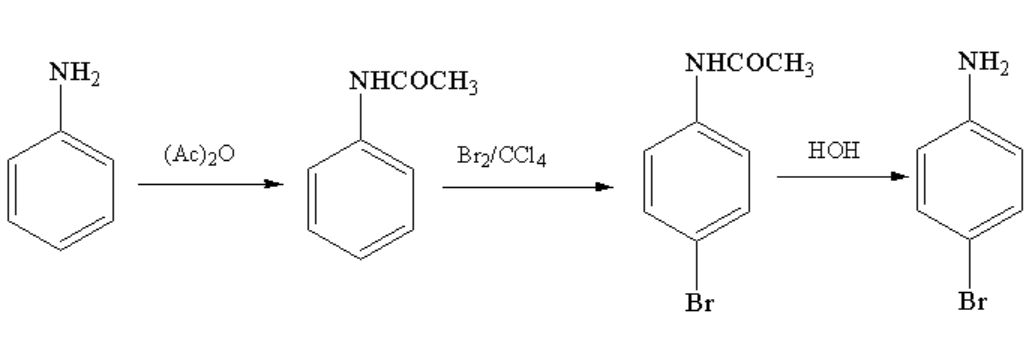
Image: Formation of P-Bromoaniline
Thus, X is N-phenylacetanamide, Y is N-(4-bromophenyl)acetamide, Z is p-bromoaniline.
Therefore the correct option is A.
Note: It should be noted that aniline is an o- and p- directing group. The lone pair of electrons present in the amine group is delocalised by the resonance with the benzene ring forming a negative charge at the ortho and para position in the resonating structure. Ortho and para directing groups are generally electrons donor whereas the meta directing groups are electron acceptors.
Complete Step by Step Solution:
In the first step, aniline reacts with acetic anhydride to form an acetylated compound known as N-phenylacetamide. Acetylation is a reaction where an acetyl group is introduced to the reactant. In the first step, the amine is getting converted to an amide.
In the second step, N-phenylacetamide reacts with bromine in presence of carbon tetrachloride to form N-(4-bromophenyl)acetamide. The reaction is known as a bromination reaction where bromine is added to the para position of the reactant.
In the third step, N-(4-bromophenyl)acetamide undergoes hydrolysis to form 4-bromobenzenamine or P-Bromoaniline. Hydrolysis is a reaction where one of the reactants. Here, the amide group is again converted to an amine group.
Image: Formation of P-Bromoaniline
Thus, X is N-phenylacetanamide, Y is N-(4-bromophenyl)acetamide, Z is p-bromoaniline.
Therefore the correct option is A.
Note: It should be noted that aniline is an o- and p- directing group. The lone pair of electrons present in the amine group is delocalised by the resonance with the benzene ring forming a negative charge at the ortho and para position in the resonating structure. Ortho and para directing groups are generally electrons donor whereas the meta directing groups are electron acceptors.
Recently Updated Pages
JEE Main Mock Test 2025-26: Principles Related To Practical

JEE Main 2025-26 Organic Compounds Containing Nitrogen Mock Test
JEE Main Chemical Kinetics Mock Test 2025-26: Free Practice Online
JEE Main 2025-26 Organic Compounds Containing Oxygen Mock Test
JEE Main 2025-26 Mock Test: Organic Compounds Containing Oxygen
JEE Main 2025-26 Organic Compounds Containing Halogens Mock Test
Trending doubts
JEE Main 2026: Exam Dates, Session 2 Updates, City Slip, Admit Card & Latest News
JEE Main Participating Colleges 2026 - A Complete List of Top Colleges
Hybridisation in Chemistry – Concept, Types & Applications
Understanding the Electric Field of a Uniformly Charged Ring
Derivation of Equation of Trajectory Explained for Students
Understanding Atomic Structure for Beginners
Other Pages
JEE Advanced 2026 Notification Out with Exam Date, Registration (Extended), Syllabus and More
JEE Advanced Percentile vs Marks 2026: JEE Main Cutoff, AIR & IIT Admission Guide
CBSE Class 12 Chemistry Question Paper 2026 PDF Download (All Sets) with Answer Key
NCERT Solutions For Class 12 Chemistry Chapter 2 Electrochemistry - 2025-26
NCERT Solutions For Class 12 Chemistry Chapter 1 Solutions - 2025-26
NCERT Solutions For Class 12 Chemistry Chapter 3 Chemical Kinetics - 2025-26