




Give the IUPAC names of the following ethers:
Given ether:
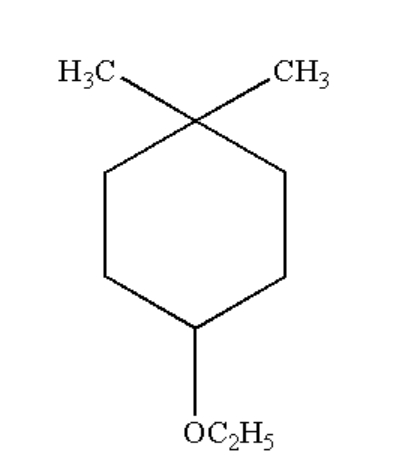
Answer
 Verified
268.2k+ views
Hint: First determine the parent chain containing a maximum number of carbon atoms. Cycloalkanes are cyclic compounds where no double bonding or triple bonding is present. In IUPAC naming the term is used as a suffix.
Complete step by step solution:
Ether functional groups consisting of chemical compounds are determined by the general formula $R - O - R'$ , where R is the alkyl group.
International Union of Pure and Applied Chemistry are the sets of rules that are applied to determine the chemical name of the compound. This is known as the IUPAC naming system.
The given chemical compound is shown below.
Numbering of Carbon atom
2. Determination of names and position of locants: In the given compound, one “Ethoxy” group is attached to the 4th position and two “Methyl” groups are attached to the first position.
3. Determination of suffix: As there is no availability of double or triple bonds, it is considered a saturated hydrocarbon. The suffix used will be “ane”.
The IUPAC name will be 4-ethoxy-1,1-dimethylcyclohexane.
Hence, the answer is “4-ethoxy-1,1-dimethylcyclohexane”.
Note: The group with less number of carbon atoms attached to the oxygen is treated as a substituent group whereas the group comprising more number of carbon atoms is considered as the parent group. Always the substituent group is written prior to the parent group. As the ethyl group is attached to the oxygen atom, therefore the substituent group is termed “Ethoxy”.
Complete step by step solution:
Ether functional groups consisting of chemical compounds are determined by the general formula $R - O - R'$ , where R is the alkyl group.
International Union of Pure and Applied Chemistry are the sets of rules that are applied to determine the chemical name of the compound. This is known as the IUPAC naming system.
The given chemical compound is shown below.
Numbering of Carbon atom
- 1. Determination of Root Word: In the given compound, the maximum number of carbon atoms present in a continuous chain is 6, so the hydrocarbon is hexane and the root word is “Hex”. As it is a cyclic compound then the hydrocarbon will be referred to as cyclohexane.
The IUPAC name will be 4-ethoxy-1,1-dimethylcyclohexane.
Hence, the answer is “4-ethoxy-1,1-dimethylcyclohexane”.
Note: The group with less number of carbon atoms attached to the oxygen is treated as a substituent group whereas the group comprising more number of carbon atoms is considered as the parent group. Always the substituent group is written prior to the parent group. As the ethyl group is attached to the oxygen atom, therefore the substituent group is termed “Ethoxy”.
Recently Updated Pages
Algebra Made Easy: Step-by-Step Guide for Students

JEE Isolation, Preparation and Properties of Non-metals Important Concepts and Tips for Exam Preparation
JEE Energetics Important Concepts and Tips for Exam Preparation
Chemical Properties of Hydrogen - Important Concepts for JEE Exam Preparation
JEE General Topics in Chemistry Important Concepts and Tips
JEE Amino Acids and Peptides Important Concepts and Tips for Exam Preparation
Trending doubts
JEE Main 2026: Exam Dates, Session 2 Updates, City Slip, Admit Card & Latest News
JEE Main Participating Colleges 2026 - A Complete List of Top Colleges
Understanding the Electric Field of a Uniformly Charged Ring
Derivation of Equation of Trajectory Explained for Students
Understanding Atomic Structure for Beginners
How to Convert a Galvanometer into an Ammeter or Voltmeter
Other Pages
JEE Advanced 2026 Notification Out with Exam Date, Registration (Extended), Syllabus and More
JEE Advanced Percentile vs Marks 2026: JEE Main Cutoff, AIR & IIT Admission Guide
JEE Advanced 2026 Marks vs Rank: Estimate IIT Rank from Your Score
JEE Advanced Weightage Chapter Wise 2026 for Physics, Chemistry, and Mathematics
NCERT Solutions For Class 11 Chemistry In Hindi Chapter 1 Some Basic Concepts Of Chemistry - 2025-26
Understanding Electromagnetic Waves and Their Importance