



Dev Uthani Ekadashi 2026: 20 or 21 November? Check Date and Timings
Dev Uthani Ekadashi 2026 will be observed on Friday, 20 November, while Gauna or Vaishnava Ekadashi falls on Saturday, 21 November 2026. Also known as Prabodhini Ekadashi or Devutthana Ekadashi, this Hindu festival marks the traditional awakening of Lord Vishnu after four months of Yoga Nidra during Chaturmas.
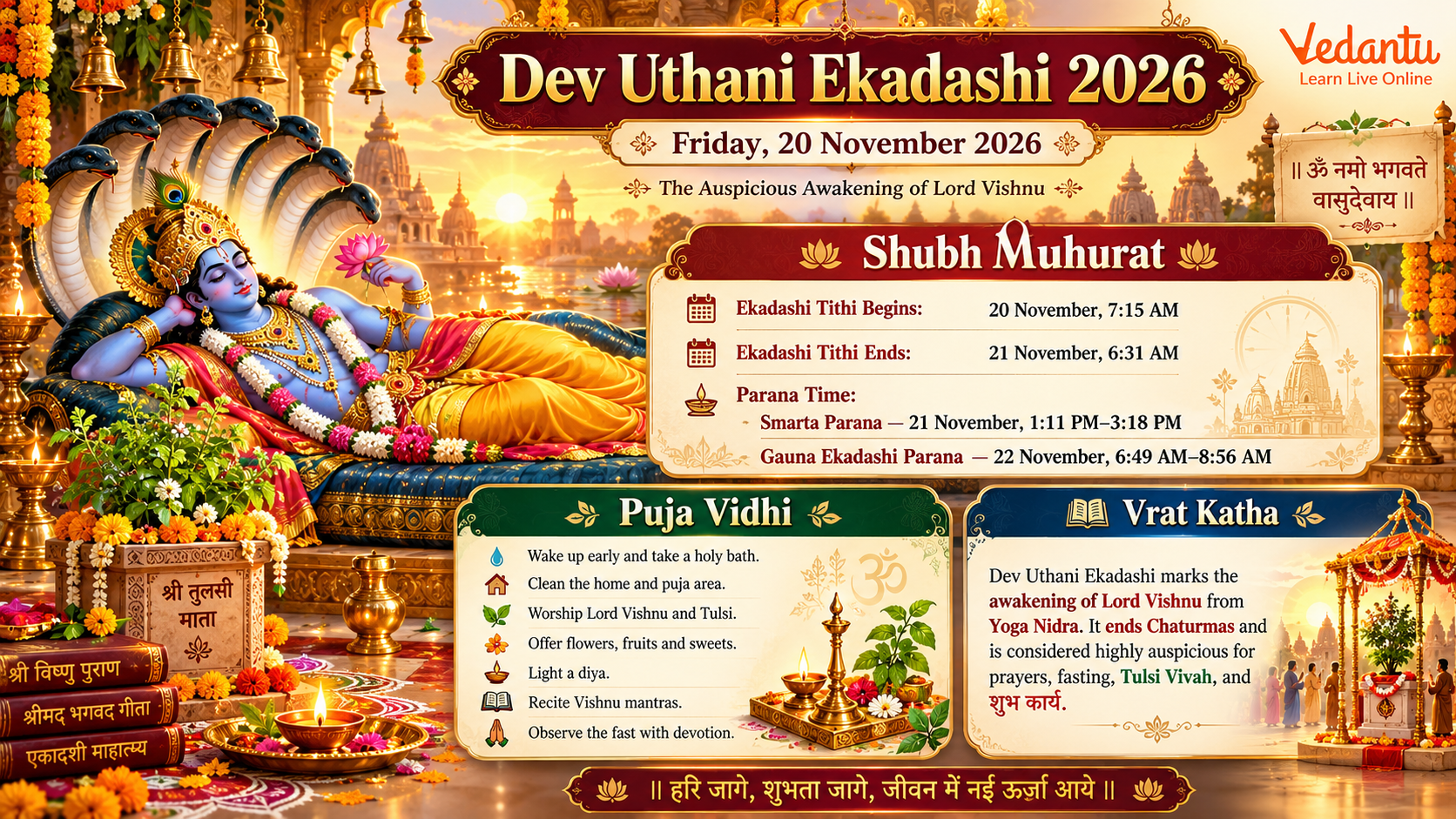
Dev Uthani Ekadashi is associated with Lord Vishnu's worship, fasting, Tulsi Vivah, and the traditional beginning of the Hindu wedding season. Devotees perform puja, listen to the Vrat Katha, offer prayers, and break their fast during the prescribed Parana time.
When Is Dev Uthani Ekadashi in 2026?
Dev Uthani Ekadashi 2026 is on Friday, 20 November for Smarta devotees and Saturday, 21 November for those following the Gauna or Vaishnava observance.
For readers searching “Dev Uthani Ekadashi kab hai 2026,” the main date is 20 November. The alternate fasting date is 21 November, depending on religious tradition.
Dev Uthani Ekadashi 2026 Date and Important Details
Note: The Parana timings above are for New Delhi, India, according to Drik Panchang. Exact timings vary by city.
Dev Uthani Ekadashi 2026: Is It on 20 or 21 November?
Many devotees are confused about the Dev Uthani Ekadashi 2026 date because different Hindu traditions observe fasting on different days.
According to Drik Panchang, the Smarta observance is on Friday, 20 November, while Gauna or Vaishnava Ekadashi is on Saturday, 21 November.
The difference comes from the traditional rules used to determine fasting dates based on Ekadashi Tithi, sunrise, and the following Dwadashi.
Smarta vs Vaishnava Ekadashi 2026
Most general festival calendars highlight 20 November as the main date. Devotees should follow their family tradition or local Panchang when determining the appropriate fasting day.
Dev Uthani Ekadashi 2026 Shubh Muhurat, Tithi and Parana Time
Dev Uthani Ekadashi falls on Kartik Shukla Paksha Ekadashi. The Tithi begins on the morning of 20 November and ends on the morning of 21 November 2026.
Dev Uthani Ekadashi 2026 Tithi and Parana Timings
These times are based on the New Delhi Panchang.
Dev Uthani Ekadashi Ka Paran Kab Hai?
Dev Uthani Ekadashi ka Paran 21 November 2026 ko dopahar 1:11 PM se 3:18 PM tak hoga, for devotees observing the Smarta fast in New Delhi.
Those observing Gauna or Vaishnava Ekadashi on 21 November will perform Parana on 22 November, during their prescribed local timing.
Why Is Dev Uthani Ekadashi Parana in the Afternoon in 2026?
Parana means breaking the Ekadashi fast. Traditionally, Parana is performed during Dwadashi Tithi after Hari Vasara, the first quarter of Dwadashi, has ended.
In 2026, Hari Vasara ends at approximately 12:07 PM on 21 November. Therefore, the prescribed Smarta Parana window in New Delhi falls in the afternoon, from 1:11 PM to 3:18 PM.
This is different from the commonly followed morning Parana schedule and is an important detail for devotees planning the fast.
Why Is Dev Uthani Ekadashi Celebrated?
Dev Uthani Ekadashi is celebrated because Lord Vishnu is traditionally believed to awaken from his four-month Yoga Nidra on this day. The occasion marks the end of Chaturmas and the traditional resumption of auspicious ceremonies.
According to Hindu religious beliefs, Lord Vishnu enters Yoga Nidra on Devshayani Ekadashi during the month of Ashadha and awakens on Prabodhini Ekadashi during Kartik.
Significance of Dev Uthani Ekadashi
1. Awakening of Lord Vishnu
The festival marks the symbolic awakening of Lord Vishnu after four months of divine rest.
2. End of Chaturmas
Chaturmas is a period associated with prayer, fasting, devotion, and spiritual discipline. Dev Uthani Ekadashi traditionally marks its conclusion.
3. Beginning of Auspicious Ceremonies
Many Hindu communities resume planning weddings, engagements, housewarmings, and other ceremonies after Dev Uthani Ekadashi, subject to suitable muhurats.
4. Importance of Tulsi Worship
Tulsi is considered sacred in Hindu traditions and is closely associated with Lord Vishnu. Tulsi Vivah is celebrated during this period.
5. Spiritual Discipline and Devotion
Devotees observe fasting, perform puja, recite prayers, and participate in devotional activities as expressions of faith.
Dev Uthani Ekadashi Vrat Katha: Story of Lord Vishnu's Awakening
The Dev Uthani Ekadashi Vrat Katha is traditionally associated with Lord Vishnu's divine rest during Chaturmas and his awakening on Kartik Shukla Ekadashi.
According to Hindu tradition, Lord Vishnu enters Yoga Nidra on Devshayani Ekadashi and rests upon Sheshnag in Kshir Sagar, the cosmic ocean of milk.
During this four-month period, devotees observe religious practices, fasting, and prayers. Many communities traditionally avoid conducting major auspicious ceremonies such as weddings.
On Dev Uthani Ekadashi, Lord Vishnu is believed to awaken from his Yoga Nidra. His awakening symbolises renewal, positive beginnings, and the traditional reopening of the auspicious ceremonial season.
Devotees welcome the Lord by lighting diyas, ringing bells, blowing the conch, singing devotional songs, and offering Tulsi leaves, flowers, and seasonal fruits.
The occasion is also connected with Tulsi Vivah, the ceremonial marriage of Tulsi Mata and Lord Vishnu in his Shaligram form.
What Is the Message of Dev Uthani Ekadashi Ki Katha?
The traditional story highlights the importance of faith, devotion, discipline, patience, and new beginnings.
Different regions also narrate other stories during Dev Uthani Ekadashi, including folk tales about sincere devotion and the story of Tulsi and Vrinda.
Families may follow the version of the Dev Uthani Ekadashi Katha preserved in their religious tradition.
Dev Uthani Ekadashi Puja Vidhi 2026: How to Perform Puja at Home
Dev Uthani Ekadashi Puja Vidhi includes cleaning the worship area, offering prayers to Lord Vishnu, observing the fast according to tradition, listening to the Vrat Katha, and performing Parana at the prescribed time.
Step-by-Step Dev Uthani Ekadashi Puja Vidhi
Step 1: Wake Up Early and Take a Bath
Begin the day by bathing and wearing clean clothes. Clean the home and prepare the puja area.
Step 2: Take Sankalp for the Vrat
Offer prayers to Lord Vishnu and take a Sankalp, or religious resolve, to observe the fast according to your family's tradition and personal capacity.
Step 3: Prepare the Puja Area
Place an image or idol of Lord Vishnu in a clean space. Decorate the area with flowers, diyas, rangoli, and traditional offerings.
Step 4: Offer Tulsi Leaves and Flowers
Devotees traditionally offer Tulsi leaves, yellow flowers, seasonal fruits, and other suitable items to Lord Vishnu.
Step 5: Perform Vishnu Puja
Light a diya, offer incense, and recite Lord Vishnu's names or devotional prayers.
Step 6: Welcome Lord Vishnu's Awakening
In many households, bells, conches, and devotional songs are used to symbolically welcome Lord Vishnu's awakening.
Step 7: Read or Listen to the Vrat Katha
Read the Dev Uthani Ekadashi Vrat Katha and perform aarti according to family customs.
Step 8: Complete the Fast with Parana
Break the fast during the prescribed Parana time on the appropriate date. The exact procedure may vary according to religious tradition.
Dev Uthani Ekadashi Vrat Rules and Fasting Food
The Dev Uthani Ekadashi Vrat is observed as an act of devotion to Lord Vishnu. Some devotees observe a strict fast, while others follow a partial or Phalahar fast.
What Can Devotees Eat During Dev Uthani Ekadashi Vrat?
Fasting customs differ by household and religious tradition.
Health consideration: Waterless fasting can cause dehydration and may be unsafe, particularly for children, pregnant people, older adults, and those with medical conditions or taking medication. A safe, modified observance can be discussed with a healthcare professional.
Tulsi Vivah 2026: Date, Rituals and Significance
Tulsi Vivah 2026 will be observed on Saturday, 21 November, according to Drik Panchang's New Delhi calendar.
Tulsi Vivah is the symbolic marriage of the sacred Tulsi plant with Lord Vishnu in the form of Shaligram or an image of Lord Vishnu or Krishna.
Tulsi Vivah 2026 Date and Tithi
Some communities perform Tulsi Vivah on Ekadashi itself or on another date between Prabodhini Ekadashi and Kartik Purnima.
How Is Tulsi Vivah Celebrated?
The Tulsi plant is decorated with flowers, a red chunri, and traditional ornaments.
A small mandap may be prepared using sugarcane and other decorations.
Shaligram or an image of Lord Vishnu is placed beside the Tulsi plant.
Devotees perform prayers, offer sweets and fruits, and celebrate the symbolic wedding ceremony.
Family members gather for aarti and distribution of prasad.
Why Do Weddings Begin After Dev Uthani Ekadashi?
Dev Uthani Ekadashi traditionally marks the end of Chaturmas, a period during which many Hindu communities avoid major auspicious ceremonies.
According to religious belief, Lord Vishnu's awakening signals the return of an auspicious period.
As a result, families traditionally begin planning:
Weddings and engagements.
Griha Pravesh or housewarming ceremonies.
Mundan and other family rituals.
Religious celebrations and community ceremonies.
However, Dev Uthani Ekadashi does not mean that every following date is automatically auspicious. Families generally consult a Panchang to select a suitable muhurat for individual ceremonies.
Dev Uthani Ekadashi Rangoli and Drawing Ideas
Creating a Dev Uthani Ekadashi rangoli or drawing is a simple way for students and families to understand the festival's religious and cultural symbols.
Dev Uthani Ekadashi Rangoli Ideas
Easy Dev Uthani Ekadashi Drawing for Students
For a school activity, students can draw Lord Vishnu resting on Sheshnag with a peaceful ocean in the background.
Another simple Dev Uthani Ekadashi drawing can show a decorated Tulsi plant, diyas, sugarcane, flowers, and a small puja mandap.
Students can write "Dev Uthani Ekadashi 2026 – A Festival of New Beginnings" above the artwork.
These drawings can be used for classroom activities, festival posters, greeting cards, and cultural presentations.
Dev Uthani Ekadashi Wishes and Greetings for 2026
Sharing Dev Uthani Ekadashi wishes is a thoughtful way to celebrate the festival with family and friends.
Happy Dev Uthani Ekadashi Wishes in English
Happy Dev Uthani Ekadashi 2026! May Lord Vishnu bless your family with peace, happiness, and prosperity.
May the awakening of Lord Vishnu bring new hope, positivity, and happiness into your life.
Wishing you a joyful Dev Uthani Ekadashi filled with faith, devotion, and meaningful beginnings.
May this auspicious occasion inspire kindness, patience, and peace in your life.
Happy Prabodhini Ekadashi! May your home be filled with happiness and harmony.
Dev Uthani Ekadashi Wishes in Hindi
देवउठनी एकादशी की हार्दिक शुभकामनाएँ! भगवान विष्णु की कृपा आपके परिवार पर सदैव बनी रहे।
देवउठनी एकादशी के पावन अवसर पर आपके जीवन में सुख, शांति और समृद्धि बनी रहे।
भगवान श्रीहरि के जागरण का यह शुभ दिन आपके जीवन में नई उम्मीदें और खुशियाँ लेकर आए।
देवोत्थान एकादशी की शुभकामनाएँ! आपके सभी शुभ कार्य मंगलमय हों।
प्रभु श्रीहरि की कृपा से आपका जीवन खुशियों और सकारात्मक ऊर्जा से भर जाए।
These original greetings can be shared through greeting cards, festival images, and personal messages.
Conclusion
Dev Uthani Ekadashi 2026 will be observed on Friday, 20 November, while Gauna or Vaishnava Ekadashi falls on Saturday, 21 November. The festival celebrates the traditional awakening of Lord Vishnu after Chaturmas and is associated with Tulsi Vivah, devotional fasting, and the beginning of auspicious ceremonies.
Devotees observing the Smarta fast in New Delhi can perform Parana on 21 November from 1:11 PM to 3:18 PM, while Gauna Ekadashi Parana is scheduled for 22 November.
Understanding the correct Dev Uthani Ekadashi date, Puja Vidhi, Vrat Katha, and Parana timings helps devotees follow their traditions with clarity. Always consult a local Panchang for city-specific timings.
FAQs on Dev Uthani Ekadashi 2026: Date, Shubh Muhurat, Parana Time, Puja Vidhi and Vrat Katha
1. When is Dev Uthani Ekadashi in 2026?
Dev Uthani Ekadashi 2026 falls on Friday, 20 November, while Gauna or Vaishnava Ekadashi will be observed on Saturday, 21 November 2026.
2. Dev Uthani Ekadashi kab hai 2026?
Dev Uthani Ekadashi 2026 20 November, Shukravar ko hai. Gauna ya Vaishnava Ekadashi 21 November, Shanivar ko manayi jayegi.
3. Dev Uthani Ekadashi kab ki hai?
Dev Uthani Ekadashi ka mukhya vrat 20 November 2026 ko rakha jayega. Vaishnava parampara mein 21 November ko vrat rakha jayega.
4. Dev Uthani Ekadashi 2026 mein kab hai?
2026 mein Dev Uthani Ekadashi 20 November ko hai, aur Gauna Ekadashi 21 November ko hogi. Yeh Kartik Shukla Paksha ki Ekadashi hai.
5. What is the Dev Uthani Ekadashi 2026 date and Tithi?
Dev Uthani Ekadashi is on 20 November 2026. Ekadashi Tithi begins at 7:15 AM on 20 November and ends at 6:31 AM on 21 November.
6. Why is Dev Uthani Ekadashi celebrated?
Dev Uthani Ekadashi is celebrated because Lord Vishnu is traditionally believed to awaken from his four-month Yoga Nidra. It marks the end of Chaturmas and the traditional return of auspicious ceremonies.
7. Dev Uthani Ekadashi ka Paran kab hai?
Smarta Dev Uthani Ekadashi ka Paran 21 November 2026 ko dopahar 1:11 PM se 3:18 PM tak hoga, according to the New Delhi Panchang.
8. When is Vaishnava Ekadashi Parana in 2026?
Vaishnava or Gauna Dev Uthani Ekadashi Parana will be performed on Sunday, 22 November 2026. The New Delhi Parana window is 6:49 AM to 8:56 AM.
9. Why are there two dates for Dev Uthani Ekadashi 2026?
The two dates arise because Smarta and Vaishnava traditions follow different religious calendar rules when determining the fasting day. Smarta devotees observe 20 November, while Vaishnava devotees observe 21 November.
10. What is the Dev Uthani Ekadashi Vrat Katha?
The traditional Dev Uthani Ekadashi Katha describes Lord Vishnu's awakening after four months of Yoga Nidra during Chaturmas. The occasion symbolises spiritual renewal and auspicious beginnings.
11. How is Dev Uthani Ekadashi Puja Vidhi performed?
Devotees traditionally bathe, clean the worship area, take Sankalp, offer Tulsi leaves and flowers to Lord Vishnu, recite devotional prayers, listen to the Vrat Katha, and complete the fast during Parana.
12. When is Tulsi Vivah 2026?
Tulsi Vivah 2026 will be observed on Saturday, 21 November, according to Drik Panchang's New Delhi calendar. Some religious traditions follow different dates within the observance period.
13. What can devotees eat during Dev Uthani Ekadashi Vrat?
Many devotees consume fruits, milk, sabudana, singhara, sweet potatoes, and other fasting foods. Rice and regular grains are traditionally avoided. Fasting practices vary according to personal health and family traditions.
14. What is the significance of Dev Uthani Ekadashi in November 2026?
Dev Uthani Ekadashi marks Lord Vishnu's symbolic awakening, the end of Chaturmas, and the traditional resumption of weddings and other auspicious ceremonies. It is also associated with Tulsi Vivah.
15. What are some easy Dev Uthani Ekadashi rangoli and drawing ideas?
Students can create rangoli or drawings featuring Lord Vishnu, Shankh, Chakra, diyas, a decorated Tulsi plant, or a Tulsi Vivah mandap. These designs are suitable for school activities and festive decorations.


