




Four particles of masses m, 2m, 3m and 4m are placed at the corners of a square of side of length ‘a’. The gravitational force on a particle of mass m placed at the centre of the square is
A) \[4\sqrt 2 \dfrac{{G{m^2}}}{{{a^2}}}\]
B) $3\sqrt 2 \dfrac{{G{m^2}}}{{{a^2}}}$
C) $2\sqrt 2 \dfrac{{G{m^2}}}{{{a^2}}}$
D) $\sqrt 2 \dfrac{{G{m^2}}}{{{a^2}}}$
Answer
 Verified
300.3k+ views
Hint: Recall Newton’s law of universal gravitation. According to this law, every object attracts other objects in the universe. The force of attraction points in a straight line between the centre of both the objects. It is directly proportional to the mass of the objects and inversely proportional to the square of distance between them.
Complete step by step solution:
The formula for gravitational force is given by
$F = \dfrac{{G{m_1}{m_2}}}{{{r^2}}}$
Where G is the gravitational force
${m_1}$ is the mass of the first object
${m_2}$ is the mass of the second object
And ‘r’ is the distance between them
Given that the length of each side of the square is = a
The distance of each corner from the centre will be $ = \dfrac{a}{{\sqrt 2 }}$
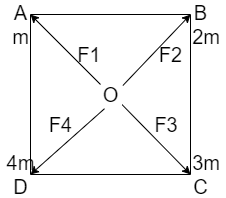
The gravitational force on point O due to point A is given by
\[\Rightarrow {F_1} = \dfrac{{Gmm}}{{{{(\dfrac{a}{{\sqrt 2 }})}^2}}} = \dfrac{{2G{m^2}}}{{{a^2}}}\]
Similarly, the gravitational force on point O due to point B is written as
$\Rightarrow {F_2} = \dfrac{{G(2m)(m)}}{{{{(\dfrac{a}{{\sqrt 2 }})}^2}}} = \dfrac{{4G{m^2}}}{{{a^2}}}$
The gravitational force on point O due to point C will be
$\Rightarrow {F_3} = \dfrac{{G(3m)(m)}}{{{{(\dfrac{a}{{\sqrt 2 }})}^2}}} = \dfrac{{6G{m^2}}}{{{a^2}}}$
The gravitational force on point O due to point D will be
$\Rightarrow {F_4} = \dfrac{{G(4m)(m)}}{{{{(\dfrac{a}{{\sqrt 2 }})}^2}}} = \dfrac{{8G{m^2}}}{{{a^2}}}$
The net force of ${F_1}$and ${F_3}$on point O is given by
$\Rightarrow {F_{13}} = {F_3} - {F_1}$
$\Rightarrow {F_{13}} = \dfrac{{6G{m^2}}}{{{a^2}}} - \dfrac{{2G{m^2}}}{{{a^2}}} = \dfrac{{4G{m^2}}}{{{a^2}}}$
Similarly, the force of ${F_2}$and${F_4}$on point O is given by
$\Rightarrow {F_{24}} = {F_4} - {F_2}$
$\Rightarrow {F_{24}} = \dfrac{{8G{m^2}}}{{{a^2}}} - \dfrac{{4G{m^2}}}{{{a^2}}} = \dfrac{{4G{m^2}}}{{{a^2}}}$
The magnitude of net force on point O is given by
$\Rightarrow F = \sqrt {{{({F_{13}})}^2} + {{({F_{24}})}^2}} $
$\Rightarrow F = \sqrt {{{(\dfrac{{4G{m^2}}}{{{a^2}}})}^2} + {{(\dfrac{{4G{m^2}}}{{{a^2}}})}^2}} $
$\Rightarrow F = \sqrt {2.\dfrac{{4{G^2}{m^4}}}{{{a^4}}}} $
\[\Rightarrow F = 2\sqrt 2 \dfrac{{G{m^2}}}{{{a^2}}}\]
Option C is the right answer.
Note: It is important to note that since the force of gravitation is directly proportional to the mass of the object, so an object with more mass will have a large force of gravitation. But it varies inversely with the square of distance, so if the distance is doubled the force of gravitation will decrease by 4 times and so on.
Complete step by step solution:
The formula for gravitational force is given by
$F = \dfrac{{G{m_1}{m_2}}}{{{r^2}}}$
Where G is the gravitational force
${m_1}$ is the mass of the first object
${m_2}$ is the mass of the second object
And ‘r’ is the distance between them
Given that the length of each side of the square is = a
The distance of each corner from the centre will be $ = \dfrac{a}{{\sqrt 2 }}$
The gravitational force on point O due to point A is given by
\[\Rightarrow {F_1} = \dfrac{{Gmm}}{{{{(\dfrac{a}{{\sqrt 2 }})}^2}}} = \dfrac{{2G{m^2}}}{{{a^2}}}\]
Similarly, the gravitational force on point O due to point B is written as
$\Rightarrow {F_2} = \dfrac{{G(2m)(m)}}{{{{(\dfrac{a}{{\sqrt 2 }})}^2}}} = \dfrac{{4G{m^2}}}{{{a^2}}}$
The gravitational force on point O due to point C will be
$\Rightarrow {F_3} = \dfrac{{G(3m)(m)}}{{{{(\dfrac{a}{{\sqrt 2 }})}^2}}} = \dfrac{{6G{m^2}}}{{{a^2}}}$
The gravitational force on point O due to point D will be
$\Rightarrow {F_4} = \dfrac{{G(4m)(m)}}{{{{(\dfrac{a}{{\sqrt 2 }})}^2}}} = \dfrac{{8G{m^2}}}{{{a^2}}}$
The net force of ${F_1}$and ${F_3}$on point O is given by
$\Rightarrow {F_{13}} = {F_3} - {F_1}$
$\Rightarrow {F_{13}} = \dfrac{{6G{m^2}}}{{{a^2}}} - \dfrac{{2G{m^2}}}{{{a^2}}} = \dfrac{{4G{m^2}}}{{{a^2}}}$
Similarly, the force of ${F_2}$and${F_4}$on point O is given by
$\Rightarrow {F_{24}} = {F_4} - {F_2}$
$\Rightarrow {F_{24}} = \dfrac{{8G{m^2}}}{{{a^2}}} - \dfrac{{4G{m^2}}}{{{a^2}}} = \dfrac{{4G{m^2}}}{{{a^2}}}$
The magnitude of net force on point O is given by
$\Rightarrow F = \sqrt {{{({F_{13}})}^2} + {{({F_{24}})}^2}} $
$\Rightarrow F = \sqrt {{{(\dfrac{{4G{m^2}}}{{{a^2}}})}^2} + {{(\dfrac{{4G{m^2}}}{{{a^2}}})}^2}} $
$\Rightarrow F = \sqrt {2.\dfrac{{4{G^2}{m^4}}}{{{a^4}}}} $
\[\Rightarrow F = 2\sqrt 2 \dfrac{{G{m^2}}}{{{a^2}}}\]
Option C is the right answer.
Note: It is important to note that since the force of gravitation is directly proportional to the mass of the object, so an object with more mass will have a large force of gravitation. But it varies inversely with the square of distance, so if the distance is doubled the force of gravitation will decrease by 4 times and so on.
Recently Updated Pages
Four persons A B C and D initially at the corners of class 11 physics JEE_Main

What is the difference between Conduction and conv class 11 physics JEE_Main
Moment of inertia of solid sphere about its diameter class 11 physics JEE_Main
If a piece of ice floating on the surface of water class 11 physics JEE_Main
At what temperature speed of sound in air will be doubled class 11 physics JEE_Main
A closed organ pipe and an open organ pipe are tuned class 11 physics JEE_Main
Trending doubts
JEE Main 2026: Exam Dates, Session 2 Updates, City Slip, Admit Card & Latest News
Understanding the Electric Field of a Uniformly Charged Ring
Electron Gain Enthalpy and Electron Affinity Explained
Derivation of Equation of Trajectory Explained for Students
Understanding Atomic Structure for Beginners
How to Convert a Galvanometer into an Ammeter or Voltmeter
Other Pages
CBSE Notes Class 11 Physics Chapter 1 - Units And Measurements - 2026-27 PDF Download (Login Required)
NCERT Solutions For Class 11 Physics Chapter 1 Units And Measurements - 2026-27 Free PDF Download (Login Required)
NCERT Solutions For Class 11 Physics Chapter 2 Motion In A Straight Line - 2026-27 Free PDF Download (Login Required)
Important Questions For Class 11 Physics Chapter 1 Units and Measurement - 2026-27 Free PDF Download (Sign-in Required)
CBSE Notes Class 11 Physics Chapter 2 - Motion in a Straight Line - 2026-27 PDF Download (Login Required)
NCERT Solutions For Class 11 Physics Chapter 3 Motion In A Plane - 2026-27 Free PDF Download (Sign-in Required)
CBSE Notes Class 11 Physics Chapter 1 - Units And Measurements - 2026-27 PDF Download (Login Required)
NCERT Solutions For Class 11 Physics Chapter 1 Units And Measurements - 2026-27 Free PDF Download (Login Required)
NCERT Solutions For Class 11 Physics Chapter 2 Motion In A Straight Line - 2026-27 Free PDF Download (Login Required)