




Find the entire length of the cardioid $r=a\left( 1+\cos \theta \right)$. Also, show that the upper half is bisected by $\theta =\dfrac{\pi }{3}$.
Answer
 Verified
259.2k+ views
Hint: First, by using the formula of the length(L) of the cardioids is given by $L=2\int\limits_{0}^{\pi }{\sqrt{\left( {{r}^{2}}+{{\left( \dfrac{dr}{d\theta } \right)}^{2}} \right)}d\theta }$. Then, to get the length L of the cardioids, we need to solve the above expression by substituting the value of r and $\dfrac{dr}{d\theta }$. Then, by using some of the basic properties of the trigonometric functions, we get the length of the upper half and its bisection angle also.
Complete step-by-step solution:
In this question, we are supposed to find the entire length of the cardioid $r=a\left( 1+\cos \theta \right)$.
So, before proceeding for this, we must know that the cardioids is symmetrical about the initial line, and for its upper half, $\theta $ goes on increasing from 0 to $\pi $.
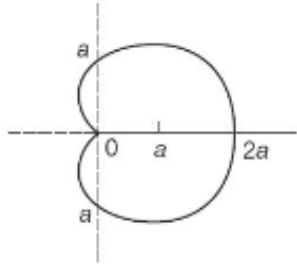
So, it gives rise to the following condition by differentiating the given cardioids function as:
$\begin{align}
& \dfrac{dr}{d\theta }=\dfrac{d}{d\theta }a\left( 1+\cos \theta \right) \\
& \Rightarrow \dfrac{dr}{d\theta }=-a\sin \theta \\
\end{align}$
Now, by using the formula of the length(L) of the cardioids which is given by:
$L=2\int\limits_{0}^{\pi }{\sqrt{\left( {{r}^{2}}+{{\left( \dfrac{dr}{d\theta } \right)}^{2}} \right)}d\theta }$
Now, to get the length L of the cardioids, we need to solve the above expression by substituting the value of r and $\dfrac{dr}{d\theta }$ in the above function as:
$\begin{align}
& L=2\int\limits_{0}^{\pi }{\sqrt{\left( {{\left[ a\left( 1+\cos \theta \right) \right]}^{2}}+{{\left( -a\sin \theta \right)}^{2}} \right)}d\theta } \\
& \Rightarrow L=2a\int\limits_{0}^{\pi }{\sqrt{\left( 1+{{\cos }^{2}}\theta +2\cos \theta +{{\sin }^{2}}\theta \right)}d\theta } \\
\end{align}$
Now, by using the basic formulas of the trigonometry that states us with the fact as:
${{\sin }^{2}}\theta +{{\cos }^{2}}\theta =1$
Then, by using this trigonometric formula, we get the above integral as:
$L=2a\int\limits_{0}^{\pi }{\sqrt{\left( 2+2\cos \theta \right)}d\theta }$
Then, again by using another trigonometric formula as:
$1+\cos \theta =2{{\cos }^{2}}\dfrac{\theta }{2}$
Then, by using this trigonometric formula, we get the above integral as:
\[\begin{align}
& L=2a\int\limits_{0}^{\pi }{\sqrt{2\times 2{{\cos }^{2}}\dfrac{\theta }{2}}d\theta } \\
& \Rightarrow L=4a\int\limits_{0}^{\pi }{\cos \dfrac{\theta }{2}d\theta } \\
& \Rightarrow L=4a\left| \dfrac{\sin \dfrac{\theta }{2}}{\dfrac{1}{2}} \right|_{0}^{\pi } \\
& \Rightarrow L=8a\left( \sin \dfrac{\pi }{2}-\sin 0 \right) \\
& \Rightarrow L=8a \\
\end{align}\]
So, the length of the cardioids is 8a.
Now, by dividing the entire length of the cardioids by 2, we get the value of the length of the upper half of the curve is 4a.
Then, we are asked to show that the upper half of the cardioid is bisected by $\theta =\dfrac{\pi }{3}$ which gives the range from 0 to $\dfrac{\pi }{3}$.
Now, by substituting the range of the integral from 0 to $\dfrac{\pi }{3}$ to prove the given fact.
So, the required integral is as:
\[\begin{align}
& \int\limits_{0}^{\dfrac{\pi }{3}}{\sqrt{2\left( 1+\cos \theta \right)}d\theta =2a}\int\limits_{0}^{\dfrac{\pi }{3}}{\cos \dfrac{\theta }{2}}d\theta \\
& \Rightarrow 4a\left| \sin \dfrac{\theta }{2} \right|_{0}^{\dfrac{\pi }{3}} \\
& \Rightarrow 4a\left( \sin \dfrac{\pi }{6}-\sin 0 \right) \\
& \Rightarrow 4a\times \dfrac{1}{2} \\
& \Rightarrow 2a \\
\end{align}\]
So, the upper half is bisected by $\theta =\dfrac{\pi }{3}$ which gives the length of the upper half as 2a. Hence, the length of the upper half of the curve is 4a and it is bisected by $\theta =\dfrac{\pi }{3}$.
Note:Now, to solve these type of the questions we need to know some of the basic trigonometric properties so that these type of questions can be solved easily. Then, some of the basic trigonometric properties are:
$\begin{align}
& {{\sin }^{2}}\theta +{{\cos }^{2}}\theta =1 \\
& 1+\cos \theta =2{{\cos }^{2}}\dfrac{\theta }{2} \\
\end{align}$.
Complete step-by-step solution:
In this question, we are supposed to find the entire length of the cardioid $r=a\left( 1+\cos \theta \right)$.
So, before proceeding for this, we must know that the cardioids is symmetrical about the initial line, and for its upper half, $\theta $ goes on increasing from 0 to $\pi $.
So, it gives rise to the following condition by differentiating the given cardioids function as:
$\begin{align}
& \dfrac{dr}{d\theta }=\dfrac{d}{d\theta }a\left( 1+\cos \theta \right) \\
& \Rightarrow \dfrac{dr}{d\theta }=-a\sin \theta \\
\end{align}$
Now, by using the formula of the length(L) of the cardioids which is given by:
$L=2\int\limits_{0}^{\pi }{\sqrt{\left( {{r}^{2}}+{{\left( \dfrac{dr}{d\theta } \right)}^{2}} \right)}d\theta }$
Now, to get the length L of the cardioids, we need to solve the above expression by substituting the value of r and $\dfrac{dr}{d\theta }$ in the above function as:
$\begin{align}
& L=2\int\limits_{0}^{\pi }{\sqrt{\left( {{\left[ a\left( 1+\cos \theta \right) \right]}^{2}}+{{\left( -a\sin \theta \right)}^{2}} \right)}d\theta } \\
& \Rightarrow L=2a\int\limits_{0}^{\pi }{\sqrt{\left( 1+{{\cos }^{2}}\theta +2\cos \theta +{{\sin }^{2}}\theta \right)}d\theta } \\
\end{align}$
Now, by using the basic formulas of the trigonometry that states us with the fact as:
${{\sin }^{2}}\theta +{{\cos }^{2}}\theta =1$
Then, by using this trigonometric formula, we get the above integral as:
$L=2a\int\limits_{0}^{\pi }{\sqrt{\left( 2+2\cos \theta \right)}d\theta }$
Then, again by using another trigonometric formula as:
$1+\cos \theta =2{{\cos }^{2}}\dfrac{\theta }{2}$
Then, by using this trigonometric formula, we get the above integral as:
\[\begin{align}
& L=2a\int\limits_{0}^{\pi }{\sqrt{2\times 2{{\cos }^{2}}\dfrac{\theta }{2}}d\theta } \\
& \Rightarrow L=4a\int\limits_{0}^{\pi }{\cos \dfrac{\theta }{2}d\theta } \\
& \Rightarrow L=4a\left| \dfrac{\sin \dfrac{\theta }{2}}{\dfrac{1}{2}} \right|_{0}^{\pi } \\
& \Rightarrow L=8a\left( \sin \dfrac{\pi }{2}-\sin 0 \right) \\
& \Rightarrow L=8a \\
\end{align}\]
So, the length of the cardioids is 8a.
Now, by dividing the entire length of the cardioids by 2, we get the value of the length of the upper half of the curve is 4a.
Then, we are asked to show that the upper half of the cardioid is bisected by $\theta =\dfrac{\pi }{3}$ which gives the range from 0 to $\dfrac{\pi }{3}$.
Now, by substituting the range of the integral from 0 to $\dfrac{\pi }{3}$ to prove the given fact.
So, the required integral is as:
\[\begin{align}
& \int\limits_{0}^{\dfrac{\pi }{3}}{\sqrt{2\left( 1+\cos \theta \right)}d\theta =2a}\int\limits_{0}^{\dfrac{\pi }{3}}{\cos \dfrac{\theta }{2}}d\theta \\
& \Rightarrow 4a\left| \sin \dfrac{\theta }{2} \right|_{0}^{\dfrac{\pi }{3}} \\
& \Rightarrow 4a\left( \sin \dfrac{\pi }{6}-\sin 0 \right) \\
& \Rightarrow 4a\times \dfrac{1}{2} \\
& \Rightarrow 2a \\
\end{align}\]
So, the upper half is bisected by $\theta =\dfrac{\pi }{3}$ which gives the length of the upper half as 2a. Hence, the length of the upper half of the curve is 4a and it is bisected by $\theta =\dfrac{\pi }{3}$.
Note:Now, to solve these type of the questions we need to know some of the basic trigonometric properties so that these type of questions can be solved easily. Then, some of the basic trigonometric properties are:
$\begin{align}
& {{\sin }^{2}}\theta +{{\cos }^{2}}\theta =1 \\
& 1+\cos \theta =2{{\cos }^{2}}\dfrac{\theta }{2} \\
\end{align}$.
Recently Updated Pages
Geometry of Complex Numbers Explained

JEE General Topics in Chemistry Important Concepts and Tips
JEE Extractive Metallurgy Important Concepts and Tips for Exam Preparation
JEE Atomic Structure and Chemical Bonding important Concepts and Tips
JEE Amino Acids and Peptides Important Concepts and Tips for Exam Preparation
Electricity and Magnetism Explained: Key Concepts & Applications
Trending doubts
JEE Main 2026: Exam Dates, Session 2 Updates, City Slip, Admit Card & Latest News
JEE Main Participating Colleges 2026 - A Complete List of Top Colleges
JEE Main Marking Scheme 2026- Paper-Wise Marks Distribution and Negative Marking Details
Hybridisation in Chemistry – Concept, Types & Applications
Understanding the Electric Field of a Uniformly Charged Ring
Derivation of Equation of Trajectory Explained for Students
Other Pages
JEE Advanced 2026 - Exam Date (Released), Syllabus, Registration, Eligibility, Preparation, and More
JEE Advanced Marks vs Ranks 2025: Understanding Category-wise Qualifying Marks and Previous Year Cut-offs
JEE Advanced Weightage 2025 Chapter-Wise for Physics, Maths and Chemistry
Understanding Atomic Structure for Beginners
Understanding Electromagnetic Waves and Their Importance
Electron Gain Enthalpy and Electron Affinity Explained