




$(E) - 3 - $bromo$ - 3 - $hexene when treated with $C{H_3}{O^ - }$ in $C{H_3}OH$ gives:
A. $3 - $hexyne
B. $2 - $hexyne
C. $2,3 - $ hexadiene
D. $2,4 - $hexadiene
Answer
 Verified
300.9k+ views
Hint : We can get the product of the given reaction with the help of Saytzeff’s rule which is used in analysis of elimination reactions of organic chemistry. Elimination reaction of any halides and alcohol produces different alkenes. In such a type of reaction Saytzeff’s rule is used to predict major products. According to this rule, stable alkene is formed if the removal of hydrogen from $\beta - $ carbon which has a low number of substituents. This rule is applicable for dehydrohalogenation reactions. This problem is also based on dehydrobromination of the reactant so the product will be formed with the help of Saytzeff's rule.
Complete step by step solution:
So we can say that according to the Satzev’s rule $(E) - 3 - $bromo$ - 3 - $hexene when treated with $C{H_3}{O^ - }$ in $C{H_3}OH$ it produce $3 - $hexyne. It undergoes dehydrobromination where a molecule of hydrobromide gets eliminated from $(E) - 3 - $bromo$ - 3 - $hexene. A dehydrobromination reaction is a kind of elimination reaction where elimination of hydrogen bromide from a substrate takes place. This reaction is mainly associated with the synthesis of alkenes. The reaction of $(E) - 3 - $bromo$ - 3 - $hexene when treated with $C{H_3}{O^ - }$ in $C{H_3}OH$ is given below.
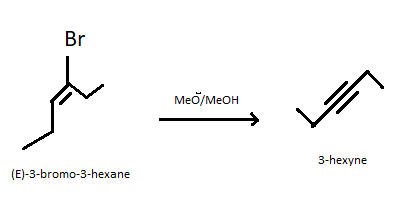
Hence option A is correct that is $(E) - 3 - $bromo$ - 3 - $hexene when treated with $C{H_3}{O^ - }$ in $C{H_3}OH$ gives $3 - $hexyne.
Note : We have approached this reaction with the help of saytzeff rule which favours the alkene with less number of hydrogen on double bonded carbon atoms.As the reaction is dehydrobromination so saytzeff rule is applicable here. We know that during the elimination reaction proton is removed from that carbon atom which have less number of substituents.Therefore $(E) - 3 - $bromo$ - 3 - $hexene when treated with $C{H_3}{O^ - }$ in $C{H_3}OH$ gives $3 - $hexyne.
Complete step by step solution:
So we can say that according to the Satzev’s rule $(E) - 3 - $bromo$ - 3 - $hexene when treated with $C{H_3}{O^ - }$ in $C{H_3}OH$ it produce $3 - $hexyne. It undergoes dehydrobromination where a molecule of hydrobromide gets eliminated from $(E) - 3 - $bromo$ - 3 - $hexene. A dehydrobromination reaction is a kind of elimination reaction where elimination of hydrogen bromide from a substrate takes place. This reaction is mainly associated with the synthesis of alkenes. The reaction of $(E) - 3 - $bromo$ - 3 - $hexene when treated with $C{H_3}{O^ - }$ in $C{H_3}OH$ is given below.
Hence option A is correct that is $(E) - 3 - $bromo$ - 3 - $hexene when treated with $C{H_3}{O^ - }$ in $C{H_3}OH$ gives $3 - $hexyne.
Note : We have approached this reaction with the help of saytzeff rule which favours the alkene with less number of hydrogen on double bonded carbon atoms.As the reaction is dehydrobromination so saytzeff rule is applicable here. We know that during the elimination reaction proton is removed from that carbon atom which have less number of substituents.Therefore $(E) - 3 - $bromo$ - 3 - $hexene when treated with $C{H_3}{O^ - }$ in $C{H_3}OH$ gives $3 - $hexyne.
Recently Updated Pages
Normality of 03 M phosphorus acid H3PO3 is A 05 B 06 class 11 chemistry JEE_Main

A molecule with highest bond energy A Fluorine B Chlorine class 11 chemistry JEE_Main
A 30 solution of H2O2 is marketed as 100 volume hydrogen class 11 chemistry JEE_Main
Covalent compounds generally have low melting and boiling class 11 chemistry JEE_Main
When an acid reacts with a metal carbonate or metal class 11 chemistry JEE_Main
The degeneracy of hydrogen atom that has equal energy class 11 chemistry JEE_Main
Trending doubts
JEE Main 2026: Exam Dates, Session 2 Updates, City Slip, Admit Card & Latest News
Understanding the Electric Field of a Uniformly Charged Ring
Electron Gain Enthalpy and Electron Affinity Explained
Derivation of Equation of Trajectory Explained for Students
Understanding Atomic Structure for Beginners
How to Convert a Galvanometer into an Ammeter or Voltmeter
Other Pages
JEE Advanced Percentile vs Marks 2026: JEE Main Cutoff, AIR & IIT Admission Guide
NCERT Solutions For Class 11 Chemistry In Hindi Chapter 1 Some Basic Concepts Of Chemistry - 2026-27 Free PDF Download (Sign-in Required)
Hybridisation in Chemistry – Concept, Types & Applications
Understanding the Different Types of Solutions in Chemistry
What Are Elastic Collisions in One Dimension?
Effective Nuclear Charge for JEE