




What does the slope of a distance-time graph indicate?
Answer
 Verified
255.6k+ views
Hint: The slope of any two quantities (let’s say for graph A-B) gives the change in A with respect to change in B. Find what change in distance with respect to change in time indicates.
Complete step by step solution:
A distance-time is a graph between, distance travelled by an object in a given time. Distance is considered on Y-axis and time is considered on X-axis. The motion of the object is said to be uniform when the graph is a straight line. The slope of the straight-line graph is the same for any two sets of points.
As per the given question, let’s check what the change in distance with respect to change in time indicates:
Consider the graph below:
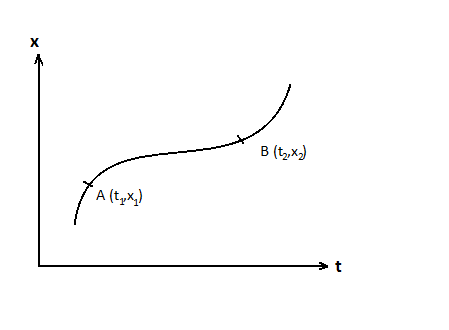
The above graph indicates the motion of an object. The change in displacement with respect to time is depicted in the graph.
We know that velocity is defined as the rate of change of displacement. And rate of change means change of some quantity with respect to time.
Now from the graph, it is clear that position of particle initially is $A({x_1},{y_1})$ and final position is $B({x_2},{y_2})$
Change in displacement will be given as:
$dx = {x_2} - {x_1}$ and $dy = {y_2} - {y_1}$
Now the rate of change in X and Y will be given as:
$\dfrac{{dx}}{{dt}} = \dfrac{{{x_2} - {x_1}}}{{dt}}$ and $\dfrac{{dy}}{{dt}} = \dfrac{{{y_2} - {y_1}}}{{dt}}$
Rate of change of displacement is velocity.
Note: The graph of displacement-time can be linear, non-linear, continuous or discontinuous depending on the motion of the particle. It must also be noted, the rate of change of velocity is known as acceleration. Please remember that for particles having constant velocity, its acceleration is zero.
Complete step by step solution:
A distance-time is a graph between, distance travelled by an object in a given time. Distance is considered on Y-axis and time is considered on X-axis. The motion of the object is said to be uniform when the graph is a straight line. The slope of the straight-line graph is the same for any two sets of points.
As per the given question, let’s check what the change in distance with respect to change in time indicates:
Consider the graph below:
The above graph indicates the motion of an object. The change in displacement with respect to time is depicted in the graph.
We know that velocity is defined as the rate of change of displacement. And rate of change means change of some quantity with respect to time.
Now from the graph, it is clear that position of particle initially is $A({x_1},{y_1})$ and final position is $B({x_2},{y_2})$
Change in displacement will be given as:
$dx = {x_2} - {x_1}$ and $dy = {y_2} - {y_1}$
Now the rate of change in X and Y will be given as:
$\dfrac{{dx}}{{dt}} = \dfrac{{{x_2} - {x_1}}}{{dt}}$ and $\dfrac{{dy}}{{dt}} = \dfrac{{{y_2} - {y_1}}}{{dt}}$
Rate of change of displacement is velocity.
Note: The graph of displacement-time can be linear, non-linear, continuous or discontinuous depending on the motion of the particle. It must also be noted, the rate of change of velocity is known as acceleration. Please remember that for particles having constant velocity, its acceleration is zero.
Recently Updated Pages
Electricity and Magnetism Explained: Key Concepts & Applications

JEE Energetics Important Concepts and Tips for Exam Preparation
JEE Isolation, Preparation and Properties of Non-metals Important Concepts and Tips for Exam Preparation
JEE Main 2023 (February 1st Shift 1) Maths Question Paper with Answer Key
JEE Main 2023 (February 1st Shift 2) Maths Question Paper with Answer Key
JEE Main 2023 (February 1st Shift 2) Chemistry Question Paper with Answer Key
Trending doubts
JEE Main 2026: Exam Dates, Session 2 Updates, City Slip, Admit Card & Latest News
JEE Main Participating Colleges 2026 - A Complete List of Top Colleges
JEE Main 2026 Application Login: Direct Link, Registration, Form Fill, and Steps
JEE Main Colleges 2026: Complete List of Participating Institutes
JEE Main Marking Scheme 2026- Paper-Wise Marks Distribution and Negative Marking Details
Hybridisation in Chemistry – Concept, Types & Applications
Other Pages
JEE Advanced 2026 - Exam Date (Released), Syllabus, Registration, Eligibility, Preparation, and More
JEE Advanced Marks vs Ranks 2025: Understanding Category-wise Qualifying Marks and Previous Year Cut-offs
CBSE Notes Class 11 Physics Chapter 1 - Units And Measurements - 2025-26
NCERT Solutions For Class 11 Physics Chapter 1 Units And Measurements - 2025-26
Important Questions For Class 11 Physics Chapter 1 Units and Measurement - 2025-26
JEE Advanced Weightage 2025 Chapter-Wise for Physics, Maths and Chemistry