




Displacement vs time curve for a particle SHM is as shown in the figure:
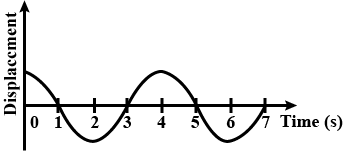
Which of the following statements is correct?
A) Phase of the oscillator is the same at t=0s and t=2s.
B) Phase of the oscillator is the same at t=2s and t=5s.
C) Phase of the oscillator is the same at t=1s and t=7s.
D) Phase of the oscillator is the same at t=1s and t=5s.
Answer
 Verified
283.5k+ views
Hint: The phase of a particle SHM is the state of the body according to its position (displacement) and direction of motion at any given time. It is measured in angular units from 0 to $2\pi$ rad.
Complete step by step solution:
Given:
We can determine the phase at each time point according to displacement and the nature of the curve.
So, phase at t=0s is,
${\theta _0} = \dfrac{\pi }{2}$ rad
Phase at t=1s is,
${\theta _1} = \pi $ rad
Phase at t=2s is,
${\theta _2} = \dfrac{{3\pi }}{2}$ rad
Phase at t=5s is,
${\theta _5} = \pi $ rad
and, phase at t=7s is,
${\theta _7} = 0$ rad
Thus, we see that the phase at t=1s and t=5s is the same.
Final Answer: The correct option is D. Phase of the oscillator is the same at t=1s and t=5s.
Note: (1) Phase can also be seen as the angle made by the arm of the particle revolving in a circle with the diameter, where the diametric projection of motion is the SHM.
(2) The phase at t=1s and t=7s can be confused to be the same as they both have the same position of the particle. But since the direction of motion is different and so the phase is different.
Complete step by step solution:
Given:
We can determine the phase at each time point according to displacement and the nature of the curve.
So, phase at t=0s is,
${\theta _0} = \dfrac{\pi }{2}$ rad
Phase at t=1s is,
${\theta _1} = \pi $ rad
Phase at t=2s is,
${\theta _2} = \dfrac{{3\pi }}{2}$ rad
Phase at t=5s is,
${\theta _5} = \pi $ rad
and, phase at t=7s is,
${\theta _7} = 0$ rad
Thus, we see that the phase at t=1s and t=5s is the same.
Final Answer: The correct option is D. Phase of the oscillator is the same at t=1s and t=5s.
Note: (1) Phase can also be seen as the angle made by the arm of the particle revolving in a circle with the diameter, where the diametric projection of motion is the SHM.
(2) The phase at t=1s and t=7s can be confused to be the same as they both have the same position of the particle. But since the direction of motion is different and so the phase is different.
Recently Updated Pages
How to Calculate Moment of Inertia: Step-by-Step Guide & Formulas

Dimensions of Charge: Dimensional Formula, Derivation, SI Units & Examples
JEE Main 2025-26 Mock Test: Binomial Theorem & Quick Practice
Properties of Solids and Liquids Mock Test 2025
JEE Main Mock Test 2025-26: Principles Related To Practical
JEE Main Mock Test 2025-26: Dual Nature of Matter & Radiation
Trending doubts
JEE Main 2026: Exam Dates, Session 2 Updates, City Slip, Admit Card & Latest News
Understanding the Electric Field of a Uniformly Charged Ring
Understanding Atomic Structure for Beginners
Derivation of Equation of Trajectory Explained for Students
Electron Gain Enthalpy and Electron Affinity Explained
How to Convert a Galvanometer into an Ammeter or Voltmeter
Other Pages
JEE Advanced Percentile vs Marks 2026: JEE Main Cutoff, AIR & IIT Admission Guide
CBSE Notes Class 11 Physics Chapter 1 - Units And Measurements - 2026-27
NCERT Solutions For Class 11 Physics Chapter 1 Units And Measurements - 2026-27 Free PDF Download (Login Required)
NCERT Solutions For Class 11 Physics Chapter 2 Motion In A Straight Line - 2026-27 Free PDF Download (Login Required)
Important Questions For Class 11 Physics Chapter 1 Units and Measurement - 2026-27
CBSE Notes Class 11 Physics Chapter 2 - Motion in a Straight Line - 2026-27