




Consider the arrangement of three plates X, Y and Z each of the area A and separation d. The energy stored when the plates are fully charged is: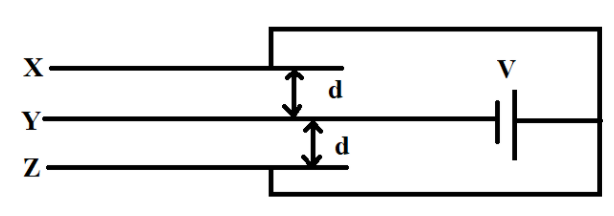
A) ${\varepsilon _0}A\dfrac{{{V^2}}}{{2d}}$
B) ${\varepsilon _0}A\dfrac{{{V^2}}}{d}$
C) $2{\varepsilon _0}A\dfrac{{{V^2}}}{d}$
D) $3{\varepsilon _0}A\dfrac{{{V^2}}}{d}$
Answer
 Verified
300.9k+ views
Hint:Work has to be done to store energy in the plates. This work is converted into electrostatic potential energy and stored in the plates of the capacitor. To find the energy stored in the plates, we have to consider the plates as the plates of a capacitor and use the formula for the energy stored in the plates of a capacitor.
Formula used:
i) $C = \dfrac{{A{\varepsilon _0}}}{d}$ (Where C stands for the capacitance of the capacitor, A stands for the area of the plates, ${\varepsilon _0}$stands for the dielectric constant of free space, d stands for the distance between two plates)
ii) $U = \dfrac{1}{2}C{V^2}$ (Where U stands for the energy stored in the capacitor, V stands for the potential difference)
Complete step by step solution:
In the diagram, the three plates can be considered as two capacitors.
Hence the capacitance is,
${C_{net}} = C + C = 2C$
We know that the capacitance of a parallel plate capacitor is $C = \dfrac{{{\varepsilon _0}A}}{d}$
Since the net capacitance is given by 2C, we can write
${C_{net}} = \dfrac{{2{\varepsilon _0}A}}{d}$
Now we have to find the energy stored in the plates by using the formula, $U = \dfrac{1}{2}C{V^2}$
Here, $U = \dfrac{1}{2}{C_{net}}{V^2}$
Substituting the value of ${C_{net}}$in the equation
$U = \dfrac{1}{2}\left( {\dfrac{{2{\varepsilon _0}A}}{d}} \right){V^2}$
$U = \dfrac{{{\varepsilon _0}A{V^2}}}{d}$
The correct answer is option(B), ${\varepsilon _0}A\dfrac{{{V^2}}}{d}$.
Note:Capacitors store electrical energy in an electrical field. According to the law of conservation of energy, the work done in storing the energy is converted into energy. To find the energy stored in the plates of a capacitor, two more formulae can be used.
If the charge Q and the capacitance C is given in the question we can use the equation, $U = \dfrac{{{Q^2}}}{{2C}}$.
If the charge Q and potential difference V is given, then use the equation, $U = \dfrac{1}{2}QV$.
Formula used:
i) $C = \dfrac{{A{\varepsilon _0}}}{d}$ (Where C stands for the capacitance of the capacitor, A stands for the area of the plates, ${\varepsilon _0}$stands for the dielectric constant of free space, d stands for the distance between two plates)
ii) $U = \dfrac{1}{2}C{V^2}$ (Where U stands for the energy stored in the capacitor, V stands for the potential difference)
Complete step by step solution:
In the diagram, the three plates can be considered as two capacitors.
Hence the capacitance is,
${C_{net}} = C + C = 2C$
We know that the capacitance of a parallel plate capacitor is $C = \dfrac{{{\varepsilon _0}A}}{d}$
Since the net capacitance is given by 2C, we can write
${C_{net}} = \dfrac{{2{\varepsilon _0}A}}{d}$
Now we have to find the energy stored in the plates by using the formula, $U = \dfrac{1}{2}C{V^2}$
Here, $U = \dfrac{1}{2}{C_{net}}{V^2}$
Substituting the value of ${C_{net}}$in the equation
$U = \dfrac{1}{2}\left( {\dfrac{{2{\varepsilon _0}A}}{d}} \right){V^2}$
$U = \dfrac{{{\varepsilon _0}A{V^2}}}{d}$
The correct answer is option(B), ${\varepsilon _0}A\dfrac{{{V^2}}}{d}$.
Note:Capacitors store electrical energy in an electrical field. According to the law of conservation of energy, the work done in storing the energy is converted into energy. To find the energy stored in the plates of a capacitor, two more formulae can be used.
If the charge Q and the capacitance C is given in the question we can use the equation, $U = \dfrac{{{Q^2}}}{{2C}}$.
If the charge Q and potential difference V is given, then use the equation, $U = \dfrac{1}{2}QV$.
Recently Updated Pages
If the magnetizing field on a ferromagnetic material class 12 physics JEE_Main

A point charge is placed at the corner of a cube The class 12 physics JEE_Main
What changes occur if the monochromatic light used class 12 physics JEE_Main
The unit of specific conductance is A Ohm B Ohmmetre class 12 physics JEE_Main
Which lens is used in magnifying glass A Concave lens class 12 physics JEE_Main
Sir C V Raman won the Nobel Prize in which year A 1928 class 12 physics JEE_Main
Trending doubts
Electron Gain Enthalpy and Electron Affinity Explained
Understanding Atomic Structure for Beginners
Effective Nuclear Charge for JEE
Understanding Inertial and Non-Inertial Frames of Reference
Understanding How a Current Loop Acts as a Magnetic Dipole
Units and Measurements Mock Test for JEE Main 2026-27 Preparation
Other Pages
JEE Advanced Weightage Chapter Wise 2026 for Physics, Chemistry, and Mathematics
JEE Advanced 2027 Notes
Isoelectronic Species: Definition, Examples & Importance
Electric field due to uniformly charged sphere class 12 physics JEE_Main
Fastest T20 International Centuries – Top Records
Navratri 2026 Colours with Dates, Devi Names & 9 Days Colour Guide Signifcance