




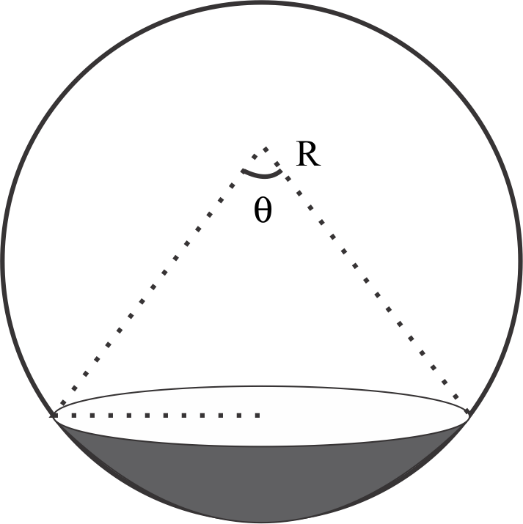
Consider a spherical drop of radius R. Surface tension of the liquid is S. Force of the surface tension on the shaded sub hemisphere due to remaining drop is $\dfrac{{S\pi R}}{2}$. The value of angle $\theta $ (angle subtended by the sub hemisphere at centre of drop) is
(A) $60^\circ $
(B) $120^\circ $
(C) $30^\circ $
(D) $90^\circ $
Answer
 Verified
294.6k+ views
Hint We are provided with the force of the surface tension on the shaded sub hemisphere due to the remaining drop being $\dfrac{{S\pi R}}{2}$. We can understand that statement from the diagram in the question. We have to find the angle subtended by the sub hemisphere at centre of drop. Use the surface tension formula to find the angle. Since the given surface is a sphere its radius makes an angle with the centre point. Use the given diagram for better understanding.
Complete step by step answer
Surface tension: The tendency of surfaces to shrink into the possible minimum surface area. The surface tension is the force per unit length of the surface. Surface area of an object is given by
$ \Rightarrow \gamma = \dfrac{F}{l}$
$\gamma $ is the surface tension
F is the force
L is the unit length
Given,
The radius of a spherical drop is R
Surface tension of the liquid is S
Force of the surface tension on the shaded sub hemisphere due to remaining drop is $F = \dfrac{{S\pi R}}{2}$.
Angle subtended by the sub hemisphere at centre of drop $\theta = ?$
We know that
$ \Rightarrow \gamma = \dfrac{F}{l}$
$ \Rightarrow F = \gamma \times l$
Substituting the known values,
$ \Rightarrow F = \gamma \times l$
$ \Rightarrow F = S \times 2\pi R$
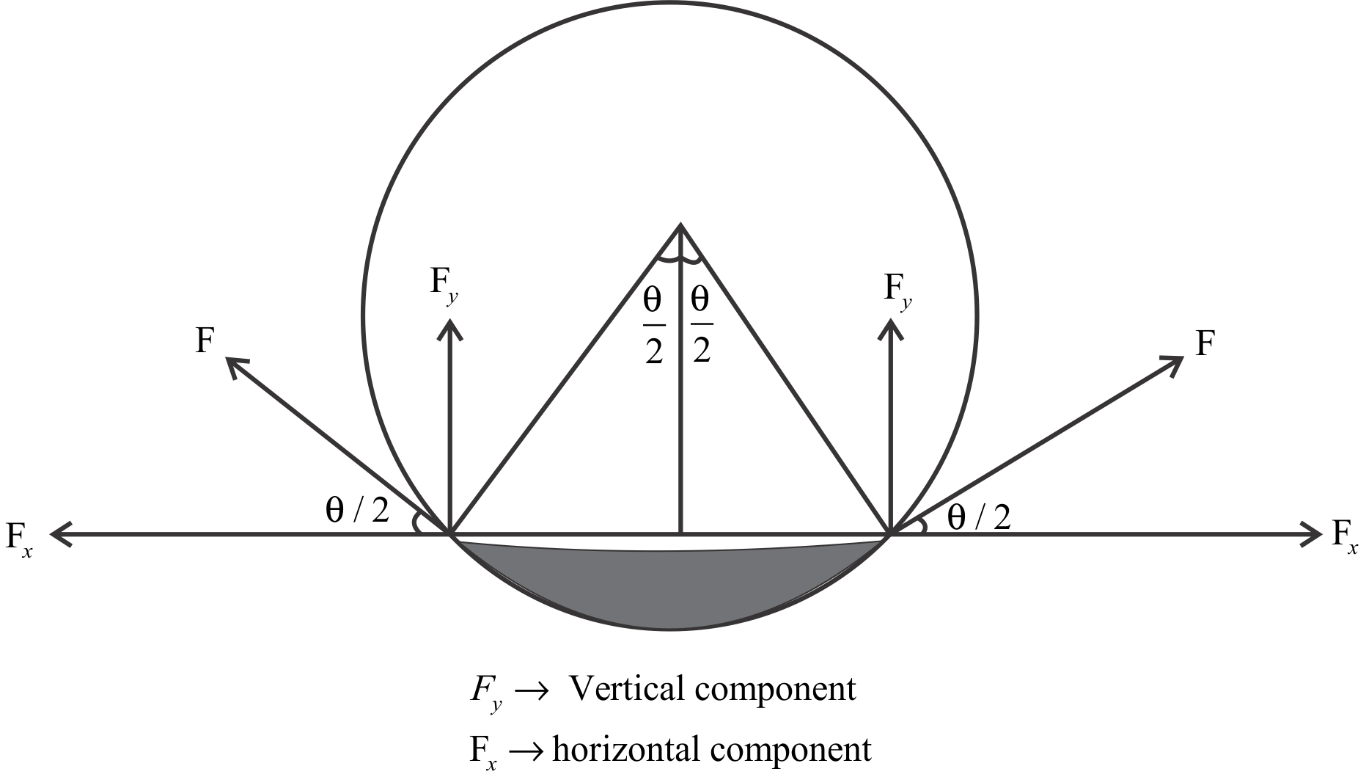
From the diagram
$ \Rightarrow F = S \times 2\pi R\sin \dfrac{\theta }{2}{\text{ }} \to {\text{1}}$
From the diagram,
All the horizontal components of the force get cancelled.
The net force by vertical component of force
$ \Rightarrow F = F\sin \dfrac{\theta }{2}$
Given $F = \dfrac{{S\pi R}}{2}$
$ \Rightarrow \dfrac{{S\pi R}}{2} = F\sin \dfrac{\theta }{2}$
From equation 1
$ \Rightarrow \dfrac{{S\pi R}}{2} = S \times 2\pi R\sin \dfrac{\theta }{2} \times \sin \dfrac{\theta }{2}$
$ \Rightarrow \dfrac{{S\pi R}}{2} = S \times 2\pi R{\sin ^2}\dfrac{\theta }{2}$
\[ \Rightarrow \dfrac{1}{2} = \times 2{\sin ^2}\dfrac{\theta }{2}\]
\[ \Rightarrow {\sin ^2}\dfrac{\theta }{2} = \dfrac{1}{4}\]
Taking square root
\[ \Rightarrow \sin \dfrac{\theta }{2} = \dfrac{1}{2}\]
\[ \Rightarrow \dfrac{\theta }{2} = {\sin ^{ - 1}}\dfrac{1}{2}\]
\[ \Rightarrow \dfrac{\theta }{2} = 30^\circ \]
\[ \Rightarrow \theta = 60^\circ \]
Angle subtended by the sub hemisphere at centre of drop, \[\theta = 60^\circ \]
Hence the correct answer is option (A) \[60^\circ \]
Note We can notice that we have used $2\pi R$ in place of L while solving. Surface tension is the force per unit length. Here we are provided with a sphere. To find the surface tension on the sphere we have to use the circumference of the sphere. Circumference of the sphere is $2\pi R$.
Complete step by step answer
Surface tension: The tendency of surfaces to shrink into the possible minimum surface area. The surface tension is the force per unit length of the surface. Surface area of an object is given by
$ \Rightarrow \gamma = \dfrac{F}{l}$
$\gamma $ is the surface tension
F is the force
L is the unit length
Given,
The radius of a spherical drop is R
Surface tension of the liquid is S
Force of the surface tension on the shaded sub hemisphere due to remaining drop is $F = \dfrac{{S\pi R}}{2}$.
Angle subtended by the sub hemisphere at centre of drop $\theta = ?$
We know that
$ \Rightarrow \gamma = \dfrac{F}{l}$
$ \Rightarrow F = \gamma \times l$
Substituting the known values,
$ \Rightarrow F = \gamma \times l$
$ \Rightarrow F = S \times 2\pi R$
From the diagram
$ \Rightarrow F = S \times 2\pi R\sin \dfrac{\theta }{2}{\text{ }} \to {\text{1}}$
From the diagram,
All the horizontal components of the force get cancelled.
The net force by vertical component of force
$ \Rightarrow F = F\sin \dfrac{\theta }{2}$
Given $F = \dfrac{{S\pi R}}{2}$
$ \Rightarrow \dfrac{{S\pi R}}{2} = F\sin \dfrac{\theta }{2}$
From equation 1
$ \Rightarrow \dfrac{{S\pi R}}{2} = S \times 2\pi R\sin \dfrac{\theta }{2} \times \sin \dfrac{\theta }{2}$
$ \Rightarrow \dfrac{{S\pi R}}{2} = S \times 2\pi R{\sin ^2}\dfrac{\theta }{2}$
\[ \Rightarrow \dfrac{1}{2} = \times 2{\sin ^2}\dfrac{\theta }{2}\]
\[ \Rightarrow {\sin ^2}\dfrac{\theta }{2} = \dfrac{1}{4}\]
Taking square root
\[ \Rightarrow \sin \dfrac{\theta }{2} = \dfrac{1}{2}\]
\[ \Rightarrow \dfrac{\theta }{2} = {\sin ^{ - 1}}\dfrac{1}{2}\]
\[ \Rightarrow \dfrac{\theta }{2} = 30^\circ \]
\[ \Rightarrow \theta = 60^\circ \]
Angle subtended by the sub hemisphere at centre of drop, \[\theta = 60^\circ \]
Hence the correct answer is option (A) \[60^\circ \]
Note We can notice that we have used $2\pi R$ in place of L while solving. Surface tension is the force per unit length. Here we are provided with a sphere. To find the surface tension on the sphere we have to use the circumference of the sphere. Circumference of the sphere is $2\pi R$.
Recently Updated Pages
The dimensional formula of k Coulombs Constant is Take class 11 physics JEE_Main

in the arrangement shown in figure m1 1kg and m2 2kg class 11 physics JEE_Main
A police van moving on a highway with a speed of 30 class 11 physics JEE_Main
Derive an expression for maximum speed of a car on class 11 physics JEE_Main
Two plates A and B of equal surface area are placed class 11 physics JEE_Main
The resultant of vec A and vec B is perpendicular to class 11 physics JEE_Main
Trending doubts
JEE Main 2026: Exam Dates, Session 2 Updates, City Slip, Admit Card & Latest News
Understanding the Electric Field of a Uniformly Charged Ring
Understanding Atomic Structure for Beginners
Derivation of Equation of Trajectory Explained for Students
How to Convert a Galvanometer into an Ammeter or Voltmeter
Electron Gain Enthalpy and Electron Affinity Explained
Other Pages
CBSE Notes Class 11 Physics Chapter 1 - Units And Measurements - 2026-27 PDF Download (Login Required)
NCERT Solutions For Class 11 Physics Chapter 1 Units And Measurements - 2026-27 Free PDF Download (Login Required)
NCERT Solutions For Class 11 Physics Chapter 2 Motion In A Straight Line - 2026-27 Free PDF Download (Login Required)
Important Questions For Class 11 Physics Chapter 1 Units and Measurement - 2026-27 Free PDF Download (Sign-in Required)
JEE Advanced Percentile vs Marks 2026: JEE Main Cutoff, AIR & IIT Admission Guide
CBSE Notes Class 11 Physics Chapter 2 - Motion in a Straight Line - 2026-27 PDF Download (Login Required)
CBSE Notes Class 11 Physics Chapter 1 - Units And Measurements - 2026-27 PDF Download (Login Required)
NCERT Solutions For Class 11 Physics Chapter 1 Units And Measurements - 2026-27 Free PDF Download (Login Required)
NCERT Solutions For Class 11 Physics Chapter 2 Motion In A Straight Line - 2026-27 Free PDF Download (Login Required)