




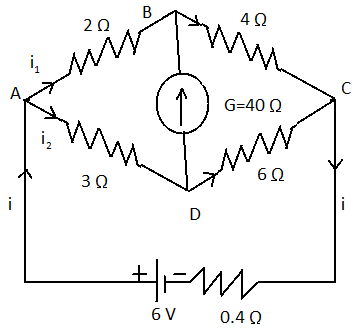
Calculate the currents $i, {i_1}$ and ${i_2}$ in given Wheatstone’s network of resistors, the internal resistance of the 6 V battery is $0.4\,\Omega $.
Answer
 Verified
284.1k+ views
Hint: The concept of wheatstone bridge should be known before solving this problem. It is an arrangement where four resistances are connected in series so as to form a rectangle. Galvanometer is connected at the diagonal of the rectangle.
For balanced Wheatstone bridge the ratio of resistances of one side of the leg of Wheatstone bridge is equal to the ratio of resistances of the other leg of it.
Complete step by step solution:
Given: voltage supply by battery is 6 V.
The internal resistance of the battery is $0.4\,\Omega $.
Wheatstone resistances are $2\,\Omega ,4\,\Omega ,3\,\Omega \,{\rm{and}}\,6\,\Omega $.
First we determine the equivalent resistance of Wheatstone as shown below.
$ R_{eq} = \dfrac{{6 \times 9}}{{6 + 9}}\\
\Rightarrow 3.6 \Omega$
Total resistance of the circuit will be the sum of the equivalent resistance of Wheatstone and the internal resistance of the body. So the total resistance of network is calculated as,
$ R = 3.6 + 0.4\\
\Rightarrow 4\,\Omega
$
The current flowing in circuit determined by the expression written as,
$i = \dfrac{V}{R}$
We can substitute the values in the above expression.
$ i = \dfrac{6}{4}\\
\Rightarrow 1.5 A $
Thus the value of i is 1.5 A.
This current $i$ is distributed in Wheatstone bridge. So the equation of current can be written as,
$ i = {i_1} + {i_2}\\
\Rightarrow 1.5 = {i_1} + {i_2}
$ ................... (1)
The voltage difference between point A and C can be write as,
$6{i_1} - 9{i_2} = 0$ ………………(2)
From equation (1) and (2) we can determine the value of ${i_1}$ and ${i_2}$.
By solving the above equations we get \[{i_1} = 0.9\,A\] and \[{i_2} = 0.6 A\].
Note: Determine the equivalent resistance of Wheatstone bridge correctly because if you calculate the wrong resistance then it will give you an incorrect solution. Resistances are connected in series parallel combinations so determine according to their combination of resistances.
For balanced Wheatstone bridge the ratio of resistances of one side of the leg of Wheatstone bridge is equal to the ratio of resistances of the other leg of it.
Complete step by step solution:
Given: voltage supply by battery is 6 V.
The internal resistance of the battery is $0.4\,\Omega $.
Wheatstone resistances are $2\,\Omega ,4\,\Omega ,3\,\Omega \,{\rm{and}}\,6\,\Omega $.
First we determine the equivalent resistance of Wheatstone as shown below.
$ R_{eq} = \dfrac{{6 \times 9}}{{6 + 9}}\\
\Rightarrow 3.6 \Omega$
Total resistance of the circuit will be the sum of the equivalent resistance of Wheatstone and the internal resistance of the body. So the total resistance of network is calculated as,
$ R = 3.6 + 0.4\\
\Rightarrow 4\,\Omega
$
The current flowing in circuit determined by the expression written as,
$i = \dfrac{V}{R}$
We can substitute the values in the above expression.
$ i = \dfrac{6}{4}\\
\Rightarrow 1.5 A $
Thus the value of i is 1.5 A.
This current $i$ is distributed in Wheatstone bridge. So the equation of current can be written as,
$ i = {i_1} + {i_2}\\
\Rightarrow 1.5 = {i_1} + {i_2}
$ ................... (1)
The voltage difference between point A and C can be write as,
$6{i_1} - 9{i_2} = 0$ ………………(2)
From equation (1) and (2) we can determine the value of ${i_1}$ and ${i_2}$.
By solving the above equations we get \[{i_1} = 0.9\,A\] and \[{i_2} = 0.6 A\].
Note: Determine the equivalent resistance of Wheatstone bridge correctly because if you calculate the wrong resistance then it will give you an incorrect solution. Resistances are connected in series parallel combinations so determine according to their combination of resistances.
Recently Updated Pages
Properties of Solids and Liquids Mock Test 2025

JEE Main Mock Test 2025-26: Dual Nature of Matter & Radiation
JEE Main 2025-26 Work, Energy and Power Mock Test – Free Practice Online
JEE Main Mock Test 2025-26: Experimental Skills Chapter Online Practice
JEE Main 2025-26 Mock Test: Properties of Solids and Liquids
JEE Main 2025 Kinetic Theory Of Gases Mock Test: Practice & Solutions
Trending doubts
JEE Main 2026: Exam Dates, Session 2 Updates, City Slip, Admit Card & Latest News
Understanding the Electric Field of a Uniformly Charged Ring
Understanding Atomic Structure for Beginners
Derivation of Equation of Trajectory Explained for Students
Electron Gain Enthalpy and Electron Affinity Explained
How to Convert a Galvanometer into an Ammeter or Voltmeter
Other Pages
CBSE Class 12 Physics Question Paper 2026: Download SET-wise PDF with Answer Key & Analysis
JEE Advanced Percentile vs Marks 2026: JEE Main Cutoff, AIR & IIT Admission Guide
JEE Advanced 2026 Notification Out with Exam Date, Registration (Extended), Syllabus and More
Understanding Uniform Acceleration in Physics
Understanding Electromagnetic Waves and Their Importance
Understanding Instantaneous Velocity