




When the bob of a pendulum is at the mean position (minimum displacement) of its motion, its total energy is
(A) All potential
(B) Zero
(C) All kinetic
(D) Partly kinetic partly potential
Answer
 Verified
556k+ views
Hint A pendulum possesses both the kinetic energy and the potential energy when it is undergoing oscillations about its mean position. The variation of one energy is inverse to the variation of the other energy such that the total energy remains conserved.
Complete Step by step solution
Kinetic energy is defined as the energy possessed by an object by the virtue of its motion while potential energy is the energy possessed by an object by the virtue of its position. When a pendulum undergoes oscillatory motion about its mean position then it possesses both the kinetic energy and the potential energy.
The kinetic energy of the bob of the pendulum is zero at the extreme positions while its value is maximum when it passes through its mean position.
The behaviour of the potential energy is opposite to that of the kinetic energy. The potential energy of the bob of the pendulum is maximum at the extreme positions and zero when it passes through its mean position.
The following graph shows the variation of the kinetic energy and the potential energy of a pendulum oscillating about its mean position.
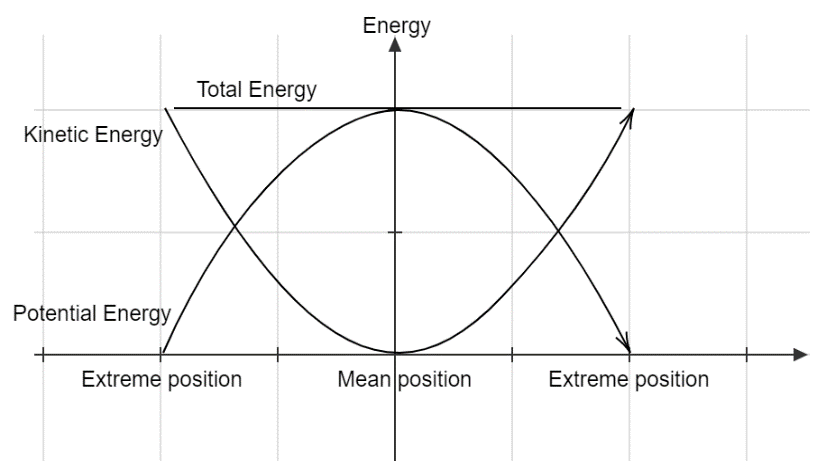
The total energy of the pendulum is equal to the sum of the kinetic energy and potential energy and its value remains constant throughout the motion of the pendulum.
Based on the above discussion we say that the correct answer is option (C) All kinetic.
Note The opposite variation of the kinetic energy and the potential energy ensures that the total energy of the pendulum remains constant. When the pendulum is at its extreme position, it momentarily comes to rest due to which the kinetic energy becomes zero at the extreme positions.
Complete Step by step solution
Kinetic energy is defined as the energy possessed by an object by the virtue of its motion while potential energy is the energy possessed by an object by the virtue of its position. When a pendulum undergoes oscillatory motion about its mean position then it possesses both the kinetic energy and the potential energy.
The kinetic energy of the bob of the pendulum is zero at the extreme positions while its value is maximum when it passes through its mean position.
The behaviour of the potential energy is opposite to that of the kinetic energy. The potential energy of the bob of the pendulum is maximum at the extreme positions and zero when it passes through its mean position.
The following graph shows the variation of the kinetic energy and the potential energy of a pendulum oscillating about its mean position.
The total energy of the pendulum is equal to the sum of the kinetic energy and potential energy and its value remains constant throughout the motion of the pendulum.
Based on the above discussion we say that the correct answer is option (C) All kinetic.
Note The opposite variation of the kinetic energy and the potential energy ensures that the total energy of the pendulum remains constant. When the pendulum is at its extreme position, it momentarily comes to rest due to which the kinetic energy becomes zero at the extreme positions.
Recently Updated Pages
Circuit Switching vs Packet Switching: Key Differences Explained

Dimensions of Pressure in Physics: Formula, Derivation & SI Unit
JEE Extractive Metallurgy Important Concepts and Tips for Exam Preparation
JEE Atomic Structure and Chemical Bonding important Concepts and Tips
JEE Amino Acids and Peptides Important Concepts and Tips for Exam Preparation
Electricity and Magnetism Explained: Key Concepts & Applications
Trending doubts
JEE Main 2026: Exam Dates, Session 2 Updates, City Slip, Admit Card & Latest News
JEE Main Participating Colleges 2026 - A Complete List of Top Colleges
Hybridisation in Chemistry – Concept, Types & Applications
Understanding the Electric Field of a Uniformly Charged Ring
Derivation of Equation of Trajectory Explained for Students
Understanding Atomic Structure for Beginners
Other Pages
JEE Advanced 2026 Notification Out with Exam Date, Registration (Extended), Syllabus and More
JEE Advanced Marks vs Ranks 2025: Understanding Category-wise Qualifying Marks and Previous Year Cut-offs
CBSE Notes Class 11 Physics Chapter 1 - Units And Measurements - 2025-26
NCERT Solutions For Class 11 Physics Chapter 1 Units And Measurements - 2025-26
Important Questions For Class 11 Physics Chapter 1 Units and Measurement - 2025-26
JEE Advanced Weightage Chapter Wise 2026 for Physics, Chemistry, and Mathematics