




Benzamide on reaction with \[POC{l_3}\] gives
(A) Aniline
(B) Chlorobenzene
(C) Benzylamine
(D) Benzonitrile
Answer
 Verified
288.6k+ views
Hint: The chemical name of \[POC{l_3}\] is phosphoryl chloride. It is used as a dehydrating agent in the given reaction.
Complete Step by Step Solution:
Phosphoryl chloride is a colourless liquid with the formula \[POC{l_3}\]. It hydrolyses in moist air and releases phosphoric acid and fumes of hydrogen chloride. Phosphoryl chloride is a commonly used dehydrating agent in chemical laboratories. It is used as a dehydrating agent for the preparation of nitriles from primary amides.
Benzamide is a white solid with chemical formula \[{C_6}{H_5}CON{H_2}\]. It is the simplest amide derived from benzoic acid. It is soluble in organic solvents and water. These are organic compounds which contain a carboxamide substituent which is attached to a benzene ring. Benzamide is an extremely weak basic compound.
When benzamide reacts with \[POC{l_3}\], a dehydration reaction takes place. The term dehydration means that \[{H_2}O\] is lost from the compound, which results in the formation of the main product that is benzonitrile. Benzonitrile is used as an intermediate for rubber manufacturing, chemicals and as a solvent for nitrile rubber.
The reaction of conversion of benzamide on treatment with \[POC{l_3}\] to give benzonitrile is given below:
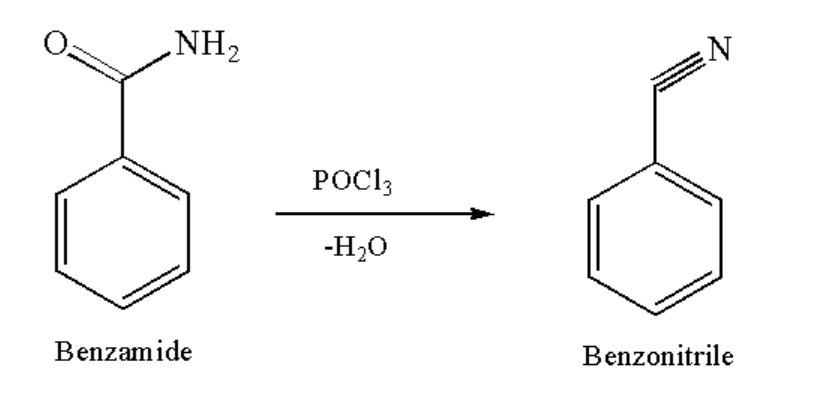
Image: Conversion of benzamide to benzonitrile
So, we can say that Benzonitrile is formed when benzamide reacts with \[POC{l_3}\].
Note: \[POC{l_3}\]is also known as phosphorous oxychloride. Phosphorus oxychloride is synthesised industrially by reacting phosphorus trichloride and oxygen atoms. It can also be prepared by reacting phosphorous trichloride with phosphorus pentachloride. It does not dissolve in water as it forms hydrogen chloride and phosphoric acid by reacting with water.
Complete Step by Step Solution:
Phosphoryl chloride is a colourless liquid with the formula \[POC{l_3}\]. It hydrolyses in moist air and releases phosphoric acid and fumes of hydrogen chloride. Phosphoryl chloride is a commonly used dehydrating agent in chemical laboratories. It is used as a dehydrating agent for the preparation of nitriles from primary amides.
Benzamide is a white solid with chemical formula \[{C_6}{H_5}CON{H_2}\]. It is the simplest amide derived from benzoic acid. It is soluble in organic solvents and water. These are organic compounds which contain a carboxamide substituent which is attached to a benzene ring. Benzamide is an extremely weak basic compound.
When benzamide reacts with \[POC{l_3}\], a dehydration reaction takes place. The term dehydration means that \[{H_2}O\] is lost from the compound, which results in the formation of the main product that is benzonitrile. Benzonitrile is used as an intermediate for rubber manufacturing, chemicals and as a solvent for nitrile rubber.
The reaction of conversion of benzamide on treatment with \[POC{l_3}\] to give benzonitrile is given below:
Image: Conversion of benzamide to benzonitrile
So, we can say that Benzonitrile is formed when benzamide reacts with \[POC{l_3}\].
Note: \[POC{l_3}\]is also known as phosphorous oxychloride. Phosphorus oxychloride is synthesised industrially by reacting phosphorus trichloride and oxygen atoms. It can also be prepared by reacting phosphorous trichloride with phosphorus pentachloride. It does not dissolve in water as it forms hydrogen chloride and phosphoric acid by reacting with water.
Recently Updated Pages
Hess Law of Constant Heat Summation: Definition, Formula & Applications

Disproportionation Reaction: Definition, Example & JEE Guide
JEE Extractive Metallurgy Important Concepts and Tips for Exam Preparation
JEE General Topics in Chemistry Important Concepts and Tips
JEE Atomic Structure and Chemical Bonding important Concepts and Tips
JEE Amino Acids and Peptides Important Concepts and Tips for Exam Preparation
Trending doubts
JEE Main 2026: Exam Dates, Session 2 Updates, City Slip, Admit Card & Latest News
Understanding the Electric Field of a Uniformly Charged Ring
Electron Gain Enthalpy and Electron Affinity Explained
Derivation of Equation of Trajectory Explained for Students
Understanding Atomic Structure for Beginners
How to Convert a Galvanometer into an Ammeter or Voltmeter
Other Pages
JEE Advanced Percentile vs Marks 2026: JEE Main Cutoff, AIR & IIT Admission Guide
JEE Advanced 2026 Notification Out with Exam Date, Registration (Extended), Syllabus and More
NCERT Solutions For Class 11 Chemistry In Hindi Chapter 1 Some Basic Concepts Of Chemistry - 2026-27 Free PDF Download (Sign-in Required)
JEE Advanced Weightage Chapter Wise 2026 for Physics, Chemistry, and Mathematics
Hybridisation in Chemistry – Concept, Types & Applications
NCERT Solutions For Class 11 Chemistry Chapter 8 Organic Chemistry - Some Basic Principles And Techniques - 2026-27 Free PDF Download (Sign-in Required)
JEE Advanced Percentile vs Marks 2026: JEE Main Cutoff, AIR & IIT Admission Guide
JEE Advanced 2026 Notification Out with Exam Date, Registration (Extended), Syllabus and More
NCERT Solutions For Class 11 Chemistry In Hindi Chapter 1 Some Basic Concepts Of Chemistry - 2026-27 Free PDF Download (Sign-in Required)