




ASSERTION
Among the carbon allotropes diamond is an insulator, whereas graphite is a good conductor of electricity.
REASON
Hybridization of carbon in diamond and graphite are \[{\text{s}}{{\text{p}}^{{\text{3\;}}}}\]and \[{\text{s}}{{\text{p}}^2}\]respectively.
A. Both Assertion and Reason are correct and Reason is the correct explanation for Assertion.
B. Both Assertion and Reason are correct and Reason is the correct explanation for Assertion.
C. Assertion is correct but Reason is incorrect
D. Both Assertion and Reason are incorrect.
Answer
 Verified
257.7k+ views
Hint: Presence of unpaired electrons make the compound a good conductor. This is determined from the structure.
Complete step by step answer: There are two major allotropes of carbon, diamond and graphite. In case conductivity, diamond is an insulator, whereas graphite is a good conductor of electricity. This is due to hybridisation and structure of carbon present in it.
In diamond, the carbon atoms are \[{\text{s}}{{\text{p}}^{{\text{3\;}}}}\]hybridised, the electrons are present in 1s and 3p orbitals with no presence of unpaired electrons. Absence of unpaired electrons makes it an insulator.
In graphite the hybridisation of carbon is \[{\text{s}}{{\text{p}}^2}\]thus we can see that in the below structure of \[{\text{s}}{{\text{p}}^2}\]carbon there is an availability of one unpaired electron in p orbital this helps in the conduction of electricity thus they are regarded as good conductor of electricity.
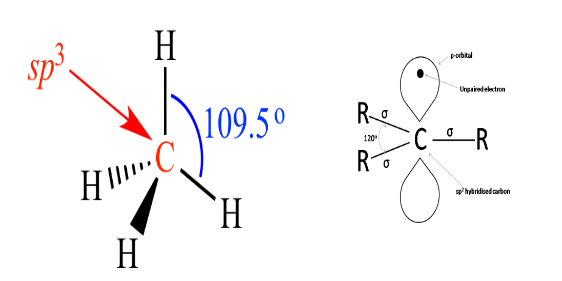
Hence, both Assertion and Reason are correct and Reason is the correct explanation for Assertion. So, the correct option is A.
Note: Availability of free unpaired electrons is must for conductivity. Graphite is used in pencils and lubricants. Its high conductivity makes it useful in electronic products such as electrodes, batteries, and solar panels. Diamonds are used to make fine jewellery because diamonds are so they are extremely effective at polishing, cutting, and drilling.
Complete step by step answer: There are two major allotropes of carbon, diamond and graphite. In case conductivity, diamond is an insulator, whereas graphite is a good conductor of electricity. This is due to hybridisation and structure of carbon present in it.
In diamond, the carbon atoms are \[{\text{s}}{{\text{p}}^{{\text{3\;}}}}\]hybridised, the electrons are present in 1s and 3p orbitals with no presence of unpaired electrons. Absence of unpaired electrons makes it an insulator.
In graphite the hybridisation of carbon is \[{\text{s}}{{\text{p}}^2}\]thus we can see that in the below structure of \[{\text{s}}{{\text{p}}^2}\]carbon there is an availability of one unpaired electron in p orbital this helps in the conduction of electricity thus they are regarded as good conductor of electricity.
Hence, both Assertion and Reason are correct and Reason is the correct explanation for Assertion. So, the correct option is A.
Note: Availability of free unpaired electrons is must for conductivity. Graphite is used in pencils and lubricants. Its high conductivity makes it useful in electronic products such as electrodes, batteries, and solar panels. Diamonds are used to make fine jewellery because diamonds are so they are extremely effective at polishing, cutting, and drilling.
Recently Updated Pages
Disproportionation Reaction: Definition, Example & JEE Guide

Hess Law of Constant Heat Summation: Definition, Formula & Applications
JEE General Topics in Chemistry Important Concepts and Tips
JEE Extractive Metallurgy Important Concepts and Tips for Exam Preparation
JEE Atomic Structure and Chemical Bonding important Concepts and Tips
JEE Amino Acids and Peptides Important Concepts and Tips for Exam Preparation
Trending doubts
JEE Main 2026: Exam Dates, Session 2 Updates, City Slip, Admit Card & Latest News
JEE Main Participating Colleges 2026 - A Complete List of Top Colleges
JEE Main 2026 Application Login: Direct Link, Registration, Form Fill, and Steps
JEE Main Colleges 2026: Complete List of Participating Institutes
JEE Main Marking Scheme 2026- Paper-Wise Marks Distribution and Negative Marking Details
Hybridisation in Chemistry – Concept, Types & Applications
Other Pages
JEE Advanced 2026 - Exam Date (Released), Syllabus, Registration, Eligibility, Preparation, and More
JEE Advanced Marks vs Ranks 2025: Understanding Category-wise Qualifying Marks and Previous Year Cut-offs
CBSE Notes Class 11 Chemistry Chapter 9 - Hydrocarbons - 2025-26
CBSE Notes Class 11 Chemistry Chapter 5 - Thermodynamics - 2025-26
JEE Advanced Weightage 2025 Chapter-Wise for Physics, Maths and Chemistry
CBSE Notes Class 11 Chemistry Chapter 8 - Organic Chemistry Some Basic Principles And Techniques - 2025-26