




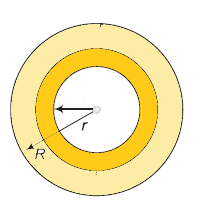
An annular ring of internal and outer radii r and R respectively oscillates in a vertical plane about a horizontal axis perpendicular to its plane and passing through a point on its outer edge. Calculate its time period and show that the length of an equivalent simple pendulum is $\dfrac{{3R}}{2}$ as $r \to 0$ and 2R as $r \to R$.
Answer
 Verified
233.1k+ views
Hint: Here we have to find the time period and length. Apply the relation between angular and linear force $\tau = r \times F$ where $\tau $= angular force; $r$= distance; F = linear force and then for angular acceleration $\alpha = - {\omega ^2}\theta $ where $\alpha $= angular acceleration; $\omega $= angular velocity and solve.
Complete step by step solution:
Step 1:
When the ring is rotated through an angle $\theta $.
We know the torque in terms of linear force;
$\tau = r \times F$;
$\tau = rF\sin \theta $;
Put the value of F = mg in the above relation:
$\tau = mgr\sin \theta $;
Now,
$\tau = mgr\sin \theta = - mgr\theta $;
Here $\tau = I\alpha $; …($I$= Moment of Inertia; $\alpha $= Angular acceleration)
Put the value of torque in the above relation:
$I\alpha = - mgr\theta $;
$\alpha = - \dfrac{{mgr\theta }}{I}$;
We know the relation between angular acceleration and angular velocity:
$ - {\omega ^2}\theta = - \dfrac{{mgr\theta }}{I}$;
Solve for $\omega $= Angular velocity;
$\omega = \sqrt {\dfrac{{mgr}}{I}} $;
Step 2: We know the relation between time period and angular velocity:
$T = \dfrac{{2\pi }}{\omega }$ ;
Put the value of $\omega = \sqrt {\dfrac{{mgr}}{I}} $in the above relation:
$T = \dfrac{{2\pi }}{{\sqrt {\dfrac{{mgr}}{I}} }}$;
Now,
$T = 2\pi \sqrt {\dfrac{I}{{mgr}}} $;
Now for a circular disk the moment of inertia is:
$I = \dfrac{{M{r^2}}}{2}$;
Here we have a ring which is equal to 2 circular disks, the moment of inertia would be:
$I = \dfrac{{{M_1}{R^2}}}{2} - \dfrac{{{M_2}{R^2}}}{2}$;
Now the Mass of the whole area of ring M would be:
$M = \sigma \pi ({R^2} - {r^2})$ ; ….($\sigma $= Mass per unit area)
From here we can find out the Mass per unit area
$\dfrac{M}{{\pi ({R^2} - {r^2})}} = \sigma $;
Similarly, mass for first disk would be:
${M_1} = \sigma \pi {R^2}$;
Put the value of $\sigma $in the above equation:
${M_1} = \dfrac{M}{{\pi ({R^2} - {r^2})}}\pi {R^2}$;
${M_1} = \dfrac{{M{R^2}}}{{({R^2} - {r^2})}}$;
The same would be applicable for disk 2:
${M_2} = \sigma \pi {r^2}$;
${M_2} = \dfrac{{M{r^2}}}{{({R^2} - {r^2})}}$;
Put the value of ${M_1}\& {M_2}$ in $I = \dfrac{{{M_1}{R^2}}}{2} - \dfrac{{{M_2}{R^2}}}{2}$;
$I = \dfrac{{M{R^4}}}{{2\left( {{R^2} - {r^{^2}}} \right)}} - \dfrac{{M{r^4}}}{{2\left( {{R^2} - {r^{^2}}} \right)}}$;
The formula for time period is:
$T = 2\pi \sqrt {\dfrac{I}{{mgr}}} $ ;
(Here $I$= moment of inertia; m = mass; g = gravitational acceleration; T = time period)
Put the value of Moment of Inertia in the above equation:
\[T = 2\pi \sqrt {\dfrac{{\dfrac{{M{R^4}}}{{2\left( {{R^2} - {r^{^2}}} \right)}} - \dfrac{{M{r^4}}}{{2\left( {{R^2} - {r^{^2}}} \right)}}}}{{mgr}}} \];
\[T = 2\pi \sqrt {\dfrac{{\dfrac{M}{{2\left( {{R^2} - {r^{^2}}} \right)}}\left( {{R^4} - {r^4}} \right)}}{{mgR}}} \];
Simplify the above equation:
\[T = 2\pi \sqrt {\dfrac{{\dfrac{M}{2}\left( {{R^2} + {r^{^2}}} \right) + {R^2}}}{{mgR}}} \];
Here M = m; so, they will cancel out:
\[T = 2\pi \sqrt {\dfrac{{\dfrac{1}{2}\left( {{R^2} - {r^{^2}}} \right) + {R^2}}}{{gR}}} \]
Again, simplify the equation:
\[T = 2\pi \sqrt {\dfrac{{\dfrac{{3R}}{2} + \dfrac{{{r^2}}}{{2R}}}}{g}} \];
Step 3:
The length would be:
\[{l_{eff}} = \dfrac{{3R}}{2} + \dfrac{{{r^2}}}{{2R}}\];
At $r \to 0$ ;
\[{l_{eff}} = \dfrac{{3R}}{2}\];
At $r \to R$:
\[{l_{eff}} = \dfrac{{3R}}{2} + \dfrac{{{R^2}}}{{2R}}\];
Do the needed calculation:
\[{l_{eff}} = \dfrac{{4R}}{2}\];
The length would be:
\[{l_{eff}} = 2R\];
The time period is \[T = 2\pi \sqrt {\dfrac{{\dfrac{{3R}}{2} + \dfrac{{{r^2}}}{{2R}}}}{g}} \] and the effective length is At $r \to 0$,\[{l_{eff}} = \dfrac{{3R}}{2}\]; At $r \to R$,\[{l_{eff}} = 2R\].
Note: It is a very lengthy process go step by step, first write the relation between transitional and rotational force then write the relation between angular acceleration and torque then find out the moment of inertia after that put the value of M.I in the formula for time period and solve.
Complete step by step solution:
Step 1:
When the ring is rotated through an angle $\theta $.
We know the torque in terms of linear force;
$\tau = r \times F$;
$\tau = rF\sin \theta $;
Put the value of F = mg in the above relation:
$\tau = mgr\sin \theta $;
Now,
$\tau = mgr\sin \theta = - mgr\theta $;
Here $\tau = I\alpha $; …($I$= Moment of Inertia; $\alpha $= Angular acceleration)
Put the value of torque in the above relation:
$I\alpha = - mgr\theta $;
$\alpha = - \dfrac{{mgr\theta }}{I}$;
We know the relation between angular acceleration and angular velocity:
$ - {\omega ^2}\theta = - \dfrac{{mgr\theta }}{I}$;
Solve for $\omega $= Angular velocity;
$\omega = \sqrt {\dfrac{{mgr}}{I}} $;
Step 2: We know the relation between time period and angular velocity:
$T = \dfrac{{2\pi }}{\omega }$ ;
Put the value of $\omega = \sqrt {\dfrac{{mgr}}{I}} $in the above relation:
$T = \dfrac{{2\pi }}{{\sqrt {\dfrac{{mgr}}{I}} }}$;
Now,
$T = 2\pi \sqrt {\dfrac{I}{{mgr}}} $;
Now for a circular disk the moment of inertia is:
$I = \dfrac{{M{r^2}}}{2}$;
Here we have a ring which is equal to 2 circular disks, the moment of inertia would be:
$I = \dfrac{{{M_1}{R^2}}}{2} - \dfrac{{{M_2}{R^2}}}{2}$;
Now the Mass of the whole area of ring M would be:
$M = \sigma \pi ({R^2} - {r^2})$ ; ….($\sigma $= Mass per unit area)
From here we can find out the Mass per unit area
$\dfrac{M}{{\pi ({R^2} - {r^2})}} = \sigma $;
Similarly, mass for first disk would be:
${M_1} = \sigma \pi {R^2}$;
Put the value of $\sigma $in the above equation:
${M_1} = \dfrac{M}{{\pi ({R^2} - {r^2})}}\pi {R^2}$;
${M_1} = \dfrac{{M{R^2}}}{{({R^2} - {r^2})}}$;
The same would be applicable for disk 2:
${M_2} = \sigma \pi {r^2}$;
${M_2} = \dfrac{{M{r^2}}}{{({R^2} - {r^2})}}$;
Put the value of ${M_1}\& {M_2}$ in $I = \dfrac{{{M_1}{R^2}}}{2} - \dfrac{{{M_2}{R^2}}}{2}$;
$I = \dfrac{{M{R^4}}}{{2\left( {{R^2} - {r^{^2}}} \right)}} - \dfrac{{M{r^4}}}{{2\left( {{R^2} - {r^{^2}}} \right)}}$;
The formula for time period is:
$T = 2\pi \sqrt {\dfrac{I}{{mgr}}} $ ;
(Here $I$= moment of inertia; m = mass; g = gravitational acceleration; T = time period)
Put the value of Moment of Inertia in the above equation:
\[T = 2\pi \sqrt {\dfrac{{\dfrac{{M{R^4}}}{{2\left( {{R^2} - {r^{^2}}} \right)}} - \dfrac{{M{r^4}}}{{2\left( {{R^2} - {r^{^2}}} \right)}}}}{{mgr}}} \];
\[T = 2\pi \sqrt {\dfrac{{\dfrac{M}{{2\left( {{R^2} - {r^{^2}}} \right)}}\left( {{R^4} - {r^4}} \right)}}{{mgR}}} \];
Simplify the above equation:
\[T = 2\pi \sqrt {\dfrac{{\dfrac{M}{2}\left( {{R^2} + {r^{^2}}} \right) + {R^2}}}{{mgR}}} \];
Here M = m; so, they will cancel out:
\[T = 2\pi \sqrt {\dfrac{{\dfrac{1}{2}\left( {{R^2} - {r^{^2}}} \right) + {R^2}}}{{gR}}} \]
Again, simplify the equation:
\[T = 2\pi \sqrt {\dfrac{{\dfrac{{3R}}{2} + \dfrac{{{r^2}}}{{2R}}}}{g}} \];
Step 3:
The length would be:
\[{l_{eff}} = \dfrac{{3R}}{2} + \dfrac{{{r^2}}}{{2R}}\];
At $r \to 0$ ;
\[{l_{eff}} = \dfrac{{3R}}{2}\];
At $r \to R$:
\[{l_{eff}} = \dfrac{{3R}}{2} + \dfrac{{{R^2}}}{{2R}}\];
Do the needed calculation:
\[{l_{eff}} = \dfrac{{4R}}{2}\];
The length would be:
\[{l_{eff}} = 2R\];
The time period is \[T = 2\pi \sqrt {\dfrac{{\dfrac{{3R}}{2} + \dfrac{{{r^2}}}{{2R}}}}{g}} \] and the effective length is At $r \to 0$,\[{l_{eff}} = \dfrac{{3R}}{2}\]; At $r \to R$,\[{l_{eff}} = 2R\].
Note: It is a very lengthy process go step by step, first write the relation between transitional and rotational force then write the relation between angular acceleration and torque then find out the moment of inertia after that put the value of M.I in the formula for time period and solve.
Recently Updated Pages
Circuit Switching vs Packet Switching: Key Differences Explained

Dimensions of Pressure in Physics: Formula, Derivation & SI Unit
JEE General Topics in Chemistry Important Concepts and Tips
JEE Extractive Metallurgy Important Concepts and Tips for Exam Preparation
JEE Amino Acids and Peptides Important Concepts and Tips for Exam Preparation
JEE Atomic Structure and Chemical Bonding important Concepts and Tips
Trending doubts
JEE Main 2026 Application Login: Direct Link, Registration, Form Fill, and Steps
JEE Main Marking Scheme 2026- Paper-Wise Marks Distribution and Negative Marking Details
Understanding Uniform Acceleration in Physics
Understanding Electromagnetic Waves and Their Importance
Inductive Effect and Its Role in Acidic Strength
Degree of Dissociation: Meaning, Formula, Calculation & Uses
Other Pages
Understanding Average and RMS Value in Electrical Circuits
Understanding Collisions: Types and Examples for Students
JEE Main Participating Colleges 2026 - A Complete List of Top Colleges
Chemistry Question Papers for JEE Main, NEET & Boards (PDFs)
JEE Main 2023 January 25 Shift 1 Question Paper with Answer Keys & Solutions
NCERT Solutions For Class 11 Physics Chapter 6 Systems of Particles and Rotational Motion (2025-26)