




Among the naturally occurring carbohydrates, furanose ring is found in the:
A.glucose unit of cane sugar
B.glucose unit of cellulose
C.fructose unit of cane sugar
D.galactose unit of lactose
Answer
 Verified
257.4k+ views
Hint: To answer this question, you should recall the concept of furanose sugars. Furanose is a term which designates carbohydrates with a five-membered ring (cyclic) structure, consisting of 4 carbon atoms and single oxygen. It is called furanose because of its structural similarity to furan.
Complete Step by step solution:
We know that the different structures of carbohydrates that result from a keto form are:
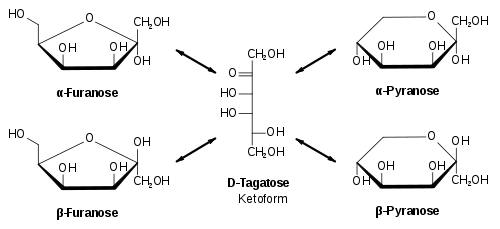
We know that the reducing carbohydrates possess anomeric carbon which acts as a chiral centre for the cyclization of the molecules. The cyclization of the carbohydrate molecules forms two different Structural isomers –
1) Pyranose
2) furanose
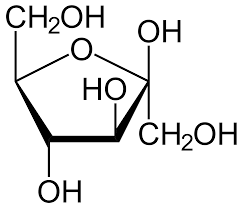
The same rule applies to fructose as it also exists in a cyclic form which is known as furanose with an analogy to the compound furan which is a five-membered cyclic compound with one oxygen and four carbon atoms. The structure of furanose can be drawn as:
Therefore, we can conclude that the correct answer to this question is option C.
Note: You should know that if you have seen drawings of sugars before, you might not have noticed the carbonyl. The reason is that carbonyl is usually "masked" as a hemiacetal structure. The hemiacetal structure is generated when a hydroxyl group along the carbon chain reaches back and bonds to the electrophilic carbonyl carbon. We can see from the structure of fructose that the keto group is present on the second carbon. Now two possibilities for cyclization exist: If attacked by the \[{\text{ - C}}{{\text{H}}_{\text{2}}}{\text{OH}}\] on the 6th carbon it will generate pyranose (6-membered) ring and second that, attacked by the \[{\text{ - CH}}\left( {{\text{OH}}} \right){\text{ - }}\] group on the 5th carbon it will result in a furanose. In general, we can conclude that pyranose rings are more stable than furanose rings, because there are more conformational isomeric structures available for pyranose vs. furanose.
Complete Step by step solution:
We know that the different structures of carbohydrates that result from a keto form are:
We know that the reducing carbohydrates possess anomeric carbon which acts as a chiral centre for the cyclization of the molecules. The cyclization of the carbohydrate molecules forms two different Structural isomers –
1) Pyranose
2) furanose
The same rule applies to fructose as it also exists in a cyclic form which is known as furanose with an analogy to the compound furan which is a five-membered cyclic compound with one oxygen and four carbon atoms. The structure of furanose can be drawn as:
Therefore, we can conclude that the correct answer to this question is option C.
Note: You should know that if you have seen drawings of sugars before, you might not have noticed the carbonyl. The reason is that carbonyl is usually "masked" as a hemiacetal structure. The hemiacetal structure is generated when a hydroxyl group along the carbon chain reaches back and bonds to the electrophilic carbonyl carbon. We can see from the structure of fructose that the keto group is present on the second carbon. Now two possibilities for cyclization exist: If attacked by the \[{\text{ - C}}{{\text{H}}_{\text{2}}}{\text{OH}}\] on the 6th carbon it will generate pyranose (6-membered) ring and second that, attacked by the \[{\text{ - CH}}\left( {{\text{OH}}} \right){\text{ - }}\] group on the 5th carbon it will result in a furanose. In general, we can conclude that pyranose rings are more stable than furanose rings, because there are more conformational isomeric structures available for pyranose vs. furanose.
Recently Updated Pages
JEE Main Mock Test 2025-26: Principles Related To Practical

JEE Main 2025-26 Mock Test: Organic Compounds Containing Nitrogen
JEE Main Mock Test 2025-26: Purification & Characterisation of Organic Compounds
JEE Main 2025-26 Mock Test: Principles Related To Practical
JEE Main Mock Test 2025-26: Principles & Best Practices
Purification and Characterisation of Organic Compounds JEE Main 2025-26 Mock Test
Trending doubts
JEE Main 2026: Exam Dates, Session 2 Updates, City Slip, Admit Card & Latest News
JEE Main Participating Colleges 2026 - A Complete List of Top Colleges
JEE Main 2026 Application Login: Direct Link, Registration, Form Fill, and Steps
JEE Main Colleges 2026: Complete List of Participating Institutes
JEE Main Marking Scheme 2026- Paper-Wise Marks Distribution and Negative Marking Details
Hybridisation in Chemistry – Concept, Types & Applications
Other Pages
JEE Advanced 2026 - Exam Date (Released), Syllabus, Registration, Eligibility, Preparation, and More
CBSE Class 12 Chemistry Question Paper 2026 PDF Download (All Sets) with Answer Key
NCERT Solutions For Class 12 Chemistry Chapter 10 Biomolecules - 2025-26
JEE Advanced Marks vs Ranks 2025: Understanding Category-wise Qualifying Marks and Previous Year Cut-offs
NCERT Solutions For Class 12 Chemistry Chapter 2 Electrochemistry - 2025-26
NCERT Solutions For Class 12 Chemistry Chapter 1 Solutions - 2025-26