




Among the following the achiral amino acid is
A. 2- Ethylalanine
B. 2- Methylglycine
C. 2- Hydroxymethyl serine
D. Tryptophan
Answer
 Verified
251.1k+ views
Hint: In order to solve this question we should know that achirality is present in those compounds in which two or more groups are present on the same atom.
Complete Step by Step Solution:
Chiral and achiral compounds are a part of stereochemistry. Chiral centres or compounds are those which have an atom which has all different groups attached to it and on the other hand achiral compounds are those which have all the atoms to which two or more same constituents or functional groups are attached. According to the given question, the structure of 2-Ethylalanine is given as:
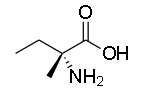
We can see there are four different groups (that are\[-COOH\],$-N{{H}_{2}}$,$-{{C}_{2}}{{H}_{5}}$,$-C{{H}_{3}}$) attached to the same carbon and thus we can say that this carbon is a chiral carbon and thereby this compound is a chiral compound. For the compound, 2-Methylglycine, the structure is given as:
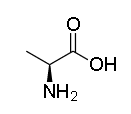
Here, we can see that there are four different groups attached to the carbon (that are\[-COOH\],$-N{{H}_{2}}$,$-H$,$-C{{H}_{3}}$) and thus again it is a chiral carbon and this compound is a chiral compound. The next structure given is 2-Hydroxylmethyl serine, the structure of the compound is given as:
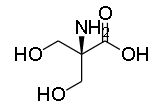
The groups attached to the carbon are$-COOH$, $-N{{H}_{2}}$, $-C{{H}_{2}}OH$. Here, we can see that there are two similar groups are attached to the carbon and when two similar groups are attached to the carbon it’s said to be achiral carbon and the compound is achiral compound. The next compound is tryptophan and its structure is given by
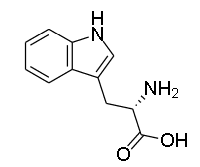
Here, there are four different groups attached to the carbon and thus the compound is said to be a chiral compound.
So, the correct option is c. 2-hydroxymethyl serine.
Note: The thing to remember is that a chiral compound is the one in which any of the carbon or any atom of the main chain has four different groups attached to it so achiral compound is the one in which all the atoms of the main chain have two or more same groups attached to it.
Complete Step by Step Solution:
Chiral and achiral compounds are a part of stereochemistry. Chiral centres or compounds are those which have an atom which has all different groups attached to it and on the other hand achiral compounds are those which have all the atoms to which two or more same constituents or functional groups are attached. According to the given question, the structure of 2-Ethylalanine is given as:
We can see there are four different groups (that are\[-COOH\],$-N{{H}_{2}}$,$-{{C}_{2}}{{H}_{5}}$,$-C{{H}_{3}}$) attached to the same carbon and thus we can say that this carbon is a chiral carbon and thereby this compound is a chiral compound. For the compound, 2-Methylglycine, the structure is given as:
Here, we can see that there are four different groups attached to the carbon (that are\[-COOH\],$-N{{H}_{2}}$,$-H$,$-C{{H}_{3}}$) and thus again it is a chiral carbon and this compound is a chiral compound. The next structure given is 2-Hydroxylmethyl serine, the structure of the compound is given as:
The groups attached to the carbon are$-COOH$, $-N{{H}_{2}}$, $-C{{H}_{2}}OH$. Here, we can see that there are two similar groups are attached to the carbon and when two similar groups are attached to the carbon it’s said to be achiral carbon and the compound is achiral compound. The next compound is tryptophan and its structure is given by
Here, there are four different groups attached to the carbon and thus the compound is said to be a chiral compound.
So, the correct option is c. 2-hydroxymethyl serine.
Note: The thing to remember is that a chiral compound is the one in which any of the carbon or any atom of the main chain has four different groups attached to it so achiral compound is the one in which all the atoms of the main chain have two or more same groups attached to it.
Recently Updated Pages
JEE Isolation, Preparation and Properties of Non-metals Important Concepts and Tips for Exam Preparation

Isoelectronic Definition in Chemistry: Meaning, Examples & Trends
Ionisation Energy and Ionisation Potential Explained
Iodoform Reactions - Important Concepts and Tips for JEE
Introduction to Dimensions: Understanding the Basics
Instantaneous Velocity Explained: Formula, Examples & Graphs
Trending doubts
JEE Main 2026: Exam Dates, Session 2 Updates, City Slip, Admit Card & Latest News
JEE Main Marking Scheme 2026- Paper-Wise Marks Distribution and Negative Marking Details
Hybridisation in Chemistry – Concept, Types & Applications
JEE Main 2026 Application Login: Direct Link, Registration, Form Fill, and Steps
Understanding the Electric Field of a Uniformly Charged Ring
Derivation of Equation of Trajectory Explained for Students
Other Pages
CBSE Class 12 Chemistry Question Paper 2026 PDF Download (All Sets) with Answer Key
NCERT Solutions For Class 12 Chemistry Chapter 10 Biomolecules - 2025-26
JEE Advanced 2026 - Exam Date (Released), Syllabus, Registration, Eligibility, Preparation, and More
JEE Advanced Marks vs Ranks 2025: Understanding Category-wise Qualifying Marks and Previous Year Cut-offs
NCERT Solutions For Class 12 Chemistry Chapter 2 Electrochemistry - 2025-26
NCERT Solutions For Class 12 Chemistry Chapter 1 Solutions - 2025-26