




Allyl cyanide molecule contains:
A. 9 sigma bonds, 4 pi bonds and no lone pair
B. 9 sigma bonds, 3 pi bonds and one lone pair
C. 8 sigma bonds, 5 pi bonds and one lone pair
D. 8 sigma bonds, 3 pi bonds and two lone pair
E. 6 sigma bonds, 2 pi bonds and four lone pair
Answer
 Verified
283.5k+ views
Hint: A sigma bond is formed by the head on overlapping of half filled atomic orbitals along the internuclear axis. Formation of sigma bonds involves either s-s overlapping or s-p overlapping or p-p overlapping.
On the other hand, a pi bond is formed by the sidewise overlapping of half filled atomic orbitals in a direction perpendicular to the internuclear axis. It involves only p-p sideways overlapping.
Complete step by step answer:
A sigma bond can be formed independently between two atoms but a pi bond can be formed only when a sigma bond has already been formed between two atoms. This means every single bond will contain one sigma bond. Every double bond will also contain one sigma bond. But in a double bond, one pi bond will also be present in addition to the sigma bond. Similarly, in a triple bond, there will be a sigma bond and two pi bonds.
Let us now check the structures of the given compound allyl cyanide and determine the number of sigma and pi bonds present in it.
Allyl cyanide has the following structure.
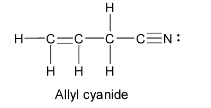
Its structure has a cyanide group attached to an allyl group.
Let us first calculate the number of sigma and pi bonds between carbon and another carbon. There are two single bonds and one double bond between carbon-carbon. This means there are 3 sigma bonds and one pi bond between carbon-carbon.
Now, let us calculate the number of sigma and pi bonds between carbon and hydrogen. There are 5 single bonds between carbon and hydrogen which means there are 5 carbon-hydrogen sigma bonds and no pi bonds.
Now, let us calculate the number of sigma and pi bonds between carbon and nitrogen. Each cyanide group has a triple bond or one sigma and two pi bonds. Therefore, there are 1 sigma bond and 2 pi bonds between carbon and nitrogen.
There is also one lone pair on the nitrogen atom.
Thus, overall there are 9 sigma bonds, 3 pi bonds and one lone pair in allyl cyanide.
So, B is the correct answer.
Note: Sigma bonds are strong bonds as orbitals overlap to a greater extent but pi bonds are weak as the orbitals overlap to less extent. There is free rotation of atoms about the sigma bond but no free rotation about the pi bond. Moreover, the shape of a molecule is decided by the number of sigma bonds and it does not depend upon the pi bonds.
On the other hand, a pi bond is formed by the sidewise overlapping of half filled atomic orbitals in a direction perpendicular to the internuclear axis. It involves only p-p sideways overlapping.
Complete step by step answer:
A sigma bond can be formed independently between two atoms but a pi bond can be formed only when a sigma bond has already been formed between two atoms. This means every single bond will contain one sigma bond. Every double bond will also contain one sigma bond. But in a double bond, one pi bond will also be present in addition to the sigma bond. Similarly, in a triple bond, there will be a sigma bond and two pi bonds.
Let us now check the structures of the given compound allyl cyanide and determine the number of sigma and pi bonds present in it.
Allyl cyanide has the following structure.
Its structure has a cyanide group attached to an allyl group.
Let us first calculate the number of sigma and pi bonds between carbon and another carbon. There are two single bonds and one double bond between carbon-carbon. This means there are 3 sigma bonds and one pi bond between carbon-carbon.
Now, let us calculate the number of sigma and pi bonds between carbon and hydrogen. There are 5 single bonds between carbon and hydrogen which means there are 5 carbon-hydrogen sigma bonds and no pi bonds.
Now, let us calculate the number of sigma and pi bonds between carbon and nitrogen. Each cyanide group has a triple bond or one sigma and two pi bonds. Therefore, there are 1 sigma bond and 2 pi bonds between carbon and nitrogen.
There is also one lone pair on the nitrogen atom.
Thus, overall there are 9 sigma bonds, 3 pi bonds and one lone pair in allyl cyanide.
So, B is the correct answer.
Note: Sigma bonds are strong bonds as orbitals overlap to a greater extent but pi bonds are weak as the orbitals overlap to less extent. There is free rotation of atoms about the sigma bond but no free rotation about the pi bond. Moreover, the shape of a molecule is decided by the number of sigma bonds and it does not depend upon the pi bonds.
Recently Updated Pages
Disproportionation Reaction: Definition, Example & JEE Guide

JEE Main 2025-26 Mock Test: Binomial Theorem & Quick Practice
Properties of Solids and Liquids Mock Test 2025
JEE Main Mock Test 2025-26: Principles Related To Practical
JEE Main Mock Test 2025-26: Dual Nature of Matter & Radiation
JEE Main 2025-26 Work, Energy and Power Mock Test – Free Practice Online
Trending doubts
JEE Main 2026: Exam Dates, Session 2 Updates, City Slip, Admit Card & Latest News
Understanding the Electric Field of a Uniformly Charged Ring
Understanding Atomic Structure for Beginners
Derivation of Equation of Trajectory Explained for Students
Electron Gain Enthalpy and Electron Affinity Explained
How to Convert a Galvanometer into an Ammeter or Voltmeter
Other Pages
JEE Advanced Percentile vs Marks 2026: JEE Main Cutoff, AIR & IIT Admission Guide
JEE Advanced 2026 Notification Out with Exam Date, Registration (Extended), Syllabus and More
NCERT Solutions For Class 11 Chemistry In Hindi Chapter 1 Some Basic Concepts Of Chemistry - 2026-27
Understanding Electromagnetic Waves and Their Importance
Understanding Instantaneous Velocity
NCERT Solutions For Class 11 Chemistry Chapter 8 Organic Chemistry - Some Basic Principles And Techniques - 2026-27