




(a) What is shunt?
(b) State Ampere’s circuital law. Using the law, obtain an expression for the magnetic field well aside the solenoid of finite length
Answer
 Verified
264.6k+ views
Hint: Shunt can be an electrical device that is used to protect valuable electrical equipment from electrical surges by providing a low resistance path. Ampere’s current law deals with the magnetic field due to a current loop. It gives us a relation between the two quantities.
Complete step-by-step answer:
(a) A stunt is an electrical circuit which provides an alternate low resistance path to pass around a point in the circuit. Hence, we can say that a shunt connection is a parallel low resistance path with respect to another element in the circuit. Now, the word ‘shunt’ is used to denote parallel connection as well. However, it should be a low resistance path.
One of the uses of shunt is as a protective device. If there is a surge of current in the circuit, it will flow through the low resistance path and the other device will be protected.
(b) Ampere’s circuital law is one of the most important laws in the domain of electromagnetism. It states that,
“The line integral of the magnetic field around some closed loop is equal to the net current enclosed by this path’
So, the mathematical expression of the Ampere’s circuital law is,
$\oint{B.dl={{\mu }_{0}}I}$
Where, I is the total current passing through the loop
B is the magnetic field due to the wire.
Now, let’s use this law to find the magnetic field inside a solenoid of finite length.
Let’s look at the following diagram to understand the application of Ampere’s law.
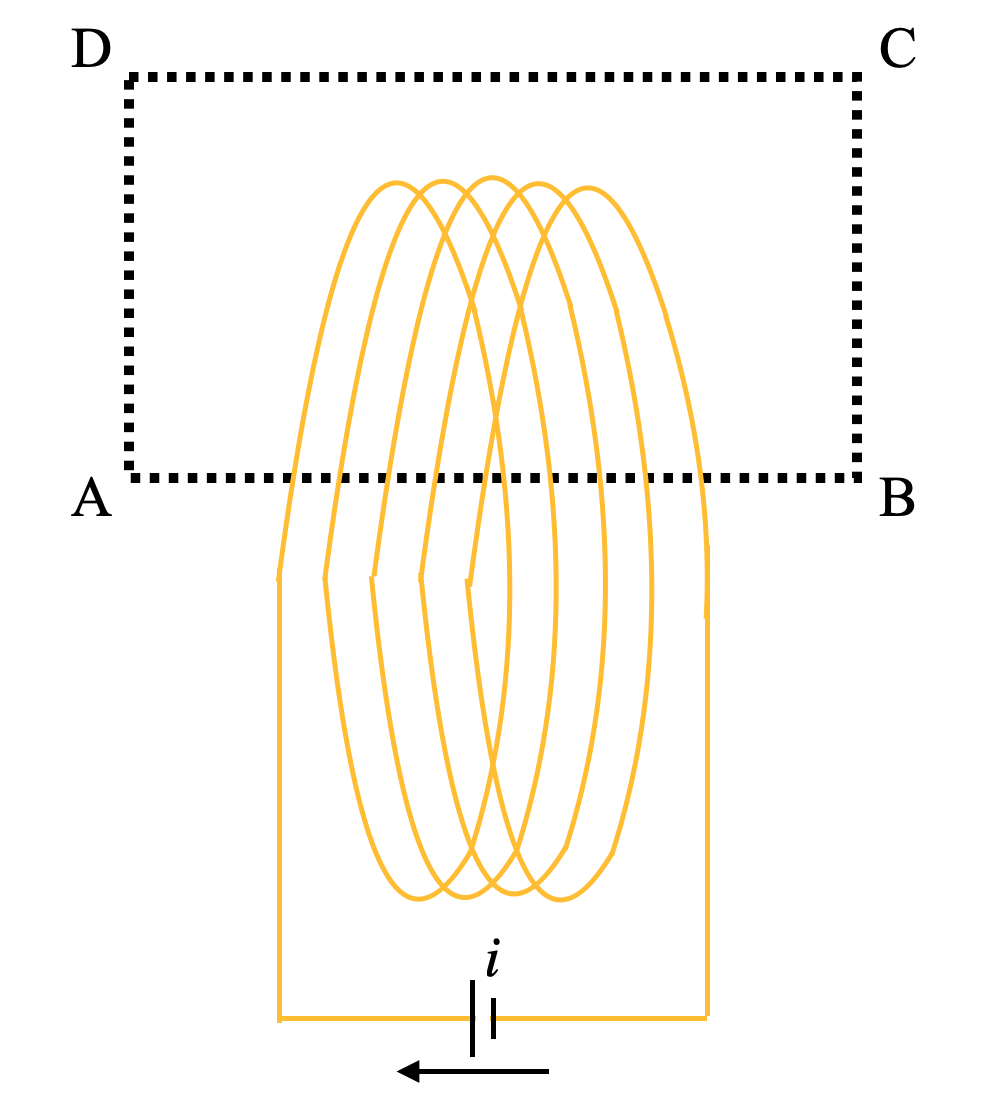
Let the length of the solenoid be ‘l’
And the number of turns is ‘I’.
Let the square ABCD be the enclosed path in which AB passes through the coaxial loops of the solenoid.
We will assume that the solenoid only has a magnetic field inside the solenoid. However, there is no magnetic field outside and there is no fringing effect as well at the end of the solenoid.
So, we can write ampere’s law for the loop ABCD,
$\oint\limits_{ABCD}{B.dl={{\mu }_{0}}I}$
We can divide the term $\oint\limits_{ABCD}{B.dl}$ in four segments, which are as follows-
$\oint\limits_{ABCD}{B.dl}=\oint\limits_{AB}{B.dl}+\oint\limits_{BC}{B.dl}+\oint\limits_{CD}{B.dl}+\oint\limits_{DA}{B.dl}$
$\Rightarrow \oint\limits_{ABCD}{B.dl}=\oint\limits_{AB}{B.dl}$
$\Rightarrow \oint\limits_{ABCD}{B.dl}=B.l$
Total current passing through the loop =
Current × Number of turns
$=NI$
Hence, we can write,
$Bl={{\mu }_{0}}NI$
$\Rightarrow B=\dfrac{{{\mu }_{0}}NI}{l}$
So, the magnetic field inside the solenoid =
$B=\dfrac{{{\mu }_{0}}NI}{l}$
Note:
We need to define the loop such that it is simple to perform the line integral. You can divide the line integral into various segments so that the calculation is easy. Generally, we express the term in turns per unit length, because that is a significant quantity while deriving the magnetic flux or self-inductance.
Complete step-by-step answer:
(a) A stunt is an electrical circuit which provides an alternate low resistance path to pass around a point in the circuit. Hence, we can say that a shunt connection is a parallel low resistance path with respect to another element in the circuit. Now, the word ‘shunt’ is used to denote parallel connection as well. However, it should be a low resistance path.
One of the uses of shunt is as a protective device. If there is a surge of current in the circuit, it will flow through the low resistance path and the other device will be protected.
(b) Ampere’s circuital law is one of the most important laws in the domain of electromagnetism. It states that,
“The line integral of the magnetic field around some closed loop is equal to the net current enclosed by this path’
So, the mathematical expression of the Ampere’s circuital law is,
$\oint{B.dl={{\mu }_{0}}I}$
Where, I is the total current passing through the loop
B is the magnetic field due to the wire.
Now, let’s use this law to find the magnetic field inside a solenoid of finite length.
Let’s look at the following diagram to understand the application of Ampere’s law.
Let the length of the solenoid be ‘l’
And the number of turns is ‘I’.
Let the square ABCD be the enclosed path in which AB passes through the coaxial loops of the solenoid.
We will assume that the solenoid only has a magnetic field inside the solenoid. However, there is no magnetic field outside and there is no fringing effect as well at the end of the solenoid.
So, we can write ampere’s law for the loop ABCD,
$\oint\limits_{ABCD}{B.dl={{\mu }_{0}}I}$
We can divide the term $\oint\limits_{ABCD}{B.dl}$ in four segments, which are as follows-
$\oint\limits_{ABCD}{B.dl}=\oint\limits_{AB}{B.dl}+\oint\limits_{BC}{B.dl}+\oint\limits_{CD}{B.dl}+\oint\limits_{DA}{B.dl}$
$\Rightarrow \oint\limits_{ABCD}{B.dl}=\oint\limits_{AB}{B.dl}$
$\Rightarrow \oint\limits_{ABCD}{B.dl}=B.l$
Total current passing through the loop =
Current × Number of turns
$=NI$
Hence, we can write,
$Bl={{\mu }_{0}}NI$
$\Rightarrow B=\dfrac{{{\mu }_{0}}NI}{l}$
So, the magnetic field inside the solenoid =
$B=\dfrac{{{\mu }_{0}}NI}{l}$
Note:
We need to define the loop such that it is simple to perform the line integral. You can divide the line integral into various segments so that the calculation is easy. Generally, we express the term in turns per unit length, because that is a significant quantity while deriving the magnetic flux or self-inductance.
Recently Updated Pages
JEE Main 2025-26 Experimental Skills Mock Test – Free Practice

JEE Main 2025-26 Electronic Devices Mock Test: Free Practice Online
JEE Main 2025-26 Mock Tests: Free Practice Papers & Solutions
JEE Main 2025-26: Magnetic Effects of Current & Magnetism Mock Test
JEE Main 2025-26 Atoms and Nuclei Mock Test – Free Practice Online
JEE Main Mock Test 2025-26: Experimental Skills Chapter Online Practice
Trending doubts
JEE Main 2026: Exam Dates, Session 2 Updates, City Slip, Admit Card & Latest News
JEE Main Participating Colleges 2026 - A Complete List of Top Colleges
Kinematics Mock Test for JEE Main 2025-26: Practice & Ace the Exam
Kinematics Mock Test for JEE Main 2025-26: Comprehensive Practice
Hybridisation in Chemistry – Concept, Types & Applications
Understanding the Electric Field of a Uniformly Charged Ring
Other Pages
CBSE Class 12 Physics Question Paper 2026: Download SET-wise PDF with Answer Key & Analysis
JEE Advanced 2026 Notification Out with Exam Date, Registration (Extended), Syllabus and More
JEE Advanced Percentile vs Marks 2026: JEE Main Cutoff, AIR & IIT Admission Guide
JEE Advanced Weightage Chapter Wise 2026 for Physics, Chemistry, and Mathematics
JEE Advanced Marks vs Rank 2025 - Predict Your IIT Rank Based on Score
Derivation of Equation of Trajectory Explained for Students