




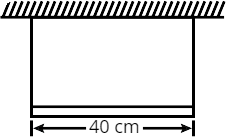
A uniform horizontal rod of length 40 cm and mass 1.2 kg is supported by two identical wires as shown in figure (below). Where should a mass of 4.8 kg be placed on the rod so that the same tuning fork may excite the wire on left into its fundamental vibrations and that on right into its first overtone? Take $g = 10~m {s^{−2}}$.
Answer
 Verified
259.5k+ views
Hint: In the given question, Length of the rod is 40 cm and two identical wire supporting the mass 1.2 kg. Length= 40cm, Mass=1.2kg.Let us assume mass of 4.8kg is placed at y distance from the left.
Formula used:
${f_1} = 2{f_2}$
Complete answer:
According to the question${f_1} = 2{f_2}$ , where ${f_1}$is the frequency on the left side and ${f_2}$ is the frequency on the right side.
Let us assume, ${T_1}$ and ${T_2}$ be the tension on the left and right side respectively
\[ \Rightarrow \frac{1}{{2L}}\sqrt {\frac{{{T_1}}}{m}} = \frac{1}{{2L}} \times 2 \times \sqrt {\frac{{{T_2}}}{m}} \]
\[ \Rightarrow \sqrt {\frac{{{T_1}}}{{T{}_2}}} = 2\]
\[ \Rightarrow \frac{{{T_1}}}{{{T_2}}} = 4 \cdots (1)\]
Now from the given question,
$ \Rightarrow {T_1} + {T_2} = 48 + 12 = 60N$
$ \Rightarrow 4{T_2} + {T_2} = 60N$
$ \Rightarrow {T_2} = 12N$
$ \Rightarrow {T_1} = 48N$
Now take look over point A
${T_2} \times 0.4 = 48y + 12(0.2)$
$\therefore y = 0.05 = 5cm$
Therefore, the mass must be placed 5cm behind the left end.
Note:In this type of question, particular attention must be taken while answering the problems and the proper values must be entered into the specified formula in order to arrive at the correct result with precision.
Formula used:
${f_1} = 2{f_2}$
Complete answer:
According to the question${f_1} = 2{f_2}$ , where ${f_1}$is the frequency on the left side and ${f_2}$ is the frequency on the right side.
Let us assume, ${T_1}$ and ${T_2}$ be the tension on the left and right side respectively
\[ \Rightarrow \frac{1}{{2L}}\sqrt {\frac{{{T_1}}}{m}} = \frac{1}{{2L}} \times 2 \times \sqrt {\frac{{{T_2}}}{m}} \]
\[ \Rightarrow \sqrt {\frac{{{T_1}}}{{T{}_2}}} = 2\]
\[ \Rightarrow \frac{{{T_1}}}{{{T_2}}} = 4 \cdots (1)\]
Now from the given question,
$ \Rightarrow {T_1} + {T_2} = 48 + 12 = 60N$
$ \Rightarrow 4{T_2} + {T_2} = 60N$
$ \Rightarrow {T_2} = 12N$
$ \Rightarrow {T_1} = 48N$
Now take look over point A
${T_2} \times 0.4 = 48y + 12(0.2)$
$\therefore y = 0.05 = 5cm$
Therefore, the mass must be placed 5cm behind the left end.
Note:In this type of question, particular attention must be taken while answering the problems and the proper values must be entered into the specified formula in order to arrive at the correct result with precision.
Recently Updated Pages
Circuit Switching vs Packet Switching: Key Differences Explained

Dimensions of Pressure in Physics: Formula, Derivation & SI Unit
JEE General Topics in Chemistry Important Concepts and Tips
JEE Extractive Metallurgy Important Concepts and Tips for Exam Preparation
JEE Atomic Structure and Chemical Bonding important Concepts and Tips
JEE Amino Acids and Peptides Important Concepts and Tips for Exam Preparation
Trending doubts
JEE Main 2026: Exam Dates, Session 2 Updates, City Slip, Admit Card & Latest News
JEE Main Participating Colleges 2026 - A Complete List of Top Colleges
JEE Main Marking Scheme 2026- Paper-Wise Marks Distribution and Negative Marking Details
Hybridisation in Chemistry – Concept, Types & Applications
Understanding the Electric Field of a Uniformly Charged Ring
Derivation of Equation of Trajectory Explained for Students
Other Pages
JEE Advanced 2026 - Exam Date (Released), Syllabus, Registration, Eligibility, Preparation, and More
JEE Advanced Marks vs Ranks 2025: Understanding Category-wise Qualifying Marks and Previous Year Cut-offs
CBSE Notes Class 11 Physics Chapter 1 - Units And Measurements - 2025-26
NCERT Solutions For Class 11 Physics Chapter 1 Units And Measurements - 2025-26
Important Questions For Class 11 Physics Chapter 1 Units and Measurement - 2025-26
JEE Advanced Weightage 2025 Chapter-Wise for Physics, Maths and Chemistry