




A sugar solution with sugar molecules and water molecules is-
A. Weak electrolyte
B. Non-electrolyte
C. Metallic conductor
D. Strong electrolyte
Answer
 Verified
270k+ views
Hint: Sugar is sucrose and is composed of twelve carbon atoms, twenty two hydrogen atoms and eleven oxygen atoms which are bonded together by covalent bonds. Water is a polar molecule composed of two hydrogen atoms and one oxygen atom which are also bonded together by covalent bond.
Step-by-Step Solution-
Sugar solution contains both sugar molecules and water molecules. Sugar molecules have a chemical formula ${C_{12}}{H_{22}}{O_{11}}$ where all the carbon, hydrogen and oxygen atoms are joined together by covalent bonds. Its structure is-
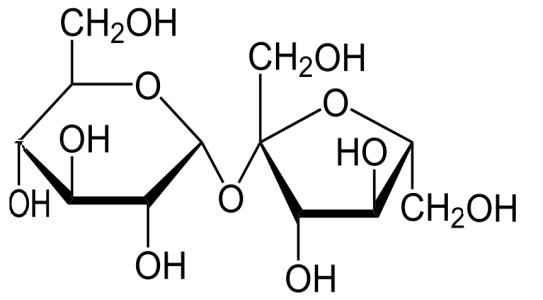
Since it is covalently bonded so it cannot decompose into ions which are necessary to conduct electricity in the solution.
Water molecule has formula ${{\text{H}}_2}{\text{O}}$ and it does dissociate into ions but its ionization constant is very low so the numbers of ions produced are not enough to conduct electricity. Since sugar and water molecules do not readily dissociate into ions when they are in their dissolved state and do not conduct electricity. Hence they are Non-electrolytes.
Non- electrolytes are typically joined by covalent bonds unlike electrolytes which are held together by ionic bonds so non- electrolytes do not easily break apart when placed in the aqueous solution.
Hence the correct answer is B.
Note: Electrolytes are totally opposite of non-electrolytes as they conduct electricity when they are in their dissolved state as they readily decompose into their ions. There are two types of electrolyte –
Weak Electrolyte- They do not dissociate completely in water only partially ionize in aqueous solution like hydrogen fluoride HF.
Strong Electrolyte-They completely dissociate into ions in the aqueous solution and completely ionize like sodium hydroxide (NaOH).
Metallic conductor is a metal that conducts electricity due to flow of electrons like in copper, silver. There is only a physical change involved in it, no chemical changes occur.
Step-by-Step Solution-
Sugar solution contains both sugar molecules and water molecules. Sugar molecules have a chemical formula ${C_{12}}{H_{22}}{O_{11}}$ where all the carbon, hydrogen and oxygen atoms are joined together by covalent bonds. Its structure is-
Since it is covalently bonded so it cannot decompose into ions which are necessary to conduct electricity in the solution.
Water molecule has formula ${{\text{H}}_2}{\text{O}}$ and it does dissociate into ions but its ionization constant is very low so the numbers of ions produced are not enough to conduct electricity. Since sugar and water molecules do not readily dissociate into ions when they are in their dissolved state and do not conduct electricity. Hence they are Non-electrolytes.
Non- electrolytes are typically joined by covalent bonds unlike electrolytes which are held together by ionic bonds so non- electrolytes do not easily break apart when placed in the aqueous solution.
Hence the correct answer is B.
Note: Electrolytes are totally opposite of non-electrolytes as they conduct electricity when they are in their dissolved state as they readily decompose into their ions. There are two types of electrolyte –
Weak Electrolyte- They do not dissociate completely in water only partially ionize in aqueous solution like hydrogen fluoride HF.
Strong Electrolyte-They completely dissociate into ions in the aqueous solution and completely ionize like sodium hydroxide (NaOH).
Metallic conductor is a metal that conducts electricity due to flow of electrons like in copper, silver. There is only a physical change involved in it, no chemical changes occur.
Recently Updated Pages
JEE General Topics in Chemistry Important Concepts and Tips

JEE Extractive Metallurgy Important Concepts and Tips for Exam Preparation
JEE Atomic Structure and Chemical Bonding important Concepts and Tips
JEE Amino Acids and Peptides Important Concepts and Tips for Exam Preparation
Electricity and Magnetism Explained: Key Concepts & Applications
JEE Energetics Important Concepts and Tips for Exam Preparation
Trending doubts
JEE Main 2026: Exam Dates, Session 2 Updates, City Slip, Admit Card & Latest News
JEE Main Participating Colleges 2026 - A Complete List of Top Colleges
Understanding the Electric Field of a Uniformly Charged Ring
Understanding Atomic Structure for Beginners
Derivation of Equation of Trajectory Explained for Students
JEE Main Marking Scheme 2026- Paper-Wise Marks Distribution and Negative Marking Details
Other Pages
JEE Advanced 2026 Notification Out with Exam Date, Registration (Extended), Syllabus and More
JEE Advanced Percentile vs Marks 2026: JEE Main Cutoff, AIR & IIT Admission Guide
CBSE Class 12 Chemistry Question Paper 2026 PDF Download (All Sets) with Answer Key
NCERT Solutions For Class 12 Chemistry Chapter 2 Electrochemistry - 2025-26
NCERT Solutions For Class 12 Chemistry Chapter 1 Solutions - 2025-26
NCERT Solutions For Class 12 Chemistry Chapter 3 Chemical Kinetics - 2025-26