




A plane mirror is placed vertically facing due north. An arrow pointing north-east is kept in front of the mirror. In which direction will the arrow point in this image?
A) north-east
B) south-east
C) south-west
D) north-west
Answer
 Verified
253.5k+ views
Hint: To solve this question, it is important to understand the concept of vector resolution into components. The arrow must be considered as a vector and split into its vertical and horizontal components in order to consider its reflection off a mirror.
Complete answer:
Reflection is defined as the change in direction of the ray of light in the same medium after bouncing off a flat, shining surface.
Consider a ray of light undergoing reflection as follows:
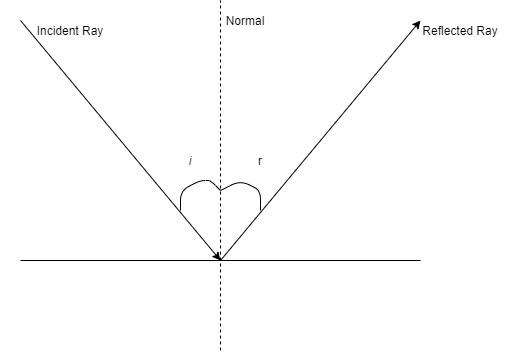
There are two laws governing the reflection known as, the laws of reflection: They are:
i)The incident ray, normal and the reflected ray lie on the same plane and are in the same medium.
ii)The angle made by the incident ray is equal to the angle made by the reflected ray.
Here, it says, that
Angle of incidence = Angle of reflection,
Consider an arrow oriented along the North-East direction placed in front of a mirror bound north as shown:
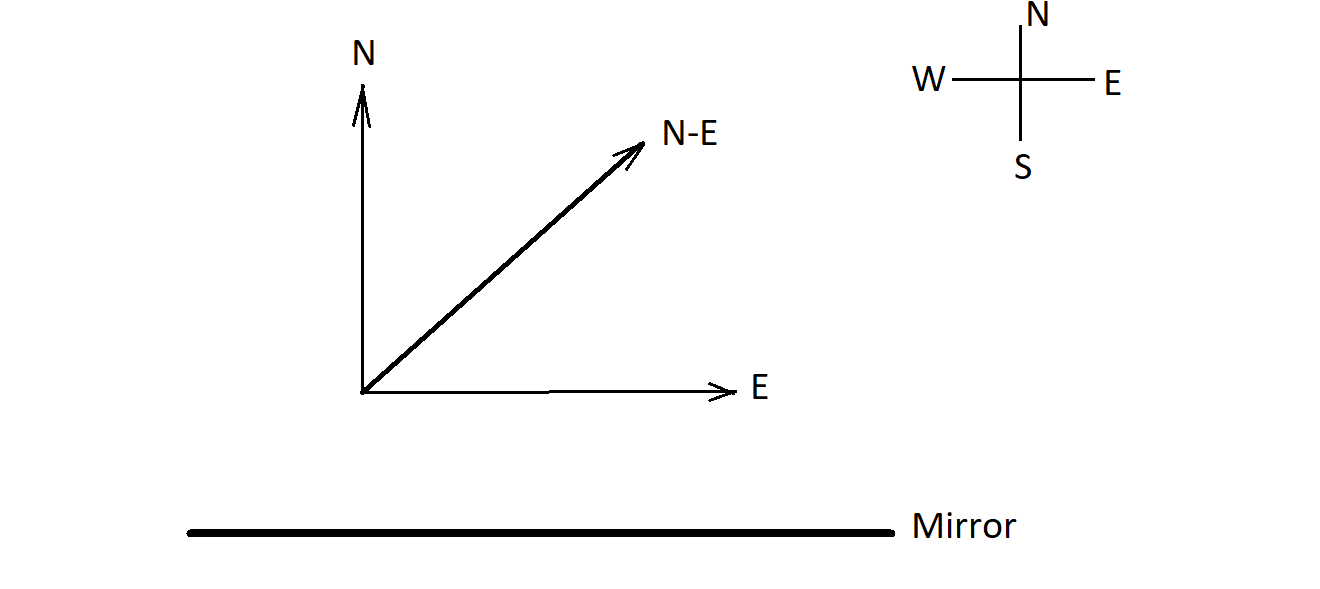 The arrow that is pointing in the direction of North-East can be resolved as a vector oriented along the direction North-East.
If we consider the arrow to be a vector, we can say that the arrow vector is obtained by a vector sum of its rectangular components along the directions North and East.
Thus, the arrow oriented North-East is a vector sum of North and East arrows.
If we reflect the North arrow along the mirror oriented towards the North as shown, the direction of the arrow gets reversed along the southern direction.
If we reflect the East arrow along the mirror shown, the direction of the arrow does not change since the arrow is in parallel direction of the mirror.
The image of the reflected arrow is the vector sum of the South and East arrows, as shown in the figure below:
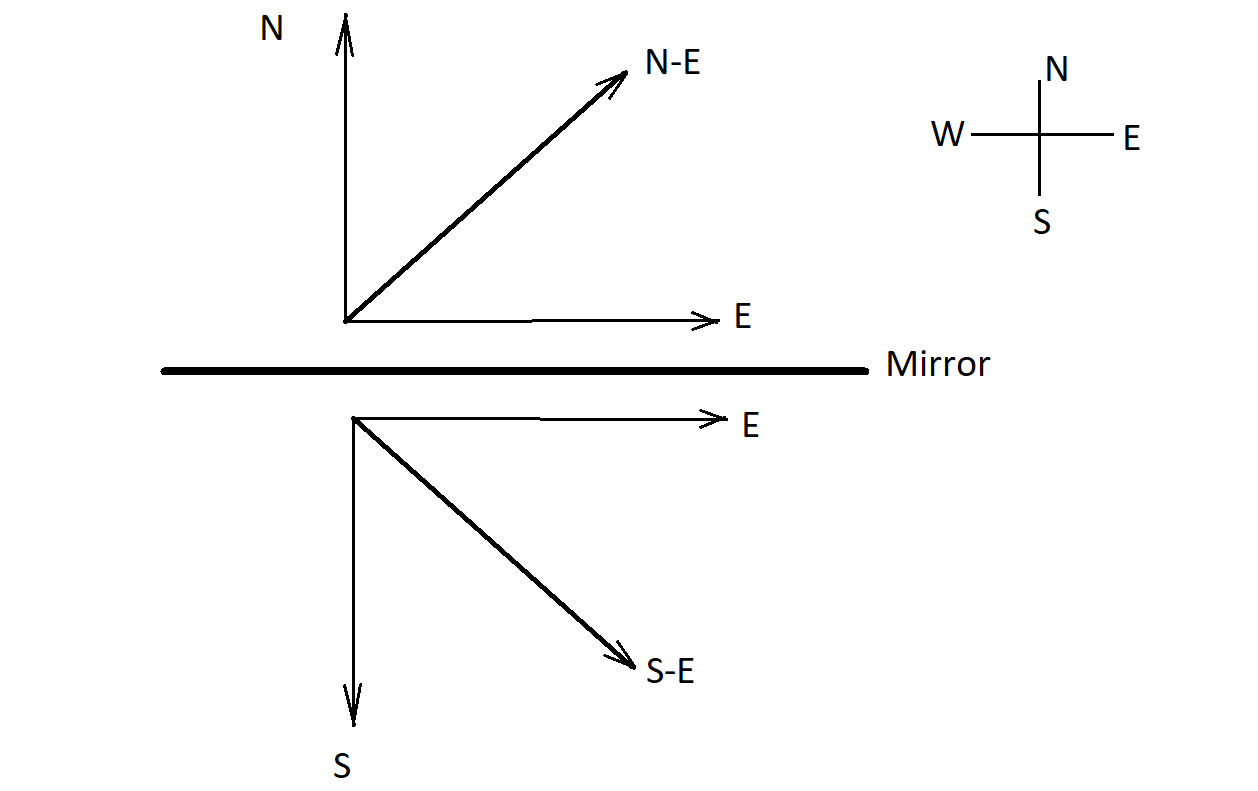
Thus, the direction in which the arrow in the image points, is the South-East direction.
Hence, the correct option is Option B.
Note: In this question, the light is considered to be a ray. In the olden days during Newton’s times, the light was considered to be a ray. However, the experiments by scientists like Huygen and Maxwell, proved that the light is not a ray, but a wave. So, it does not mean that the concept of the reflection is refuted.
After the concept of Huygens wavefronts were discovered, the ray of light simply meant the perpendicular direction of the wavefront. So, the reflection of light meant the reflection of the wavefront of light.
Complete answer:
Reflection is defined as the change in direction of the ray of light in the same medium after bouncing off a flat, shining surface.
Consider a ray of light undergoing reflection as follows:
There are two laws governing the reflection known as, the laws of reflection: They are:
i)The incident ray, normal and the reflected ray lie on the same plane and are in the same medium.
ii)The angle made by the incident ray is equal to the angle made by the reflected ray.
Here, it says, that
Angle of incidence = Angle of reflection,
Consider an arrow oriented along the North-East direction placed in front of a mirror bound north as shown:
The arrow that is pointing in the direction of North-East can be resolved as a vector oriented along the direction North-East. If we consider the arrow to be a vector, we can say that the arrow vector is obtained by a vector sum of its rectangular components along the directions North and East.
Thus, the arrow oriented North-East is a vector sum of North and East arrows.
If we reflect the North arrow along the mirror oriented towards the North as shown, the direction of the arrow gets reversed along the southern direction.
If we reflect the East arrow along the mirror shown, the direction of the arrow does not change since the arrow is in parallel direction of the mirror.
The image of the reflected arrow is the vector sum of the South and East arrows, as shown in the figure below:
Thus, the direction in which the arrow in the image points, is the South-East direction.
Hence, the correct option is Option B.
Note: In this question, the light is considered to be a ray. In the olden days during Newton’s times, the light was considered to be a ray. However, the experiments by scientists like Huygen and Maxwell, proved that the light is not a ray, but a wave. So, it does not mean that the concept of the reflection is refuted.
After the concept of Huygens wavefronts were discovered, the ray of light simply meant the perpendicular direction of the wavefront. So, the reflection of light meant the reflection of the wavefront of light.
Recently Updated Pages
States of Matter Chapter For JEE Main Chemistry

Young’s Double Slit Experiment Derivation Explained
JEE Main Participating Colleges 2026 - A Complete List of Top Colleges
Wheatstone Bridge – Principle, Formula, Diagram & Applications
Circuit Switching vs Packet Switching: Key Differences Explained
Mass vs Weight: Key Differences Explained for Students
Trending doubts
JEE Main 2026: Exam Dates, Session 2 Updates, City Slip, Admit Card & Latest News
JEE Main Marking Scheme 2026- Paper-Wise Marks Distribution and Negative Marking Details
JEE Main 2026 Application Login: Direct Link, Registration, Form Fill, and Steps
Hybridisation in Chemistry – Concept, Types & Applications
Understanding the Electric Field of a Uniformly Charged Ring
Derivation of Equation of Trajectory Explained for Students
Other Pages
CBSE Class 12 Physics Question Paper 2026: Download SET-wise PDF with Answer Key & Analysis
JEE Advanced 2026 - Exam Date (Released), Syllabus, Registration, Eligibility, Preparation, and More
JEE Advanced Marks vs Ranks 2025: Understanding Category-wise Qualifying Marks and Previous Year Cut-offs
JEE Advanced Weightage 2025 Chapter-Wise for Physics, Maths and Chemistry
Ideal and Non-Ideal Solutions Explained for Class 12 Chemistry
JEE Advanced Marks vs Rank 2025 - Predict Your IIT Rank Based on Score