




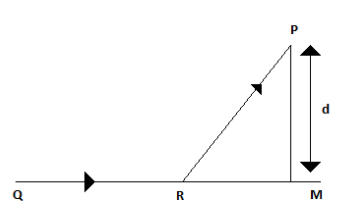
A man in a car at a location $Q$ on a straight highway is moving with speed $v$. He decides to reach a point \[P\] in a field at a distance d from the highway (point \[M\] ) as shown in the figure. The speed of the car in the field is half that on the highway. What should be the distance\[RM\] , so that the time taken to reach \[P\] is minimum?
$\left( A \right)\dfrac{d}{{\sqrt 3 }}$
$\left( B \right)\dfrac{d}{2}$
$\left( C \right)\dfrac{d}{{\sqrt 2 }}$
$(D)$ $d$
Answer
 Verified
274.2k+ views
Hint: By calculating the time \[{t_1}\] and \[\;{t_2}\], We will calculate the total time. By derivation of the time with respect to \[x\] we can find the minimum time taken to reach \[P\].
Complete step by step answer:
From point \[M\] at a distance, \[x\] the car turns off the highway. Then, \[RM = x\]
And if the speed of the car in the field is $v$ , then the time is taken by the car to cover the distance $QR = QM - x$
On the highway, \[{t_1}\] can be given by
${t_1} = \dfrac{{QM - x}}{{2v}}$
Time taken by the car to travel the distance \[RP\] can be given by,
${t_2} = \dfrac{{\sqrt {{d^2} + {x^2}} }}{v}$
The total time elapsed to move from Q to P
$t = {t_1} + {t_2}$
$ \Rightarrow t = \dfrac{{QM - x}}{{2v}} + \dfrac{{\sqrt {{d^2} + {x^2}} }}{v}$
If \[t\] is minimum,
$\Rightarrow \dfrac{{dt}}{{dx}} = 0$
$\Rightarrow \dfrac{1}{v}\left[ { - \dfrac{1}{2} + \dfrac{x}{{\sqrt {{d^2} + {x^2}} }}} \right] = 0$
$\Rightarrow x = \dfrac{d}{{\sqrt {4 - 1} }} = \dfrac{d}{{\sqrt 3 }}$
Hence the right answer is in option $\left( A \right) \Rightarrow \dfrac{d}{{\sqrt 3 }}$.
Additional information:
\[{\text{Speed = }}\dfrac{{{\text{distance}}}}{{{\text{time}}}}\] : This formula describes distance traveled divided by the time taken to cover the distance.
Speed is Inversely proportional to Time and also directly Proportional to Distance.
Hence, \[{{Distance = Speed \times Time}}\], and \[{{Time = \;}}\dfrac{{{\text{distance}}}}{{{\text{speed}}}}\;\], as the speed increases the time taken will decrease and vice versa.
Note: Distance, speed, and Time can be expressed in different units:
Time: seconds\[\left( s \right)\] , minutes\[\left( {min} \right)\] , hours \[\left( {hr} \right)\]
Distance: meters\[\left( m \right)\] , kilometers\[\left( {km} \right)\] , miles, feet
Speed: $m/s$ , $km/hr$
So if Distance = \[\left( {km} \right)\] and Time = \[\left( {hr} \right)\], then
${\text{Speed = }}\dfrac{{{\text{Distance}}}}{{{\text{time}}}}{\text{ = }}\dfrac{{{\text{km}}}}{{{\text{hr}}}}$
Complete step by step answer:
From point \[M\] at a distance, \[x\] the car turns off the highway. Then, \[RM = x\]
And if the speed of the car in the field is $v$ , then the time is taken by the car to cover the distance $QR = QM - x$
On the highway, \[{t_1}\] can be given by
${t_1} = \dfrac{{QM - x}}{{2v}}$
Time taken by the car to travel the distance \[RP\] can be given by,
${t_2} = \dfrac{{\sqrt {{d^2} + {x^2}} }}{v}$
The total time elapsed to move from Q to P
$t = {t_1} + {t_2}$
$ \Rightarrow t = \dfrac{{QM - x}}{{2v}} + \dfrac{{\sqrt {{d^2} + {x^2}} }}{v}$
If \[t\] is minimum,
$\Rightarrow \dfrac{{dt}}{{dx}} = 0$
$\Rightarrow \dfrac{1}{v}\left[ { - \dfrac{1}{2} + \dfrac{x}{{\sqrt {{d^2} + {x^2}} }}} \right] = 0$
$\Rightarrow x = \dfrac{d}{{\sqrt {4 - 1} }} = \dfrac{d}{{\sqrt 3 }}$
Hence the right answer is in option $\left( A \right) \Rightarrow \dfrac{d}{{\sqrt 3 }}$.
Additional information:
\[{\text{Speed = }}\dfrac{{{\text{distance}}}}{{{\text{time}}}}\] : This formula describes distance traveled divided by the time taken to cover the distance.
Speed is Inversely proportional to Time and also directly Proportional to Distance.
Hence, \[{{Distance = Speed \times Time}}\], and \[{{Time = \;}}\dfrac{{{\text{distance}}}}{{{\text{speed}}}}\;\], as the speed increases the time taken will decrease and vice versa.
Note: Distance, speed, and Time can be expressed in different units:
Time: seconds\[\left( s \right)\] , minutes\[\left( {min} \right)\] , hours \[\left( {hr} \right)\]
Distance: meters\[\left( m \right)\] , kilometers\[\left( {km} \right)\] , miles, feet
Speed: $m/s$ , $km/hr$
So if Distance = \[\left( {km} \right)\] and Time = \[\left( {hr} \right)\], then
${\text{Speed = }}\dfrac{{{\text{Distance}}}}{{{\text{time}}}}{\text{ = }}\dfrac{{{\text{km}}}}{{{\text{hr}}}}$
Recently Updated Pages
Mass vs Weight: Key Differences Explained for Students

Circuit Switching vs Packet Switching: Key Differences Explained
Uniform Acceleration Explained: Formula, Examples & Graphs
Wheatstone Bridge – Principle, Formula, Diagram & Applications
Classification of Drugs in Chemistry: Types, Examples & Exam Guide
Area vs Volume: Key Differences Explained for Students
Trending doubts
JEE Main 2026: Exam Dates, Session 2 Updates, City Slip, Admit Card & Latest News
JEE Main Participating Colleges 2026 - A Complete List of Top Colleges
Understanding the Electric Field of a Uniformly Charged Ring
Understanding Atomic Structure for Beginners
Derivation of Equation of Trajectory Explained for Students
How to Convert a Galvanometer into an Ammeter or Voltmeter
Other Pages
JEE Advanced 2026 Notification Out with Exam Date, Registration (Extended), Syllabus and More
JEE Advanced Percentile vs Marks 2026: JEE Main Cutoff, AIR & IIT Admission Guide
CBSE Notes Class 11 Physics Chapter 1 - Units And Measurements - 2026-27
NCERT Solutions For Class 11 Physics Chapter 1 Units And Measurements - 2025-26
Important Questions For Class 11 Physics Chapter 1 Units and Measurement - 2026-27
JEE Advanced Weightage Chapter Wise 2026 for Physics, Chemistry, and Mathematics