




A magnetic field
A. Always exerts a force on a charged particle
B. Never exerts a force on a charged particle
C. Exerts a force, if the charged particle is moving across the magnetic lines of force
D. Exerts a force, if the charged particle is moving along the magnetic lines of force
Answer
 Verified
283.5k+ views
Hint: In the given question, we need to determine whether the magnetic field exerts a force or not in certain conditions. For this, first we will define the magnetic field. For this, we need to use the formula for force experienced by a charged particle in an external magnetic field to get the desired result.
Formula used:
The following formula is used for solving the given question.
Magnetic force experienced by a charged particle is \[\vec F = q(\vec v \times \vec B)\].
Here, \[F\] is the force, \[B\] is the magnetic field, \[q\] is the charge of a particle and \[v\] is the velocity.
Complete answer:
We know that the magnetic force experienced by a charged particle is \[\vec F = q(\vec v \times \vec B)\].
Here, \[F\] is the force, \[B\] is the magnetic field, \[q\] is the charge of a particle and \[v\] is the velocity.
So, consider the following figure for this.
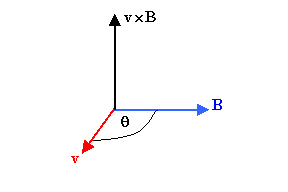
Image: Direction of cross product of magnetic field and velocity
We can define it as \[F = qvB\sin \theta \]
Here, we can say that If \[{\bf{v}}\parallel {\bf{B}}\] then only \[{\bf{F}} = {\bf{0}}\].
Thus, the velocity is parallel to the magnetic field line means the value of \[\sin \theta \] is zero.
This indicates that \[\theta = {0^o}\].
As a result, the magnitude of force is non-zero only if a charged particle moves across the magnetic field lines of forces.
Therefore, the correct option is (C).
Note: Many students forget to write an expression for the magnetic force experienced by a charged particle. They may give the explanation without the formula but it will not give a clear idea about the condition. This is the only way through which we can solve the example in the simplest way.
Formula used:
The following formula is used for solving the given question.
Magnetic force experienced by a charged particle is \[\vec F = q(\vec v \times \vec B)\].
Here, \[F\] is the force, \[B\] is the magnetic field, \[q\] is the charge of a particle and \[v\] is the velocity.
Complete answer:
We know that the magnetic force experienced by a charged particle is \[\vec F = q(\vec v \times \vec B)\].
Here, \[F\] is the force, \[B\] is the magnetic field, \[q\] is the charge of a particle and \[v\] is the velocity.
So, consider the following figure for this.
Image: Direction of cross product of magnetic field and velocity
We can define it as \[F = qvB\sin \theta \]
Here, we can say that If \[{\bf{v}}\parallel {\bf{B}}\] then only \[{\bf{F}} = {\bf{0}}\].
Thus, the velocity is parallel to the magnetic field line means the value of \[\sin \theta \] is zero.
This indicates that \[\theta = {0^o}\].
As a result, the magnitude of force is non-zero only if a charged particle moves across the magnetic field lines of forces.
Therefore, the correct option is (C).
Note: Many students forget to write an expression for the magnetic force experienced by a charged particle. They may give the explanation without the formula but it will not give a clear idea about the condition. This is the only way through which we can solve the example in the simplest way.
Recently Updated Pages
Properties of Solids and Liquids Mock Test 2025

JEE Main Mock Test 2025-26: Dual Nature of Matter & Radiation
JEE Main 2025-26 Work, Energy and Power Mock Test – Free Practice Online
JEE Main Mock Test 2025-26: Experimental Skills Chapter Online Practice
JEE Main 2025-26 Mock Test: Properties of Solids and Liquids
JEE Main 2025 Kinetic Theory Of Gases Mock Test: Practice & Solutions
Trending doubts
JEE Main 2026: Exam Dates, Session 2 Updates, City Slip, Admit Card & Latest News
Understanding the Electric Field of a Uniformly Charged Ring
Understanding Atomic Structure for Beginners
Derivation of Equation of Trajectory Explained for Students
Electron Gain Enthalpy and Electron Affinity Explained
How to Convert a Galvanometer into an Ammeter or Voltmeter
Other Pages
CBSE Class 12 Physics Question Paper 2026: Download SET-wise PDF with Answer Key & Analysis
JEE Advanced Percentile vs Marks 2026: JEE Main Cutoff, AIR & IIT Admission Guide
JEE Advanced 2026 Notification Out with Exam Date, Registration (Extended), Syllabus and More
Understanding Uniform Acceleration in Physics
Understanding Electromagnetic Waves and Their Importance
Understanding Instantaneous Velocity