




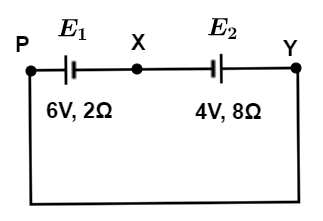
A cell ${E_1}$ of emf $6V$ and internal resistance $2\Omega $ is connected with another cell ${E_2}$ of emf $4V$ and internal resistance $8\Omega $ (as shown in the figure). The potential difference across points X and Y is:
(A) $3.6V$
(B) $10V$
(C) $5.6V$
(D) $2V$
Answer
 Verified
249.6k+ views
Hint: In order to solve this question, firstly we will find the net resistance and emf of the circuit to calculate the current in the circuit, and then using the general relation between emf, current, and resistance, we will solve for the potential difference between two points X and Y.
Formula Used:
$V = E + IR$
Where,
E-The emf of the battery,
R- The resistance
I-The current flowing into the battery and
V-The potential difference across the two points including the battery
Complete answer:
We have given that, cell ${E_1}$ of emf 6V and internal resistance $2\Omega $ is connected with another cell ${E_2}$ of emf $4V$ and internal resistance $8\Omega $, let us assume that ‘I’ be the current flowing in the circuit as shown in the below figure,
Now, the net emf of two batteries is
\[
E = {E_1} - {E_2} \\
E = 6 - 4 \\
E = 2V \\
\]
The net resistance of series combination of the circuit is
$
R = {R_1} + {R_2} \\
R = 8 + 2 \\
R = 10\Omega \\
$
So, Current I flowing in the circuit is given by $I = \dfrac{E}{R}$ on putting the required values, we get
$
I = \dfrac{2}{{10}} \\
I = 0.2A \\
$
Now, Between the points X and Y the emf of the battery is ${E_2} = 4V$ ,resistance between points X and Y is ${R_2} = 8\Omega $ and current is $I = 0.2A$ let V be the potential difference across pints X and Y then using formula, $V = E + IR$ we get
$
V = 4 + (0.2)8 \\
V = 4 + 1.6 \\
V = 5.6 \\
$
So, The potential difference between points X and Y is 5.6V
Hence, the correct option is (C) 5.6V.
Note: It should be remembered that the equation $V = E + IR$ is used because the current is entering into the battery if current were leaving the battery then the equation $V = E - IR$ will be used and in a series combination of resistances same current flows in every resistance of the circuit.
Formula Used:
$V = E + IR$
Where,
E-The emf of the battery,
R- The resistance
I-The current flowing into the battery and
V-The potential difference across the two points including the battery
Complete answer:
We have given that, cell ${E_1}$ of emf 6V and internal resistance $2\Omega $ is connected with another cell ${E_2}$ of emf $4V$ and internal resistance $8\Omega $, let us assume that ‘I’ be the current flowing in the circuit as shown in the below figure,
Now, the net emf of two batteries is
\[
E = {E_1} - {E_2} \\
E = 6 - 4 \\
E = 2V \\
\]
The net resistance of series combination of the circuit is
$
R = {R_1} + {R_2} \\
R = 8 + 2 \\
R = 10\Omega \\
$
So, Current I flowing in the circuit is given by $I = \dfrac{E}{R}$ on putting the required values, we get
$
I = \dfrac{2}{{10}} \\
I = 0.2A \\
$
Now, Between the points X and Y the emf of the battery is ${E_2} = 4V$ ,resistance between points X and Y is ${R_2} = 8\Omega $ and current is $I = 0.2A$ let V be the potential difference across pints X and Y then using formula, $V = E + IR$ we get
$
V = 4 + (0.2)8 \\
V = 4 + 1.6 \\
V = 5.6 \\
$
So, The potential difference between points X and Y is 5.6V
Hence, the correct option is (C) 5.6V.
Note: It should be remembered that the equation $V = E + IR$ is used because the current is entering into the battery if current were leaving the battery then the equation $V = E - IR$ will be used and in a series combination of resistances same current flows in every resistance of the circuit.
Recently Updated Pages
JEE Isolation, Preparation and Properties of Non-metals Important Concepts and Tips for Exam Preparation

Isoelectronic Definition in Chemistry: Meaning, Examples & Trends
Ionisation Energy and Ionisation Potential Explained
Iodoform Reactions - Important Concepts and Tips for JEE
Introduction to Dimensions: Understanding the Basics
Instantaneous Velocity Explained: Formula, Examples & Graphs
Trending doubts
JEE Main 2026: Exam Dates, Session 2 Updates, City Slip, Admit Card & Latest News
Hybridisation in Chemistry – Concept, Types & Applications
JEE Main 2026 Application Login: Direct Link, Registration, Form Fill, and Steps
Understanding the Electric Field of a Uniformly Charged Ring
Derivation of Equation of Trajectory Explained for Students
JEE Main Marking Scheme 2026- Paper-Wise Marks Distribution and Negative Marking Details
Other Pages
CBSE Class 12 Physics Question Paper 2026: Download SET-wise PDF with Answer Key & Analysis
JEE Advanced Marks vs Ranks 2025: Understanding Category-wise Qualifying Marks and Previous Year Cut-offs
JEE Advanced 2026 - Exam Date (Released), Syllabus, Registration, Eligibility, Preparation, and More
JEE Advanced Weightage 2025 Chapter-Wise for Physics, Maths and Chemistry
Understanding the Angle of Deviation in a Prism
Understanding Centrifugal Force in Physics