




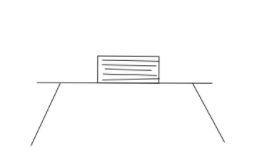
A book is at rest. What is the “reaction” force according to Newton’s third law to the gravitational force by the earth on the book?
A) The normal force exerted by the table on the book.
B) The normal force exerted by the table on the ground
C) The normal force exerted by the ground on the table.
D) The gravitational force exerted on the earth by the book.
Answer
 Verified
272.7k+ views
Hint: According to Newton’s third law of motion, forces always act in a pair, so if the earth exerts a gravitational force on the book, then the book will exert the same force but in the opposite direction. The two forces always act on different bodies.
Complete step by step solution:
Newton’s third law states that if an object $1$ exerts a force on another object, say object $2$, then the object $2$ must exert a force of equal magnitude but in the opposite direction on object $1$. Forces always occur in pairs; a body doesn’t exert force on another body without experiencing a force on itself. When the book is kept on the table, its weight (gravitational force- the force with which the earth pulls the book) acts downwards, and a gravitational force with the same magnitude but opposite in direction is exerted on the book by the earth. The gravitational force exerted by the book on the earth is very small because the size of the earth is gigantic, so it does not affect the earth much.
The correct answer is (D), the gravitational force exerted on the earth by the book.
Additional information:
The forces that are acting on the book are the normal force exerted by the table on the book in the upward direction, the gravitational force exerted by the earth that pulls the book towards itself.
Note: We will not consider the gravitational force exerted by the table on the earth and vice versa in this case, as we will only focus upon the forces acting on the book and also keep in mind that the reaction forces are equal and opposite in nature.
Complete step by step solution:
Newton’s third law states that if an object $1$ exerts a force on another object, say object $2$, then the object $2$ must exert a force of equal magnitude but in the opposite direction on object $1$. Forces always occur in pairs; a body doesn’t exert force on another body without experiencing a force on itself. When the book is kept on the table, its weight (gravitational force- the force with which the earth pulls the book) acts downwards, and a gravitational force with the same magnitude but opposite in direction is exerted on the book by the earth. The gravitational force exerted by the book on the earth is very small because the size of the earth is gigantic, so it does not affect the earth much.
The correct answer is (D), the gravitational force exerted on the earth by the book.
Additional information:
The forces that are acting on the book are the normal force exerted by the table on the book in the upward direction, the gravitational force exerted by the earth that pulls the book towards itself.
Note: We will not consider the gravitational force exerted by the table on the earth and vice versa in this case, as we will only focus upon the forces acting on the book and also keep in mind that the reaction forces are equal and opposite in nature.
Recently Updated Pages
WBJEE 2026 Result Live: Important Dates, Last Date Apply Online 2026

Circuit Switching vs Packet Switching: Key Differences Explained
Dimensions of Pressure in Physics: Formula, Derivation & SI Unit
JEE General Topics in Chemistry Important Concepts and Tips
JEE Extractive Metallurgy Important Concepts and Tips for Exam Preparation
JEE Atomic Structure and Chemical Bonding important Concepts and Tips
Trending doubts
JEE Main 2026: Exam Dates, Session 2 Updates, City Slip, Admit Card & Latest News
JEE Main Participating Colleges 2026 - A Complete List of Top Colleges
Understanding the Electric Field of a Uniformly Charged Ring
Understanding Atomic Structure for Beginners
Derivation of Equation of Trajectory Explained for Students
How to Convert a Galvanometer into an Ammeter or Voltmeter
Other Pages
JEE Advanced 2026 Notification Out with Exam Date, Registration (Extended), Syllabus and More
JEE Advanced Percentile vs Marks 2026: JEE Main Cutoff, AIR & IIT Admission Guide
CBSE Notes Class 11 Physics Chapter 1 - Units And Measurements - 2026-27
NCERT Solutions For Class 11 Physics Chapter 1 Units And Measurements - 2025-26
Important Questions For Class 11 Physics Chapter 1 Units and Measurement - 2025-26
JEE Advanced Weightage Chapter Wise 2026 for Physics, Chemistry, and Mathematics