




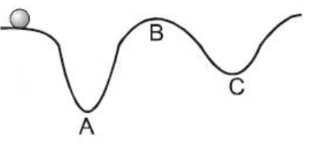
A body moves along an uneven surface with constant speed at all points. The normal reaction of the road on the body is:
A) maximum at A
B) maximum at B
C) minimum at C
D) the same at A, B & C
Answer
 Verified
258.9k+ views
Hint: For any question type where the normal reaction of the body is asked then start the question by making FBD (free body diagram) as it facilitates the further solution in a smooth manner.
Complete step by step solution:
Free body diagram is given as
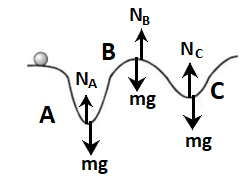
Let us consider that the body is moving with constant velocity v.
For A:
The body exerts a force (action) equal to the weight W=mg on the surface. The surface exerts a reaction NA on the body in equal direction.
Here, the centripetal force (${{\text{F}}_{\text{C}}}{\text{ = }}\dfrac{{{\text{m}}{{\text{v}}^{\text{2}}}}}{{{{\text{R}}_{\text{A}}}}}$) is in upward direction.
Net force is given by
$ {{\text{N}}_{\text{A}}}{\text{ - mg = }}\dfrac{{{\text{m}}{{\text{v}}^{\text{2}}}}}{{{{\text{R}}_{\text{A}}}}} \\
\Rightarrow {{\text{N}}_{\text{A}}}{\text{ = }}\dfrac{{{\text{m}}{{\text{v}}^{\text{2}}}}}{{{{\text{R}}_{\text{A}}}}}{\text{ + mg}}...{\text{(i)}} \\
$
Where ${{\text{N}}_{\text{A}}}$= Normal reaction
For B:
The body exerts a force (action) equal to the weight W=mg on the surface. The surface exerts a reaction NB on the body in equal direction.
Here, the centripetal force (${{\text{F}}_{\text{C}}}{\text{ = }}\dfrac{{{\text{m}}{{\text{v}}^{\text{2}}}}}{{{{\text{R}}_{\text{B}}}}}$) is in downward direction.
Net force is given by
$ {\text{mg - }}{{\text{N}}_{\text{B}}}{\text{ = }}\dfrac{{{\text{m}}{{\text{v}}^{\text{2}}}}}{{{{\text{R}}_{\text{B}}}}} \\
\Rightarrow {{\text{N}}_{\text{B}}}{\text{ = mg - }}\dfrac{{{\text{m}}{{\text{v}}^{\text{2}}}}}{{{{\text{R}}_{\text{B}}}}}...{\text{(ii)}} \\
$
For C:
The body exerts a force (action) equal to the weight W=mg on the surface. The surface exerts a reaction NC on the body in an equal direction.
Here, the centripetal force (${{\text{F}}_{\text{C}}}{\text{ = }}\dfrac{{{\text{m}}{{\text{v}}^{\text{2}}}}}{{{{\text{R}}_{\text{C}}}}}$) is in downward direction.
Net force is given by
$ {{\text{N}}_{\text{C}}}{\text{ - mg = }}\dfrac{{{\text{m}}{{\text{v}}^{\text{2}}}}}{{{{\text{R}}_{\text{C}}}}} \\
\Rightarrow {{\text{N}}_{\text{C}}}{\text{ = mg + }}\dfrac{{{\text{m}}{{\text{v}}^{\text{2}}}}}{{{{\text{R}}_{\text{C}}}}}...{\text{(iii)}} \\
$
Since radius of A < radius of C i.e. ${{\text{R}}_{\text{A}}}{\text{ < }}{{\text{R}}_{\text{C}}}$ (from the given figure)
From (i), (ii) and (iii) we get
${{\text{N}}_{\text{A}}}$ is maximum.
Thus, the normal reaction of the road on the body is maximum at A.
Therefore, option (A) is the correct choice.
Note: Action and reaction are equal in magnitude, opposite in direction and the most important point is that both the forces i.e. (action and reaction) act on different bodies not on the same body.
Complete step by step solution:
Free body diagram is given as
Let us consider that the body is moving with constant velocity v.
For A:
The body exerts a force (action) equal to the weight W=mg on the surface. The surface exerts a reaction NA on the body in equal direction.
Here, the centripetal force (${{\text{F}}_{\text{C}}}{\text{ = }}\dfrac{{{\text{m}}{{\text{v}}^{\text{2}}}}}{{{{\text{R}}_{\text{A}}}}}$) is in upward direction.
Net force is given by
$ {{\text{N}}_{\text{A}}}{\text{ - mg = }}\dfrac{{{\text{m}}{{\text{v}}^{\text{2}}}}}{{{{\text{R}}_{\text{A}}}}} \\
\Rightarrow {{\text{N}}_{\text{A}}}{\text{ = }}\dfrac{{{\text{m}}{{\text{v}}^{\text{2}}}}}{{{{\text{R}}_{\text{A}}}}}{\text{ + mg}}...{\text{(i)}} \\
$
Where ${{\text{N}}_{\text{A}}}$= Normal reaction
For B:
The body exerts a force (action) equal to the weight W=mg on the surface. The surface exerts a reaction NB on the body in equal direction.
Here, the centripetal force (${{\text{F}}_{\text{C}}}{\text{ = }}\dfrac{{{\text{m}}{{\text{v}}^{\text{2}}}}}{{{{\text{R}}_{\text{B}}}}}$) is in downward direction.
Net force is given by
$ {\text{mg - }}{{\text{N}}_{\text{B}}}{\text{ = }}\dfrac{{{\text{m}}{{\text{v}}^{\text{2}}}}}{{{{\text{R}}_{\text{B}}}}} \\
\Rightarrow {{\text{N}}_{\text{B}}}{\text{ = mg - }}\dfrac{{{\text{m}}{{\text{v}}^{\text{2}}}}}{{{{\text{R}}_{\text{B}}}}}...{\text{(ii)}} \\
$
For C:
The body exerts a force (action) equal to the weight W=mg on the surface. The surface exerts a reaction NC on the body in an equal direction.
Here, the centripetal force (${{\text{F}}_{\text{C}}}{\text{ = }}\dfrac{{{\text{m}}{{\text{v}}^{\text{2}}}}}{{{{\text{R}}_{\text{C}}}}}$) is in downward direction.
Net force is given by
$ {{\text{N}}_{\text{C}}}{\text{ - mg = }}\dfrac{{{\text{m}}{{\text{v}}^{\text{2}}}}}{{{{\text{R}}_{\text{C}}}}} \\
\Rightarrow {{\text{N}}_{\text{C}}}{\text{ = mg + }}\dfrac{{{\text{m}}{{\text{v}}^{\text{2}}}}}{{{{\text{R}}_{\text{C}}}}}...{\text{(iii)}} \\
$
Since radius of A < radius of C i.e. ${{\text{R}}_{\text{A}}}{\text{ < }}{{\text{R}}_{\text{C}}}$ (from the given figure)
From (i), (ii) and (iii) we get
${{\text{N}}_{\text{A}}}$ is maximum.
Thus, the normal reaction of the road on the body is maximum at A.
Therefore, option (A) is the correct choice.
Note: Action and reaction are equal in magnitude, opposite in direction and the most important point is that both the forces i.e. (action and reaction) act on different bodies not on the same body.
Recently Updated Pages
Circuit Switching vs Packet Switching: Key Differences Explained

Dimensions of Pressure in Physics: Formula, Derivation & SI Unit
JEE General Topics in Chemistry Important Concepts and Tips
JEE Extractive Metallurgy Important Concepts and Tips for Exam Preparation
JEE Atomic Structure and Chemical Bonding important Concepts and Tips
JEE Amino Acids and Peptides Important Concepts and Tips for Exam Preparation
Trending doubts
JEE Main 2026: Exam Dates, Session 2 Updates, City Slip, Admit Card & Latest News
JEE Main Participating Colleges 2026 - A Complete List of Top Colleges
JEE Main Marking Scheme 2026- Paper-Wise Marks Distribution and Negative Marking Details
Hybridisation in Chemistry – Concept, Types & Applications
Understanding the Electric Field of a Uniformly Charged Ring
Derivation of Equation of Trajectory Explained for Students
Other Pages
JEE Advanced 2026 - Exam Date (Released), Syllabus, Registration, Eligibility, Preparation, and More
JEE Advanced Marks vs Ranks 2025: Understanding Category-wise Qualifying Marks and Previous Year Cut-offs
CBSE Notes Class 11 Physics Chapter 1 - Units And Measurements - 2025-26
NCERT Solutions For Class 11 Physics Chapter 1 Units And Measurements - 2025-26
Important Questions For Class 11 Physics Chapter 1 Units and Measurement - 2025-26
JEE Advanced Weightage 2025 Chapter-Wise for Physics, Maths and Chemistry